
Clarkesworld, March 2026
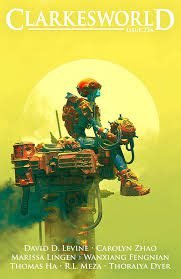
The story is narrated by Camilla, a subcolony of an alien collective intelligence that has dedicated itself to learning human languages and communication. Camilla takes pride in speaking human exceptionally well — not just English, but French, Navajo, and Japanese — and reflects with dry wit on the peculiarities of human communication: the contradictory emphasis on things left unsaid alongside things constantly spoken, and the exhausting complexity of implication and social context. Camilla belongs to a translator subcolony within a larger colony organism made up of specialized subcolonies, including olfactory, shielding, photosynthetic, and propulsion units, each contributing to the whole.
The colony has relocated to Deimos, one of Mars’s moons, to study humanity up close. There, Camilla interacts primarily with Dr. Kira, a linguist fascinated by their languages, and Captain Daniels, a practical administrator more concerned with operational order than intellectual discovery. A recurring tension plays out between Dr. Kira’s scholarly curiosity and Captain Daniels’s focus on logistics — a small-scale version of the larger communicative gap Camilla is trying to bridge. Camilla adopts the name “Camilla” from a piece of human art, hoping the reference might help Dr. Kira understand the colony’s nature, though the gesture is largely misread.
A central philosophical thread runs through the story: the problem of conveying concepts that the listener has no framework to receive. Camilla cannot make the humans understand that the colony is present in full — not just a lone emissary but an interconnected being with multiple simultaneous participants. When Camilla says “I am not alone here,” Dr. Kira interprets it as an emotional statement rather than a literal one. Similarly, the colony initially could not conceive that humans could forcibly remove other humans — an act of inter-species aggression within their own kind — because nothing in the colony’s nature allows for it.
The story’s conflict escalates when Dr. Kira and Captain Daniels are abruptly removed by other humans — hostile authorities who arrive and bundle them away in spaceships. This is a revelation for Camilla and the colony: humans, unlike their own kind, will attack beings that are essentially like themselves. The new human who replaces them is aggressive and transactional, demanding spaceship schematics and threatening consequences. Camilla responds with deflection and carefully chosen cultural references — quoting Star Wars and Kermit the Frog — buying time while the colony reaches a collective decision.
That decision is unanimous: they will travel to Earth to find Dr. Kira and Captain Daniels. The hostile humans fire projectiles as the colony departs; the shielding subcolony absorbs them. Camilla, who has always hoped the mission would be one of learning and communication, fears it may become one of defense instead. The story closes on a meditation on identity and grammar — the colony is person, place, and thing simultaneously, a being-and-action that human language cannot neatly categorize. Camilla embraces all of it: “We are Camilla, habitat on Deimos, spaceship. We are understanding-becoming. We are colony-moving.“
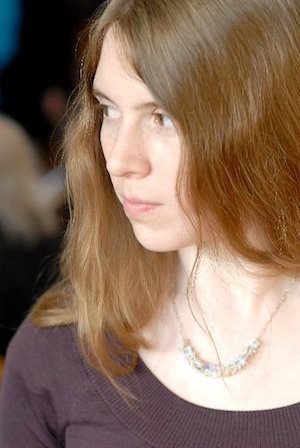
Marissa Lingen is a freelance writer who lives in the Minneapolis suburbs with her family. She is the author of over two hundred works of short science fiction and fantasy and has no intention of stopping any time soon. She also writes essays, poetry, and whatever comes to her next. Her debut novella, A Dubious Clamor, is coming soon from Horned Lark Press.