
Clarkesworld, April 2026
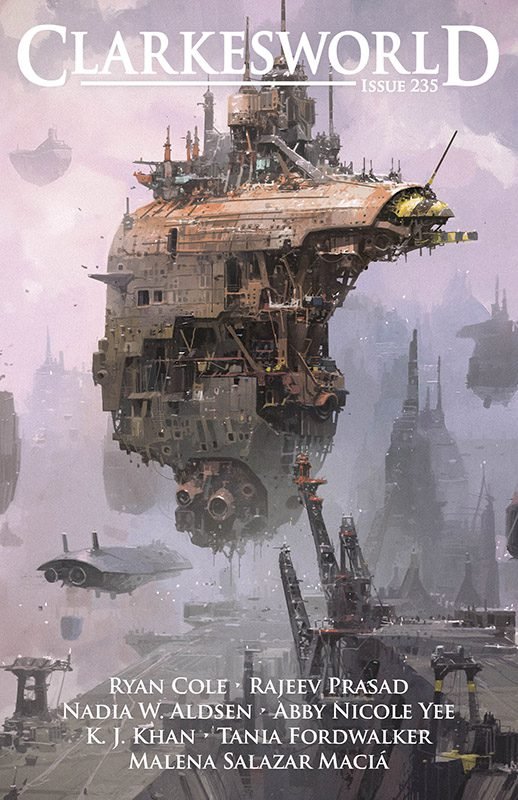
“The Trajectory of Memory is Forward” is a sprawling, biopunk novella set in a far-future Earth scarred by climate catastrophe, radical genetic engineering, and centuries of exploitation. Its world is divided between the Haves — long-lived cyborgs who augment their biology with machine intelligence and live in fortified checkpoints — and the Have-Nots, a genetically engineered underclass whose memory resets each night, waking every morning with only their trained instincts, skills, and a whisperer’s teaching to guide them through the day.
Dharsh is a Have-Not rogue living in a seaside colony in the Atlantic spine. The story opens on what should be a routine day: he and his soulmate Maxine execute a daring mission to steal a fabricator — a manufacturing unit — from a nearby Have checkpoint. The mission is disrupted when a diminutive cyborg woman named IsoVthird, who calls herself Vikki, reveals she has been waiting for him. She diverts the checkpoint drones to save Maxine and engineers her own escape by hiding inside the fabricator. Vikki is a Have heretic, banished by her own people and her system god for advocating that the Haves must reconnect with Have-Not vitality to survive their demographic collapse.
Back at Dharsh’s colony, the whisperers — the colony’s keepers of lore and collective memory — recognize that something extraordinary has happened: Vikki’s electrical conductivity has triggered a latent psychic transformation in Dharsh, awakening him as a whisperer himself. This is rare and devastating. It severs his ordinary life with Maxine and plunges him into an unrelenting hunger for history and knowledge that, if left unlearned, will drive him mad. In a poignant farewell scene, he and Maxine part ways, knowing she will mourn but move on, while he is called to a higher and lonelier purpose.
Against the objections of Atum, the colony’s elder whisperer, Dharsh decides to accompany Vikki into the wild interior of the continent, seeking AGod — the primordial artificial intelligence that once engineered all human speciation and has since gone dormant. Their journey through the flooded, overgrown interior is brutal: they survive attacks by feral hominid giants who are speciation’s failed experiments, endure catastrophic flooding, and are separated in a storm. Dharsh nearly drowns, wakes with no memory, and must navigate by his journal alone. He eventually finds Vikki captive, her arm severed and smoked by the bear hunter giant, and rescues her using the severed arm as gator bait in a desperate, darkly comic trap.
They reach AGod’s city — a golden-fielded sanctuary populated by a community of proportionate, unengineered humans born from artificial tree wombs. Vikki connects directly to AGod through the city’s neural wiring and is restored, reborn as a conduit for AGod’s intelligence. She then pivots entirely, announcing that she no longer needs the Have-Nots but the original humans. Dharsh, feeling used and betrayed, releases the imprisoned giants into the golden fields in an act of impulsive revenge — one he immediately recognizes as wrong and driven by selfishness rather than principle.
AGod awakens briefly and sorts Dharsh onto an interstellar train, where he joins other Have-Nots laboring in space. He discovers Vikki installed a chip in his shoulder containing all the colony’s whisperer teachings. Her recorded voice reaches him across death, urging him to keep learning, keep teaching. In the story’s final act, Dharsh smashes the station’s complacent robot oracle and rallies his fellow Have-Nots to reject their domesticated captivity and find their way back to Earth.
The novella meditates on identity, memory, community, and what it means to be human when biology is engineered. Its central argument is that identity is not memory alone — the Have-Nots’ daily rebirth, their instinct, cohesion, and lore, constitute a form of continuity and selfhood no less valid than the Haves’ accumulated centuries. Dharsh’s arc — from rogue to whisperer to reluctant hero in space — enacts this theme, as he carries forward the trajectory of his people’s memory even as his own resets each dawn.

Rajeev Prasad is a physician who lives with his wife, three kids, and a very cute dog in Northern California. His stories have appeared in The Magazine of Fantasy and Science Fiction, Clarkesworld, and several other markets.
Can you evaluate the writing in this story. Something seems wrong with the way it is written. Is it poor writing or am i imagining
Writing Evaluation: “The Trajectory of Memory is Forward” by Rajeev Prasad
The story has real craft issues, though it also has genuine strengths. This is not poor writing in the sense of incompetence — the architecture is solid and the imagination is real. But it reads like a strong first or second draft that needed another editorial pass focused specifically on emotional dramatization and sentence-level precision.
What works well
The world-building is inventive and coherent. The Have/Have-Not division, the memory-reset biology, the whisperer hierarchy, the speciation backstory — these are developed with real imagination and internal logic. The core premise is strong, and the thematic ambition (identity without memory, community as continuity) is genuinely interesting. The bear hunter sequence is the story’s best-written section — tense, specific, and physically grounded.
Telling rather than showing emotional states
The most persistent problem is that emotional states are announced rather than dramatized. Sentences like “He felt a longing,” “a sense of regret played on her face,” and “feelings of resentment and anger saturated his thoughts” tell the reader what to feel rather than generating that feeling through action and detail. A reader is told Dharsh loves Maxine, but the scenes between them don’t earn that feeling — so the farewell, which should be devastating, lands flat.
Expository dialogue
Dialogue is often expository rather than dramatized. Characters explain the world to each other in ways that feel like a Wikipedia article rather than conversation. Vikki in particular functions largely as an exposition delivery system in the early sections, which makes her feel like a plot mechanism rather than a person.
Uneven pacing
The novella rushes through emotionally significant moments — Dharsh becoming a whisperer, parting from Maxine, killing the giantess — and then slows for lengthy world-building passages. The moments that should breathe don’t get room. The farewell between Dharsh and Maxine is especially underwritten given how much weight the story asks it to carry.
Inconsistent prose at the sentence level
Some descriptions are vivid and well-observed (“the fecund steam of the forest rose above the canopy”). But others are slack or generic — “feelings of resentment and anger saturated his thoughts” is imprecise where it should be specific. There is also occasional tense awkwardness and some word choices that feel slightly off (“imbricated” used to describe a smell, for instance, which doesn’t quite work).
A rushed and tonally confused ending
The space station sequence feels like a different story grafted on. Dharsh smashing the robot is meant to be triumphant, but it hasn’t been earned emotionally, and the stakes feel abstract after the visceral interior journey. The final pages move too quickly and don’t resolve the thematic threads with the care they deserve.
The giants’ philosophical gibberish
The idea of the giants speaking in fragmented cosmic philosophy is interesting — genius and madness as adjacent conditions — but it goes on too long and begins to feel like padding rather than meaningful texture.
The verdict
The bones are good; the flesh needs more work. This is a writer with a clear and ambitious vision who hasn’t yet fully closed the gap between what they intend a scene to feel like and what the prose actually delivers to the reader. With a focused editorial pass on emotional dramatization and sentence-level precision, this could be a considerably stronger piece.