
Lightspeed, April 2026
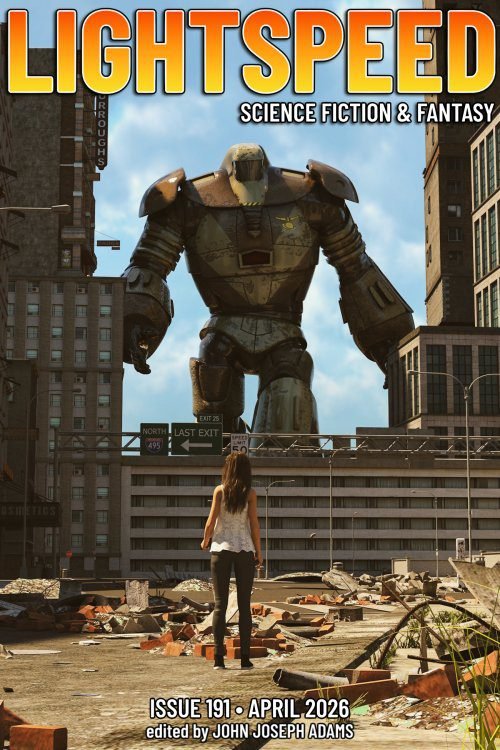
Part 2 opens with Six-Gun returning to New Providence to find the town has turned against her. Beauchamp has spent the day working his influence, the sheriff has been conveniently dispatched south on a pretextual emergency, and the deputies left in charge make clear that outsiders who ask inconvenient questions are no longer welcome. Six-Gun confronts them anyway, laying out what she found at the McGraw homestead — settler boots, settler fire-chemistry, a child’s mechanical eye made by Beauchamp’s own company — and dares them to carry that message back to their employer. They laugh her out the door.
At the Golden Spur, she’s drugged through a complimentary whiskey and beaten half to death by hired roughnecks while the bartender’s brass eye records everything. It’s a thorough trap, designed to neutralize her specifically — the dose calculated for a half-breed’s unusual constitution. She goes down hard, tangled in her own six arms.
She wakes strapped to a metal table in Beauchamp’s surgical facility, with the man himself in a stained surgeon’s apron preparing to vivisect her. His stated ambition is eugenicist in scope: he wants to understand natural mutations, eliminate them from the population, and replace organic difference with controlled, manufactured augmentation. He has performed this procedure seventeen times before, starting with drifters and circus performers, and views Six-Gun as a prize specimen. Just as the saw descends, rescue comes from an unexpected quarter: her Halfie crashes through the wall, cubs blazing, having been freed from the stable by Morton. The animals tear the room apart with enough fury to let the drugs fade and Six-Gun claw through her restraints. The family escapes into the night, pursued by Beauchamp’s mechanical cavalry.
They flee into a canyon inhabited by PeyoCoyos — peyote-fed mutant coyotes whose venomous bites induce powerful hallucinations. The pursuing riders are destroyed by the pack, but Six-Gun is bitten too, and falls into a three-day fever vision. The venom forces her through the buried memories she’s been outrunning: her childhood in India, the village elders declaring her shadow-cursed and untouchable, her parents’ slow destruction by caste exile and colonial indenture, her mother’s death from a fever no missionary doctor would treat, her father’s death broken in a settler’s field. It is brutal, clarifying, and ultimately necessary. She surfaces in Rattlesnake’s care — he pulled her from the canyon — with her grief processed and her purpose sharpened.
Rattlesnake fills in the full picture of Beauchamp’s operation. The man controls the territory through debt: McGraw’s entire empire runs on Beauchamp’s loans. The staged raid on the family was designed to give him access to Sarah, a prodigy who can instinctively communicate with machines, whom he intends to make his masterpiece of flesh-metal integration. His factory sits in Doom Valley, a sacred tribal burial ground — chosen precisely because no one will defend it. Reluctantly, Six-Gun accepts Rattlesnake as a partner.
Inside the factory, they find Beauchamp’s “think tank”: brilliant people — a Chinese railroad engineer, a tribal medicine man, a female mechanical designer — merged permanently into the machines they were forced to improve. These captives have been biding their time, learning to speak directly to the factory’s systems. They guide Six-Gun and Rattlesnake to the integration chamber where Sarah is being prepped for surgery, then — when Beauchamp springs his anticipated trap — turn the factory against its own creator. Pipes burst, mechanical arms emerge from the walls, and the enslaved minds of the think tank drag Beauchamp into his own machinery.
Sarah is returned to McGraw. Six-Gun collects her five hundred in gold, declines the offer of land and a settled life, oils Morton’s arms as promised, and rides east out of New Providence with Rattlesnake, the cubs, and the Halfie — four strange creatures and their stranger riders, heading toward a horizon that, for the first time in a long while, looks like possibility rather than flight.
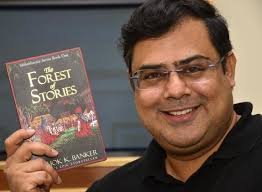
Ashok Banker is the author of the Burnt Empire Trilogy (HarperCollins Voyager), among other books. His short fiction has appeared in Asimov’s, Lightspeed, Nightmare, Weird Tales, Best New Fantasy, and is forthcoming in F&SF, among other places.