
Clarkesworld, April 2026
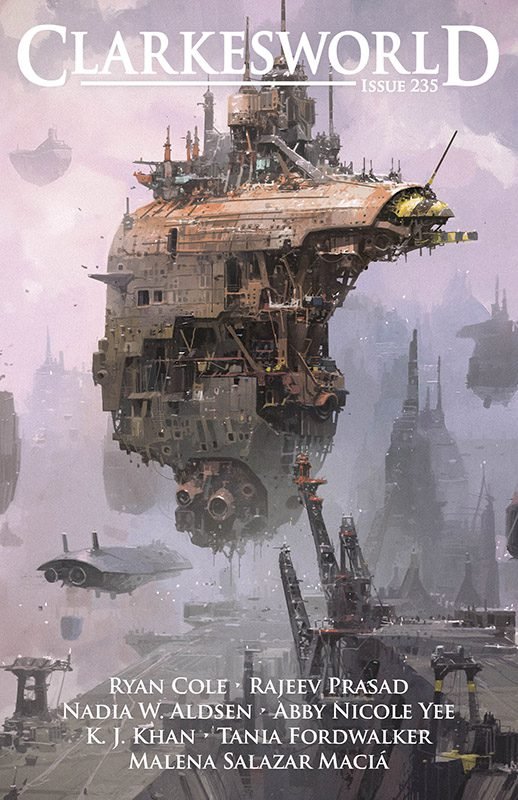
On an orbital station adrift somewhere in the quiet of space, an old man named Joel has spent his life helping others forget. His gift is technical and intimate: he weaves unwanted memories into a vast binary tapestry, encoding grief and shame and heartbreak into strings of zeroes and ones so that those who come to him bearing unbearable weight can leave a little lighter. Joel is a craftsman of oblivion, a tender architect of therapeutic silence. And yet, for all his mastery, he cannot remember the precise moment he lost his daughter Mirei.
She vanished thirty years ago. What Joel does remember is the shape of her: hazelnut eyes, dark hair that floated in clouds around her face when he cut the station’s gravity, the melodic laugh like a pan flute, and her uncanny gift for building androids. Mirei had her own workshop at the back of the station, and it was there she created her first android — a pocket-sized translator that rendered natural language into binary for Joel’s clients. She loved puzzles, zero-gravity pirouettes, and the gifts that grateful customers brought her. One of those customers was a young asteroid explorer who brought her a hand-painted porcelain ballerina figurine for her fifteenth birthday. Enchanted, Mirei eventually built a life-sized gynoid in the ballerina’s image, perfect down to its synthetic flesh and hazelnut eyes — though she never got around to waking it.
The explorer became a regular, his visits more about Mirei than forgetting. And then, without a word, Mirei followed him into the deep. She was left behind in the blaze of a supernova, trapped between asteroid fragments while the explorer jumped away and did not look back. He survived. He came to Joel’s station ten years later, broken, begging to have her erased from his mind entirely.
Joel, routine-checking his tapestry, finds the sequence. A laugh. Hazelnut eyes. His daughter, fragmented in a stranger’s sorrow, suspended in light. He cannot leave her there.
What follows is an act of devastating love. Joel places the dormant gynoid — the ballerina Mirei built in her own image — in the penitent’s chair and connects it to the tapestry. The machine reports a void: no memories, no self. So Joel puts on the helmet himself and donates what he has: every fragment of Mirei he has carried for thirty years, every dream and recollection, compressed and transferred into the waiting gynoid. The process is agony. He screams. He sobs. The system, understanding him better than he understands himself, refuses to stop.
Mirei opens her eyes in a body that is not flesh, in a father’s work cabin, surrounded by dust and the soft clicking of androids. She remembers everything — the supernova, the abandonment, the silence. She frees the collapsed old man from his helmet, cups his weathered face, and achieves a perfect match. But when he opens his eyes, he does not know her. The transfer took everything. Joel is gentle, curious, childlike in his vacancy.
Mirei does not break. She helps him to a table, instructs the androids to care for him, and returns to the console. She finds one last binary code and activates it. A song fills the station.
“Are you the one singing?” Joel asks, accepting a bowl of soup.
“Yes, Papa.”
He forgets her name again within moments. But Mirei smiles — warm, certain, and whole — and tells him what she is.
“Me? I’m your favorite memory, Papa.”
The story turns on a quiet paradox: the man who refused to forget is the one who loses everything, while the daughter he encoded into light is the one who remembers them both. Salazar Macía writes grief as a craftsman’s problem and love as the code that outlasts the coder.

Malena Salazar Maciá is a fantasy and science fiction writer born in Havana, Cuba. She is the author of the novels La ira de los sobrevivientes (2021, Editorial Gente Nueva, Cuba), Aliento de Dragón (2021, Enlace Editorial, Colombia) and Los errantes(2022, Últimos Monstruos Editores, Rep. Dominican), among others. Her stories have been collected in both national and foreign anthologies. English translations of her stories have appeared in Clarkesworld, Strange Horizons, and The Dark Magazine.Her work has also been translated into Croatian, German, Italian and Japanese.