
Lightspeed, April 2026
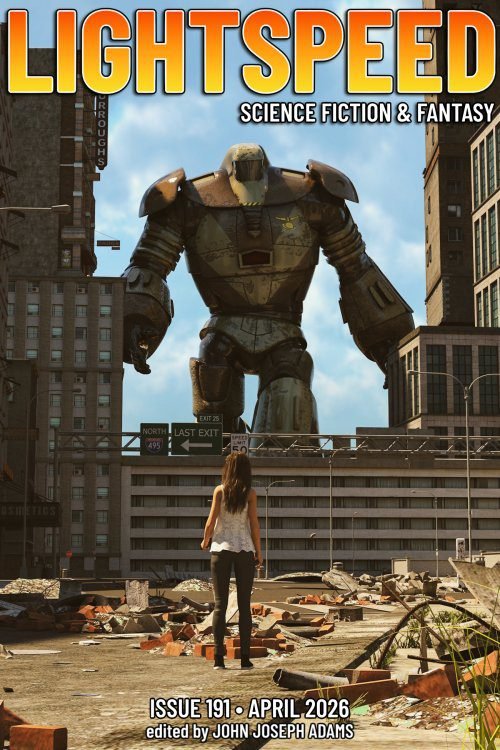
Zero Santos — nonbinary, biracial, working-class, and known to the crowds as Saint Zero of the Hollows — is a jousting knight fighting their way through a deadly asteroid tournament. The setting fuses science fiction and secondary-world fantasy: knights ride mechanical pegasi and interface with them via neural links, charging across crater surfaces at lethal speed with AI targeting systems and predictive combat analytics. The tournament is framed by the ruling class as vital science, though Zero understands it plainly as theater for bored nobility.
Zero comes from the Hollows, the impoverished underclass sector buried beneath the asteroid’s surface. They are multiply marginalized — nonbinary, biracial, and poor — and have spent their life navigating systemic exclusion. They enter the tournament not out of ambition but out of grief and rage: their father is dead, their sister was maimed in a mining accident caused by a powerful noble, their mother long since gone. The tournament is Zero’s chosen way to die — loudly, on their own terms, and with as much damage done as possible on the way out.
Their first opponent is the mine owner responsible for their sister’s accident. Zero defeats him, losing a prosthetic arm in the process, and wakes in a private hospital room — the first luxury they’ve known. Their second opponent is Augustus Pleoni IV, the queen’s cruel youngest son. Zero exploits his arrogance and predictable technique, threading their lance through the exposed gap beside his neural link and killing him. The act sparks riots in the Hollows and transforms Zero into a mythological figure of resistance they never intended to become — a knight of the people, a saint, when all they really wanted was to scream loudly enough for someone to hear.
Running through the story is Zero’s relationship with Silvi de Aguilan, the Eagle Knight — wealthy, privileged, and Zero’s lover, teacher, and only real confidant. Their relationship began when Zero snuck up to the surface looking for answers about their father’s death. Silvi traded pegasus programming manuals for Spanish lessons; Zero traded fluency for access. Silvi has always insisted the relationship is not serious, even as it clearly is. Before Zero’s final match, they spend one last night together, and Zero asks one last favor.
The final bout is between Zero and Silvi. Neither initiates countdown for as long as legally possible. They stare each other down while the crowds — surface nobility and Hollowers crammed into filthy rooms below alike — watch. Zero has no targeting protocol loaded. They charge anyway, screaming their dead father’s name. The result is mutual: Zero’s lance pierces Silvi’s stomach; Silvi’s lance pins Zero to their seat through the chest. Zero wins on a technicality by staying mounted. The victory screen cracks and flickers — a message from the Hollows breaking through, the elevators now open — but Zero barely registers it. They drag themselves to Silvi’s body and cradle her head in their lap as they die.
The story closes not on revolution but on intimacy. Zero’s final words are not for the cause or the crowds but for Silvi alone. The uprising may be beginning somewhere above them, but Zero’s last thought is simply that this was not a bad way to go.
Ayala’s accomplishment is in resisting the triumphalism the premise seems to invite. Zero is cast as a hero by circumstance and desperation rather than design, and the story is honest about the gap between legend and interiority — between what the crowds need Saint Zero to mean and what Zero actually feels, which is grief, love, and exhaustion. The jousting mechanics are rendered with satisfying tactile precision, doubling as both worldbuilding texture and emotional metaphor. Zero’s gender and ethnicity are facts of their life, handled with matter-of-fact economy rather than exposition. The class politics are sharp without being schematic. And the ending earns its sadness by never pretending the personal and the political resolve into the same thing.
V.M. Ayala (she/they) is a queer disabled biracial Mexican American sci-fi/fantasy writer. She loves dragons, space, giant robots, and their partner. Their work has appeared in Beneath Ceaseless Skies, Escape Pod, The Best American Science Fiction and Fantasy 2024, and more. She is also a streamer (ask them about indie games) and TTRPG actual play performer—as well as one of the co-founders of OTHERSIDE, an upcoming queer speculative magazine. You can find her most social media places @spacevalkyries or at spacevalkyries.com.