
Clarkesworld, April 2026
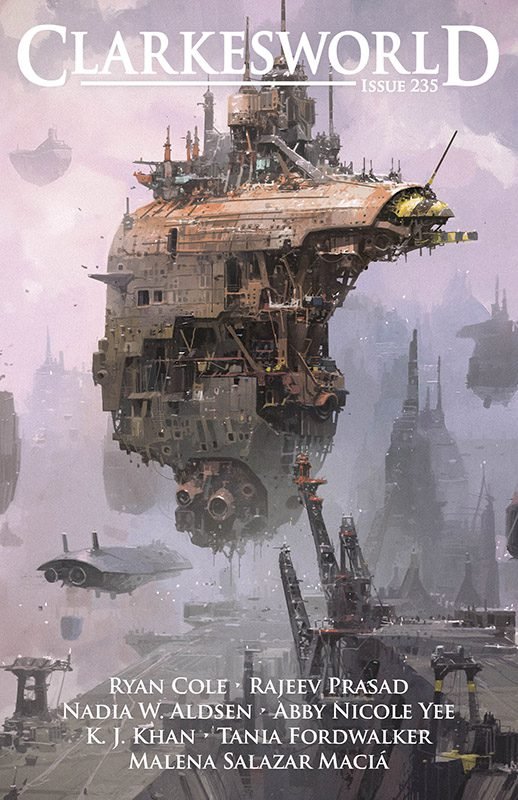
The story unfolds at Chaska Punku Space Port in the Atacama Desert of Chile, where an unnamed social worker — employed under a punishing contract with the CPSPAA, a bureaucratic authority acting on behalf of the European Space Agency — staffs a shelter for stranded extraterrestrial travelers. The contract’s fine print, interspersed throughout the narrative as ironic clause headings, reveals an employer that denies burnout as a legitimate condition, forbids external arbitration, and makes resignation financially ruinous. The worker is exhausted, emotionally hollowed out, and performing hospitality she no longer believes in.
A Uriy — a small, saurian alien with bony features, chipped gray scales, iridescent butterfly-like eyes, and fleshy throat wattles — arrives hesitant at the threshold. She speaks in hisses and trills through a handheld translation device and asks for water, shelter, and minerals. The social worker prepares a warm mineral broth using powdered veggie stock, inadvertently scalding the Uriy’s hand with the mug. After drinking a cooled, more concentrated version, the Uriy abruptly collapses, her body liquefying rapidly into a puddle and a pile of scales on the porous sandstone floor. The worker panics — fearing she has committed accidental murder, worrying about infection, and briefly tempted to simply sweep up the remains and say nothing.
Her professional ethics win out. She calls the shelter’s physician, Dr. Yán — cheerfully optimistic in a way that now reads as performative to her — who documents the scene and contacts the Uriy consulate in Santiago. Left alone with the damp heap of scales, the worker improvises: she covers it with a red plastic tub, tapes the edges to the floor, and attaches a broomstick as a flag.
A second Uriy arrives, her scales black and gold, her translation device sophisticated enough to handle idioms. She leads the worker in a vocal ritual — a sustained ooooo — over the remains, then reveals that the first Uriy is not dead. She has entered a state of transfiguration, a metamorphic process analogous to what lepidoptera undergo. She has “inoculated” the sandstone building itself, using its mineral matrix as her chrysalis. The building will become her body, her shell, her frame for becoming something vaster and more complex.
The second Uriy then informs the worker that, having touched the scales, she is now spiritually bound to the family and obligated by tradition — conveniently reinforced by the unbreakable employment contract — to serve as the transforming Uriy’s keeper. Trapped, the worker accepts the role.
The story’s final pages enact a quiet, uncanny communion. The worker begins spraying water onto the sandstone walls, feeling an urgent pull she cannot explain. She tastes mineral broth and spits it out; the floor absorbs it instantly. She senses the stone drawing moisture from her own body, feels the capillary pull of the building’s matrix, and through it begins to perceive the Uriy’s needs — her thirst, her hunger for nutrients, her vast unfolding transformation. Pouring mug after mug of broth onto the floor, the worker feels, for the first time in years, genuinely at peace. At home. Contained within a shell not of her making, she has become, perhaps, something more than a burned-out bureaucrat going through the motions — a keeper in the fullest, most symbiotic sense of the word.
The story is a layered meditation on labor exploitation, alienation, and unexpected belonging, structured as much by the cruel legalese of employment contracts as by the quiet wonder of interspecies contact.
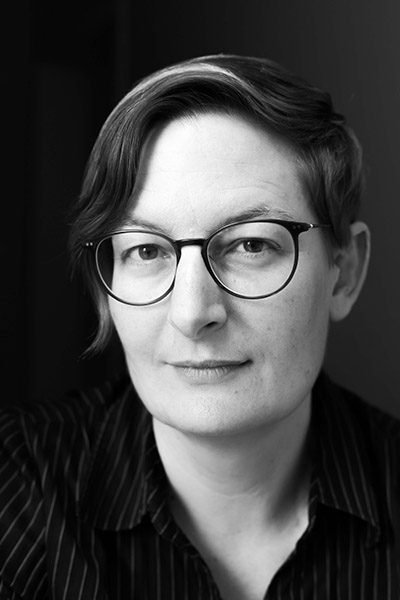
Nadia W. Aldsen is a writer and Clarion alumna based in Berlin. She lives, loves, reads, writes, and teaches in both English and German. At full moon, she transforms into an academic. Sometimes it’s the other way around. This is her first science fiction publication in English.