
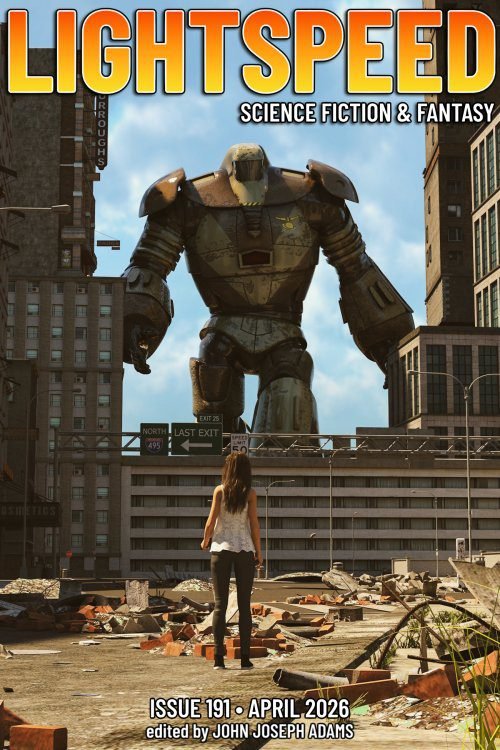
Lightspeed, April 2026
The narrator — known by the handle Six-Gun Vixen — is a deeply compelling outsider figure: a brown-skinned, six-armed, wolf-eared woman of South Asian origin, shadow-cursed and cast out by her own tribe for being too different. She rides a half-wolf, half-horse mount called a Halfie and carries two young hybrid cubs in her saddlebags, creatures she tends to with a fierce, almost maternal protectiveness. She arrives in New Providence, a gleaming steampunk boomtown of clockwork carriages, electric saloons, and brass-enhanced citizens, broke and in need of work.
After a tense confrontation in the Golden Spur Saloon — where the bartender refuses her and the local marshal attempts to enforce unwritten codes of exclusion — she is rescued from escalation by Thaddeus Beauchamp III, a banker-lawyer-judge whose clockwork eye marks him as a man of wealth and concealment. Beauchamp represents Jonathan McGraw, the territory’s most powerful rancher, whose sister’s homestead was burned three nights prior and whose twelve-year-old niece, Sarah, was apparently taken. The attack has been blamed on Indigenous raiders. Beauchamp offers Five hundred gold coins for Sarah’s return and coercive pressure to ensure Six-Gun accepts: comply, or face a convenient law suddenly discovered against her kind.
Six-Gun rides to the ruined homestead and begins reading the scene with her wolf-eye, a supernatural yellow sight that pierces ordinary appearance. What she finds troubles her. The fire started at three deliberate points — a pattern made to resemble tribal ritual — but the accelerant is settler-made chemistry. The boot tracks leaving the scene belong to four adults in settler footwear, not moccasins, alongside one small barefoot child who walked out unforced, at least at first. A mechanical eye designed for a child lies half-buried in the mud. A charred letter fragment mentions a surgical or experimental procedure requiring a young subject and references mechanical integration. This was not a raid. It was a staged abduction.
At the scene she also encounters Rattlesnake, a copper-skinned man with a shifting, tribally-etched mechanical arm and a limping gait, who speaks in riddles and drops a scrap of a child’s dress bearing a symbol from Six-Gun’s own old-world tribe — a mark used to brand the unclean, the untouchable, those to be purged. Then he vanishes. His appearance raises the story’s central tension: the violence here crosses multiple worlds of marginalization, and the lines between villain and victim are anything but clear.
She tracks the trail west into wild, unclaimed territory, passing mechanical patrols whose mounts bear tribal-designed metalwork — a fusion that no pureblood on either side would sanction. Following coordinates she reads in the very burn-pattern of the ruins, she arrives at McGraw’s vast industrial empire: a mining operation staffed by hollowed-out hybrid workers, then a ranch of hauntingly beautiful mechanical-organic cattle, then the mansion itself.
McGraw’s grief is genuine. He and his sister Katherine came over as immigrant children on a coffin ship, built everything from nothing, lost everyone along the way. Sarah, Katherine’s daughter, was a prodigy who could commune with machines. But Beauchamp is present at the meeting, watchful and cold, and Six-Gun recognizes that whatever scheme surrounds Sarah’s disappearance, Beauchamp is at its center. She declines the job on her own terms, names no reason McGraw would understand yet, and rides out into the blood-and-brass sunset — well aware that Beauchamp’s veiled threat means danger is already following her.
Part 1 ends with the mystery fully alive and Six-Gun riding hard, alone by choice, carrying cubs and conscience in equal measure into the dark.
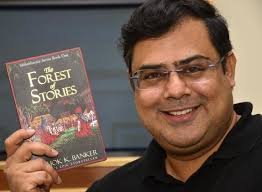
Ashok Banker is the author of the Burnt Empire Trilogy (HarperCollins Voyager), among other books. His short fiction has appeared in Asimov’s, Lightspeed, Nightmare, Weird Tales, Best New Fantasy, and is forthcoming in F&SF, among other places.