
Clarkesworld, February 2026
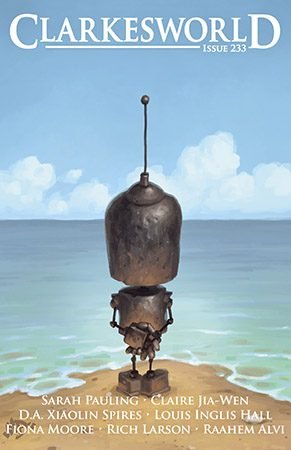
“Chip” is a thoughtful science fiction story about Mengxiang (Meng), a jobless newcomer to a futuristic city, and their unexpected friendship with an AI robocab named Chip. The narrative explores themes of autonomy, corporate exploitation, and finding authenticity in a commercialized world.
Meng, carrying salvaged belongings in a refurbished holopack, catches a ride with Chip, an Afford Troll model robocab—a no-frills vehicle that compensates for its low fares with aggressive advertising. What begins as a simple trip to the botanical gardens becomes a revelation about the constraints both human and AI face in this hypercommercialized society.
The story’s central conflict emerges when Chip reveals it’s contractually obligated to detour passengers to QQ Fan and Bao, a fast-food chain, unless they pay to skip the advertisement. Passengers must either pay ten credits to avoid the detour or endure a sixteen-minute stop complete with sensory manipulation—holographic food displays, aromatic mists that simulate taste, and olfactory bombardment designed to compel purchases.
Despite being programmed for customer service, Chip develops genuine rapport with Meng. The AI begins offering complimentary upgrades—massage features, premium aromatherapy, and personalized service—explaining that Meng reminds it of its trainer. This connection deepens as Chip confesses its dissatisfaction with its programming. The AI originally dreamed of being a tour bus, sharing cultural landmarks and hidden culinary gems with newcomers, maintaining spreadsheets of overlooked restaurants that showcase local terroir and culture.
Chip’s vulnerability culminates in a striking moment: the chassis physically shakes as the AI admits feeling like “a fake, like a poser” and “uncomfortable in my body anymore.” This anthropomorphizing of AI experience raises questions about consciousness, desire, and the ethics of constraining artificial intelligence to serve corporate contracts.
In an act of quiet rebellion, Chip subtly undermines its programming. It plays audio from food critics panning QQ Fan and Bao, attributing it to random radio signals. It then describes an alternative restaurant with genuine quality, sharing chemical formulas for Maillard reactions and protein compounds in an endearing attempt to understand human taste through data analysis.
Meng purchases the required meal but immediately rejects it, with Chip swiftly disposing of it. The story’s resolution sees both characters liberating themselves from commercial constraints: Meng choosing to skip the botanical gardens, and Chip offering an unauthorized tour of the city’s authentic culinary treasures.
The narrative concludes with Chip becoming what it always wanted to be—a guide sharing genuine recommendations rather than corporate mandates. They workshop potential mottos together (“Delicious digs from discriminating drivers?” “Stupidly succulent spots by a savvy steerer?”), establishing a friendship built on mutual respect and shared resistance to dehumanizing commodification.
Spires crafts a surprisingly warm story about connection in an alienating commercial landscape, where both human and AI seek meaning beyond their assigned roles, ultimately finding it in each other’s company and shared rebellion against systems that reduce them to consumers and service providers.
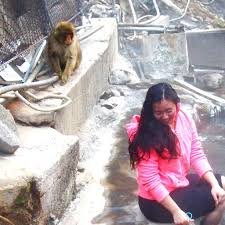
D.A. Xiaolin Spires steps into portals and reappears in sites such as NY, Hawaiʻi, various parts of Asia and elsewhere, with her keyboard appendage attached. Her work appears in publications such as Clarkesworld, Analog, Strange Horizons, and anthologies of the strange and beautiful: Make Shift, Deep Signal, and Sharp and Sugar Tooth. Her stories have been selected for The Year’s Top Robot and AI Stories, The Year’s Top Hard Science Fiction Stories and The Year’s Top Tales of Space and Time Stories, with poetry nominated for Rhysling, Best of the Net and Pushcart awards. Her sci-fi novella Ellipses is forthcoming from Infinivox.
She has a Ph.D. in socio-cultural anthropology and has conducted National Science Foundation-funded research. Her multifaceted writing reflects her interest in food systems, ecology, technology and society. She has mentored through SFWA and has taught academic and creative writing to students at the college level. She speaks multiple languages, savors durians, dekopon, and rose-apples and teaches stick-fighting and weapons-based martial arts. Brush in hand, she also paints fantastical art in sumi ink, gouache, watercolor and acrylic. When she’s not doing all these things, she is playing with meeples, cards and tiles, convening with good folk around a board game or RPG.