
Asimov’s Science Fiction, January/February 2026
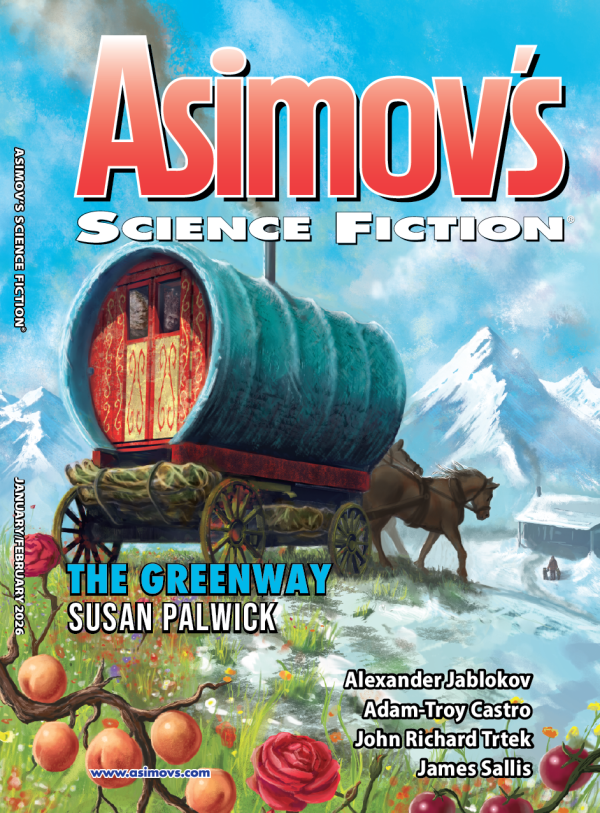
“Ecobomb” tells the story of Earth’s transformation by alien biological weapons and humanity’s eventual victory over an extraterrestrial invasion. The narrative unfolds through multiple perspectives across decades, beginning 75 years before the invasion’s climax.
Hank Okaju returns to his garden after a difficult divorce, discovering mysterious projectile fragments and strange new plants growing among the weeds. These are the first signs of “ecobombs”—biological packages fired at Earth by the Geez, an alien species fleeing their own dying world. The Geez have launched a centuries-long terraforming campaign, showering Earth with genetically engineered organisms designed to transform the planet’s ecology and make invasion easier.
As years pass, we witness the ecobombs’ effects worldwide: fishermen off Kenya catch bizarre hybrid creatures, Chinese researchers Min and Ah Lam study the alien genetics and discover evidence of deliberate design, and Russian refugees flee across steppes now populated with strange new livestock. The alien life spreads rapidly, replacing Earth’s native species and disrupting human civilization.
Parallel to Earth’s transformation, we follow Galruf, a low-status member of the Geez invasion fleet. He’s a pathetic figure obsessed with social climbing and securing reproductive rights through territorial conquest. His subordinate Himp, a skilled biotechnician responsible for designing the ecobombs, quietly works to ensure their success while managing Galruf’s incompetence and violent outbursts.
The story’s genius lies in revealing that humanity doesn’t merely resist the invasion—they co-opt it. Scientists like Min and researchers worldwide collaborate to understand and manipulate the alien genetics. They create hybrids combining Earth and alien biology, developing new crops, livestock, and defensive organisms. Hank’s granddaughter Zilla becomes an expert in “Invasion Biology,” teaching others how to domesticate and modify the hybrid lifeforms.
By the time the Geez fleet arrives for conquest, Earth has transformed the invasion into an opportunity. The alien biopackages that were meant to make Earth hostile to humans have instead been turned into tools for humanity’s benefit. The ecological networks the Geez expected to control have been thoroughly compromised and repurposed.
When Galruf finally lands on his designated territory—Hank’s old neighborhood, now dominated by a massive “sheaf tree”—he finds himself completely outmatched. The humans have bred defensive organisms, created biological weapons, and turned the Geez’s own technology against them. Galruf is quickly killed by a “bomber bird,” while most of the invasion force is destroyed. Only low-status Geez like Himp and Plini survive by cooperating with their human captors.
The story ends with Himp working alongside Hank’s descendants, using Hank’s treasured hori hori garden knife as a symbol of adaptation and cooperation. The invasion’s failure stems from the Geez’s fundamental misunderstanding: they treated Earth as a passive target, not recognizing humanity’s capacity for rapid adaptation and collaborative innovation.
“Ecobomb” is ultimately a story about resilience, showing how patient work—whether gardening or genetic engineering—can transform catastrophe into opportunity, and how humanity’s greatest strength lies in its ability to learn, adapt, and turn enemies’ weapons into tools for survival.