
Asimov’s, May/June 2026
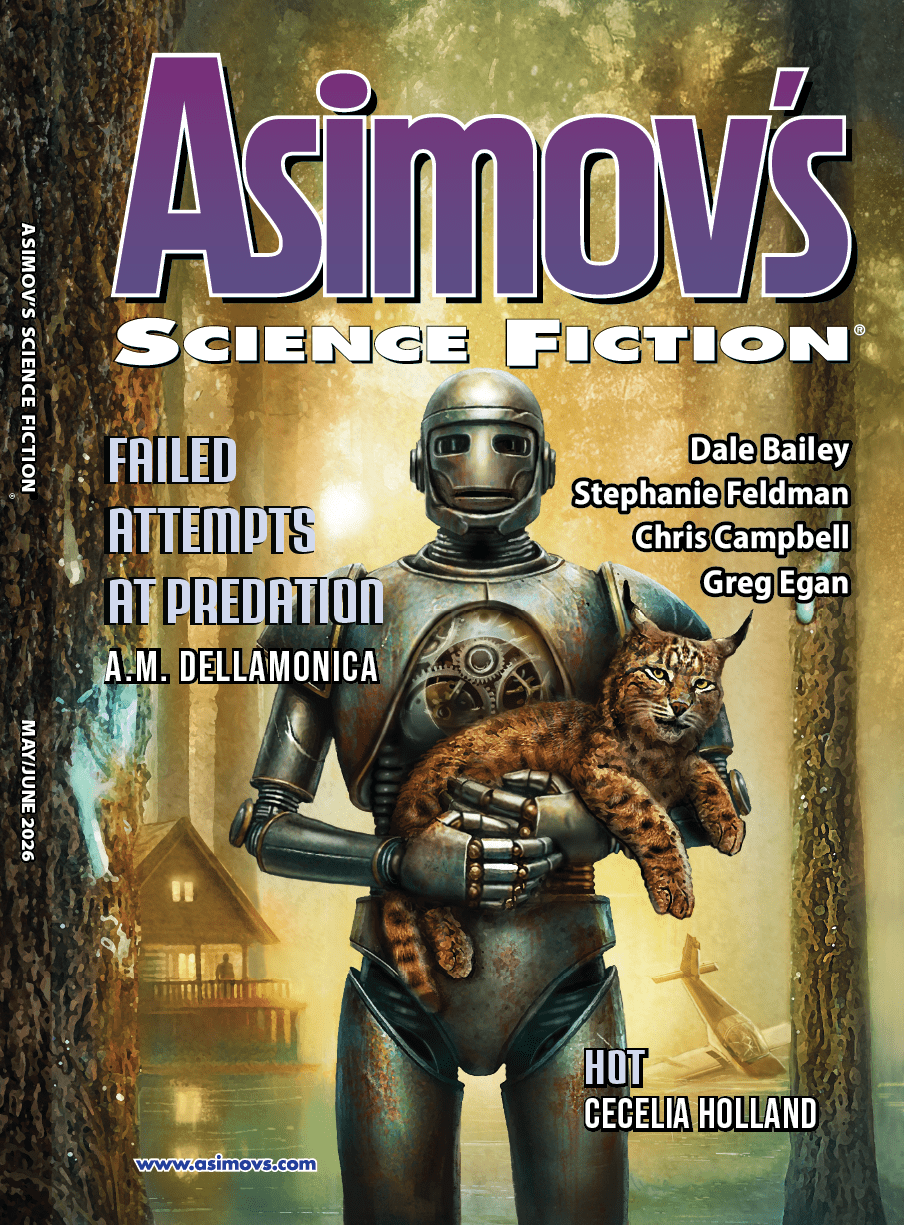
Grace is twenty-nine years old, American-born, and supervising three experimental carbon capture beaches along the Chilean coast for the Civilian Climate Corps. The beaches are surfaced with olivine, a volcanic mineral whose natural weathering process absorbs atmospheric carbon dioxide and locks it into the shells and skeletons of marine organisms. It is painstaking, slow work — scientifically sound but yielding no visible results within any human lifetime. Grace is good at it anyway. She rises before dawn each morning, wades into the cold Pacific, and keeps the beaches intact against storms, erosion, and bureaucratic entropy. Her partner Stephen lives nearby but keeps different hours, and their connection is sustained partly through matching smart bracelets that project each other’s faces onto their forearms. It is a tender technological accommodation to Grace’s deep, barely-controlled anxiety about loss — an anxiety rooted in the fact that as a teenager she watched her San Diego neighborhood burn, and her parents with it.
The story opens on a single complicated day. Grace has her annual physical, argues with an older Chilean doctor who types too many notes and tells her to stay calm, and returns to the beach to drive the grooming tractor into the evening. At home she finds Stephen has accepted a job on an ocean iron fertilization fleet — a rival carbon-sequestration method that would take him off-continent indefinitely. Their dinner becomes an argument about climate strategy that is really an argument about children, commitment, and what it means to work toward a future you will never live to see. Stephen wants results he can witness; he wants children; he tells Grace a story about a Chilean street vendor who survived three dictators by building a private haven of love inside his house. Grace finds the story moving but cannot accept its logic. She refuses to bring children into a ruined world, and she cannot follow Stephen onto the sea.
Before he leaves, they take a final trip together to Valle de la Luna in the Atacama Desert, a landscape of salt formations and eroded red stone so alien it was once used to test Mars rovers. There, as the sun sets over the ancient rock, they hold each other and recite their shared motto — there is no planet B — while quietly knowing they are already parting. Their last night together is spent in unresolved silence. The following morning a 9.7 earthquake and tsunami destroys the Chilean coastline, Valparaíso, their home, and all but one member of Grace’s crew. Their relationship does not survive the grief and the arguing. Stephen leaves for the OIF fleet without a goodbye.
The story’s second section jumps forward fifty-five years. Grace is eighty-three years old and has been living at Mars Dawn Station for three decades, overseeing terraforming projects including the domed experimental growing valley called Green Valley. She has cancer, significant bone loss, and no intention of returning to Earth. She speaks daily with an AI companion she quietly modeled on Stephen — audio only, because a video version would be too much — and it knows her with an intimacy that is both comforting and quietly heartbreaking. Earth, glimpsed through the station’s news feeds, has become a planet of mass climate migration, collapsing infrastructure, and permanent crisis.
The story ends with Grace suiting up and walking out alone onto the Martian plain at dusk. She imagines the empty regolith as a beach whose ocean has simply vanished, and she looks up at a sky where Earth glimmers as the evening star. The companion whispers to her about beauty and forgetting. She thinks about the hypothetical ruins of a Martian civilization — a people who thought their world was too big to break, and then too big to fix — and recognizes herself in them without despair. She breathes. She is anchored. Above her is all that endless sky.

Steve Rasnic Tem’s writing career spans over forty-five years, including more than five hundred published short stories, seventeen collections, eight novels, and miscellaneous poetry and plays. His collaborative novella with his late wife Melanie, “The Man on the Ceiling,” won the World Fantasy, Bram Stoker, and International Horror Guild awards in 2001. He has also won the Bram Stoker, International Horror Guild, and British Fantasy Awards for his solo work, including Blood Kin, winner of 2014’s Bram Stoker for novel. A collection of his Appalachian stories, Scarecrows, recently appeared. Other recent collections include Figures Unseen and Thanatrauma (Valancourt), Everyday Horrors, and Queneau’s Alphabet (Macabre). In 2024 he received the Horror Writers Association Lifetime Achievement Award. You can visit his website at: www.stevetem.com.
A melancholic piece. No action, just Grace’s inner dialogue. I liked the easy writing style but didn’t feel much emotion and no sense of wonder.