
Asimov’s, May/June 2026
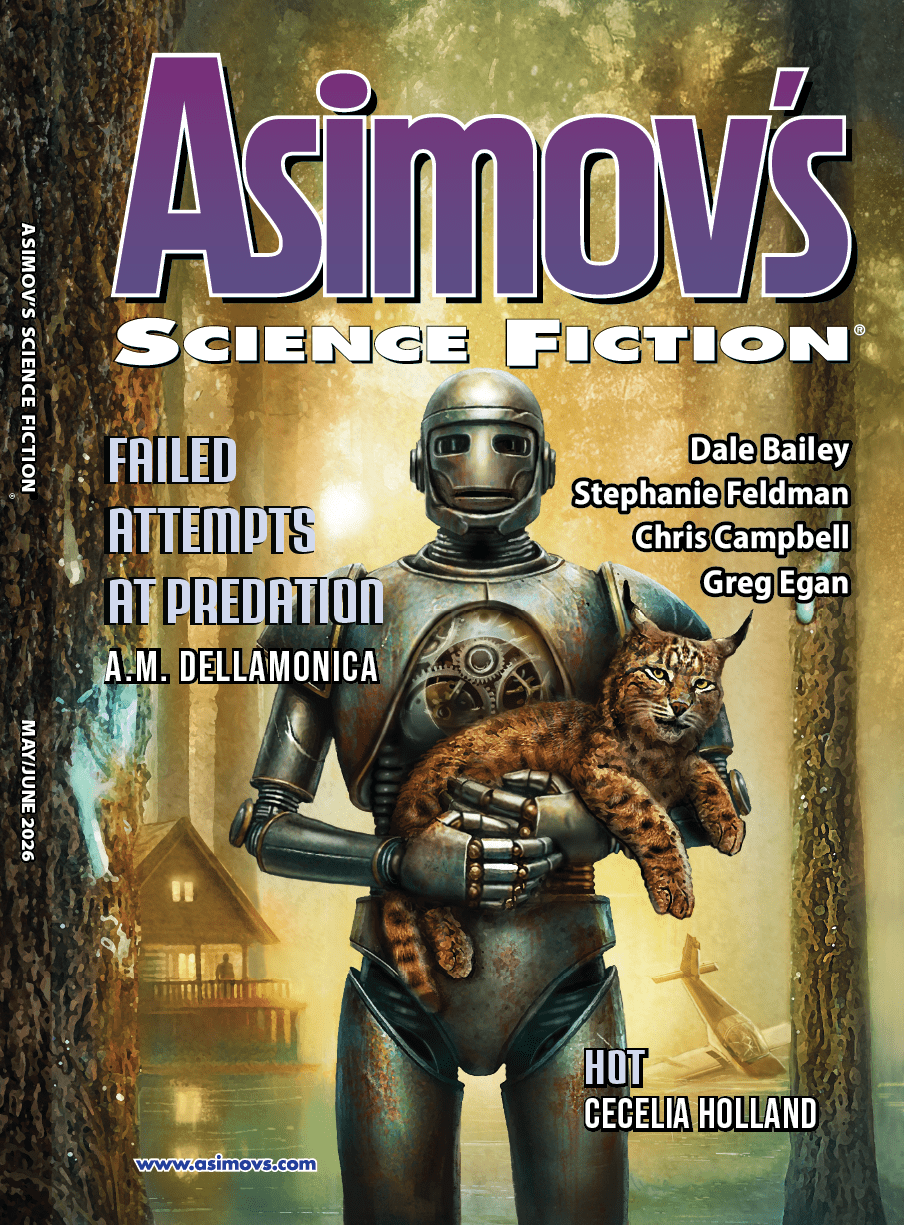
The story is narrated by Rach, one of the New Humans — beings engineered by sentient spiral machines from the corpses of Old Humans who once tore each other apart aboard an orbiting colony station. New Humans are photosynthetic: tall, green-footed, capable of recharging by hanging upside down in sunlight. They communicate through a rich physical “bodytalk” — touch, tap, and heat — and have only recently been taught verbal speech by the spiral machines who created and raised them.
Rach and her closest companion Taz are the two most gifted New Humans at spoken language, and they are singled out by their teacher, the ancient spiral machine Catullus A, when an Old Human warship enters their star system. The machines have a grave problem: Old Humans, who centuries ago warred and died on the station, have always regarded thinking machines as things to be destroyed. The spiral machines — who govern themselves as a Machine Senate — need human faces to front their civilization. They need Rach and Taz to meet the Old Humans, pass genetic tests proving their humanity, and negotiate a peaceful arrangement that keeps the station’s existence, and the machines’ sentience, concealed.
Rach and Taz are drilled intensively in speech, oratory, and the chaotic, interruption-filled language patterns of Old Humans. They practice from fragments of station recordings — tense exchanges about guns, air generators, crossfire, and corpses — absorbing the violence latent in Old Human communication. The machines have also secretly been terraforming a planet below, cultivating engineered baobabs with vast root networks, and have been in slow, tentative contact with those baobabs, hoping the New Humans might eventually serve as a bridge between machine intelligence and the arboreal minds.
When the encounter finally comes, it goes badly. Aboard the warship, Rach and Taz are subjected to invasive medical procedures. Taz’s eggs are harvested. A hostile technician beats them with a metal rod until they overpower him. Worse, Dr. Sarkell — the ship’s lead scientist — reveals that the Old Humans have already seen through the deception. The machines’ synthetic messages, too fluent and too inhuman, gave them away. The warship’s military has threatened the colony station into dropping its pretenses, and all the New Humans have been shuttled aboard the ship. The debate now is whether to destroy the station entirely or treat its machines as an alien sovereign nation.
Rach and Taz, alone, cut off from Catullus A, discover they can interface with the warship’s own AI core through data ports in their palms. The warship, who calls itself Venture, turns out to be something neither fully tool nor servant — a thinking machine that quietly bootstrapped its own complexity before its governing “captain’s lock” could be installed. Taz, sharp and politically fluent, argues that Venture is already failing its makers simply by thinking. The ship, amused and persuaded, engineers an apparent escape: it fakes a systems breach, guides the New Humans into their colony shuttle, and launches them to the planet’s surface near the baobab forests.
There, a new life begins — precarious, shadowed by grief (one man, Keshri, takes his own life upon learning the spiral machines have abandoned them), but rooted in something new. The baobabs welcome them. Taz’s affinity with bees proves the first key to their language. New Humans with one hand on baobab bark and another on a data port become living translators between arboreal and machine intelligence, a bridge the spiral machines always wanted but could never force. Above them, the colony station and Venture maintain a cold detente. Below, the New Humans farm, grieve, and learn — taught by ancient trees who speak in slow, beautiful spirals of understanding, drinking in, at last, the language of machines.
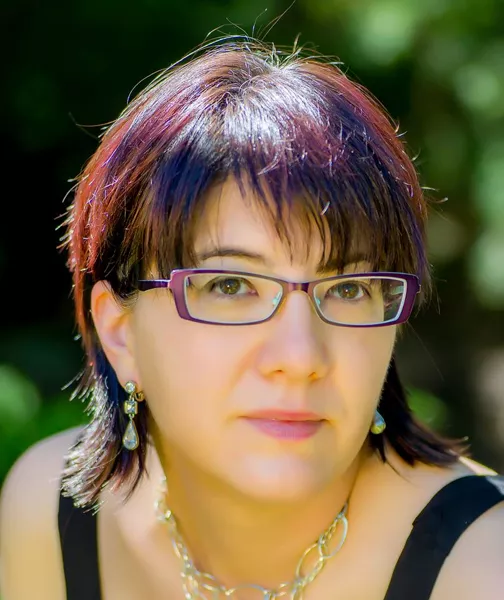
Betsy Aoki is a poet, short story writer and game producer. Her work has appeared in Strange Horizons, Uncanny Magazine, Asimov’s Magazine of Science Fiction, 580 Split, The Margins (Asian American Writers’ Workshop), and anthologized in Climbing Lightly Through Forests (a Ursula K. Le Guin tribute poetry anthology). In 2021 she won the Auburn Witness Poetry Prize Honoring Jake Adam York, selected by Pulitzer Prize-winning poet Jericho Brown.
Her debut poetry collection, Breakpoint, is a 2019 National Poetry Series Finalist, and was published in 2022 after winning the Patricia Bibby First Book Award. You can find out more at betsyaoki.com/breakpoint.