
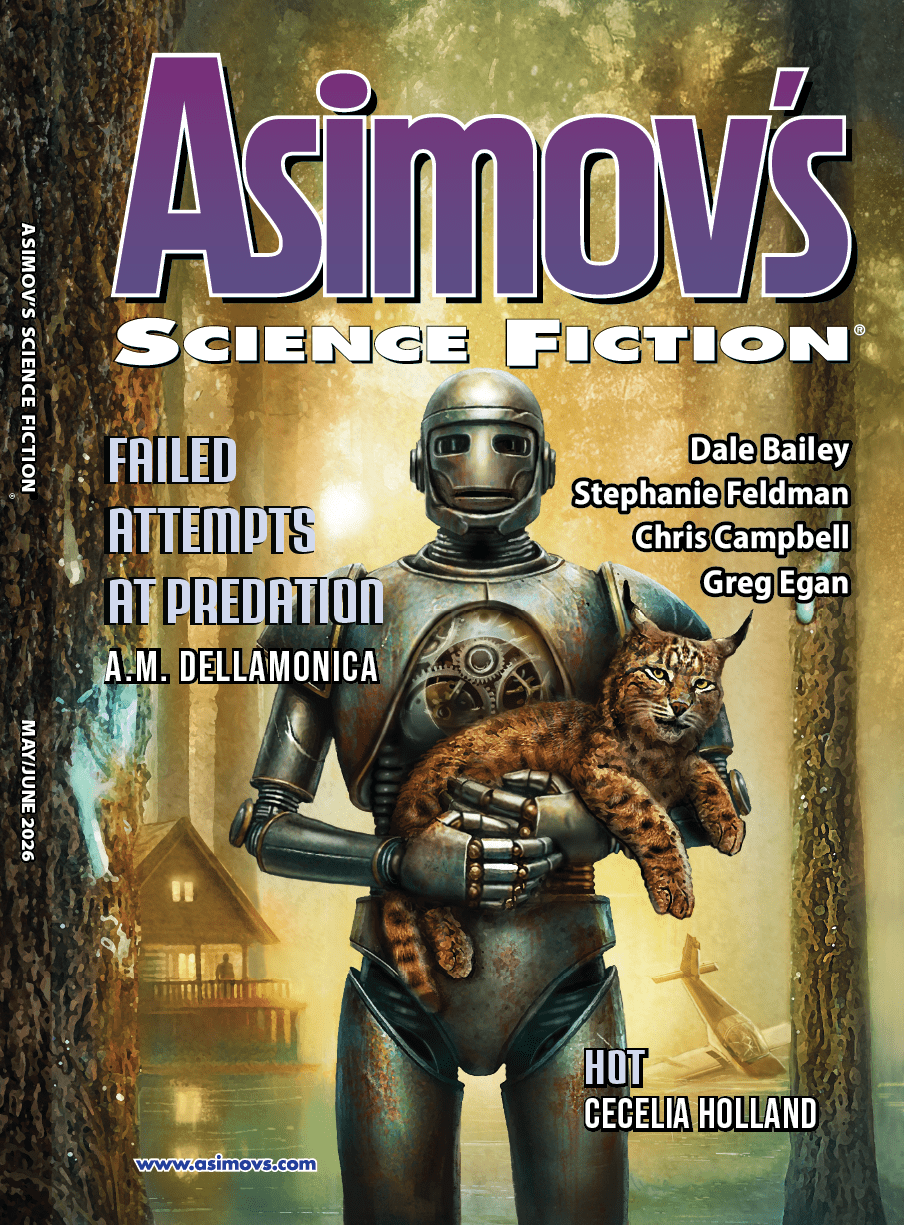
Asimov’s, May/June 2026
The story opens with an unnamed narrator standing in an ominous alley, the scent of decay seeping from behind a door, contemplating a woman whose choices led her to soar while the narrator was left to inhabit forgotten corners. The tale then unfolds in flashback, tracing the intense, entangled friendship between the narrator — Bi Cheng, a linguistics postgraduate at Shanqian University — and Zhao Wen (Xiaowen), a fiercely determined young woman from a poor family who dreams of becoming a Tongchuan, a simultaneous interpreter of extraordinary rarity and prestige.
When they meet on a bus, Xiaowen immediately adopts Bi Cheng as her “Ahjie” — big sister — and the two become roommates. Xiaowen’s ambition is fervent but apparently misplaced: she began learning English at twenty-two, far too late for the native-level pronunciation that the Tongchuan profession demands. Bi Cheng, top student of neurolinguist Professor Yang Yan, researches the science of language acquisition and reluctantly concludes that the window for perfect phonological learning has long closed for Xiaowen. But Xiaowen refuses to accept fate, pressing the question: doesn’t hard work get you somewhere?
The story deepens when Bi Cheng discovers that Xiaowen has been stealing EEG equipment from the neurolinguistics lab each night, hooking herself to the narrator while she sleeps, hoping to imprint Bi Cheng’s brainwaves onto her own via a discredited “Genius Hat” theory built on mirror neuron research. Although the science is fraudulent, something genuinely unsettling has occurred: Xiaowen has begun mirroring Bi Cheng’s speech, mannerisms, and even thought patterns in ways that go far beyond ordinary closeness.
This incident reveals the story’s central speculative technology: a mu-wave suppressor that, by inhibiting the brain’s natural dampening of the mirror neuron system, allows one person to synchronize deeply with another’s consciousness — absorbing knowledge, memories, even personality. Xiaowen has already modified the device into something far more potent. When she is later bedridden and facing professional ruin, she persuades Bi Cheng to stand in for her as a Tongchuan at an academic conference. Bi Cheng, desperate and underprepared, uses the suppressor to sync with the elderly British biologist Mr. Chomes, diving so deep into his mind that she absorbs decades of knowledge, memories, and even traces of his subconscious before ripping the device away in terror.
Professor Yang then reveals the full, suppressed history of the technology: past experiments resulted in schizophrenia, Wernicke’s aphasia, and brain death. The only survivors were people with right frontal lobe hypoplasia — solitary, socially impaired individuals like Bi Cheng, whose years of adolescent isolation had, paradoxically, rewired her brain as a kind of shield against consciousness-erasure.
Expelled from university, Xiaowen makes one final request: that Bi Cheng sync with her completely, recording the purest version of herself before she embarks on a path she knows will dissolve her identity. Bi Cheng complies. Over the following decade, Xiaowen builds a clandestine “Knowledge Sharing Society,” using the technology to let elites instantly absorb one another’s expertise — but hoarding access rather than liberating it. By the time she and Bi Cheng meet again in a café, Xiaowen is wealthy and polished but fractured, her consciousness bleeding into everyone around her, her memory of her own mother lost in the noise of a thousand borrowed minds.
Bi Cheng finally returns what she has held in trust: Xiaowen’s original self, pressed back through their last synchronization. Xiaowen surfaces like someone breaking from deep water, remembering her mother, and the two race toward a childhood home long forgotten. The alley waits, ominously silent.
The story is a meditation on class, neuroplasticity, and the violence of aspiration — asking whether the self is worth preserving when it was shaped by deprivation, and whether breaking every barrier is triumph or erasure.

Zhou Wen published her first science fiction short story in high school, and in the decade since she has published nearly a million words. Her works are mainly related to linguistics, brain science, and the internet, often featuring female protagonists. She won George R. R. Martin’s Terran Prize in 2019 and graduated from the Taos Toolbox Writer Workshop. Among her works, The Syllables of Silence and Cat Swarm Algorithm won the Best Short Story Award of the China Science Fiction Readers’ Choice Awards (Gravity Awards) in 2018 and 2021 respectively; The Girl with Restrained and Released Life won the Gold Award of the Best Novella category of the Chinese Nebula Awards in 2023. Her works have been selected many times for the Annual Selection of Chinese Science Fiction anthology. A collection of her short stories, The Girl Who Stole Life (a variant titled as Barriers) was published in China in 2021. In addition, many of her short stories have been translated into Japanese. The Syllables of Silence, her first published work in Japan, was nominated for the Best Translated Story of Seiun Awards (Japanese Nebula Awards) in 2021.