
Asimov’s, July/August 2026

Claudine is over a thousand years old, an immortal who dies and is reborn again and again in the marshes along the Seine, waking each time in an unfamiliar body with fragments of memory intact. After the death of Henri, her husband of recent decades, she moves into a Latin Quarter attic and teaches tourists to bake tarte Tatin and madeleines through a booking service run by a brisk Serbian woman named Ana, who arrives most weeks with her silent, scarred daughter Ozara in tow. Claudine’s students keep asking about a “train to Gertrude Stein,” a virtual reality experience at the Musée d’Orsay that lets visitors attend a 1920s salon with Stein, Hemingway, and Picasso. Claudine doesn’t recognize the name at first, and her confusion becomes a symptom of something larger: her memory, worn thin by centuries of dying and returning, is losing its grip on the present moment.
Between baking classes, Claudine wanders Paris practicing what she calls her flanerie, drifting through neighborhoods that hold traces of her many past lives — a garden where her mother once grew rosemary, a spot where she first kissed a fisherman named Arnulf before Vikings killed them both centuries ago, the prison where she watched Marie Antoinette go to the guillotine after secretly working as the queen’s corsetière. Her downstairs neighbor Malik, a young scholar with old-fashioned manners, notices her slipping grip on time and gently corrects her historical confusions, which only offends her. She misses a class after losing track of the days, costing Ana money and goodwill, and their relationship curdles. Malik knocks on her door in the aftermath, confessing that he has spent lifetimes searching for a lost love, his spirit “cleaved in two” from hers, but Claudine, still grieving Henri, turns him away.
The city around her grows quietly wrong: empty cafes, cancelled bookings, a bookstore clerk informing her it’s October when she thought it was August. Paris is emptying out because war is coming, though Claudine — who has spent her many lives avoiding the news — has refused to notice. When the bombs finally fall, Malik pulls her into the street and they flee toward a shelter, witnessing the city collapse into fire and rubble reminiscent of every catastrophe she has already lived through: Vikings, revolutionaries, the Nazis. Sheltering underground in the museum, Malik reveals he is truly ancient too, a Gaulish man named Vindomaros who has died and returned across dozens of wars, always searching for the wife the Romans drowned alongside him. Water begins seeping into the vault as the structure fails, and Claudine says goodbye to him, uncertain whether either of them will survive this death.
She wakes again in the marsh, in a new and unfamiliar body, in a Paris scoured by war and abandonment. A masked soldier searching the reeds finds her, and when she gives her name — reflexively, and not her own — she calls herself Ozara. The soldier, lowering his rifle and his visor, tells her his name is Arnulf, and that he will help her, closing the story on the same cycle of loss and recognition that has carried Claudine through all her centuries.
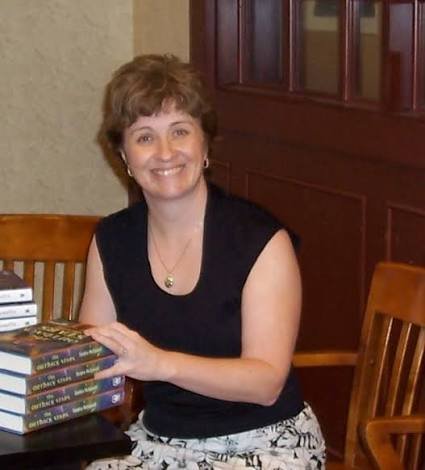
Sandra McDonald is a former military officer, recovering Hollywood assistant, and perennially patient college instructor who writes across the genres of romance, history, fantasy, science fiction, GLBTQA, and young adult fiction. Her first collection of stories, Diana Comet and Other Improbable Stories, won a Lambda Literary Award for transgender fiction. It was also a Booklist Editor’s Choice, ALA Over the Rainbow book, and Rainbow award winner. Her short fiction has been published in several dozen magazines and anthologies, including the Year’s Best YA, Year’s Best Science Fiction, Year’s Best Science Fiction and Fantasy, Tiptree Anthology, Asimov’s Science Fiction, the Magazine of Science Fiction and Fantasy, Clarkesworld, Lightspeed, Strange Horizons, and more. She has several novels in print, including the award-winning Fisher Key adventures and asexual-gay thriller City of Soldiers. She currently resides in Florida.