
Asimov’s, July/August 2026
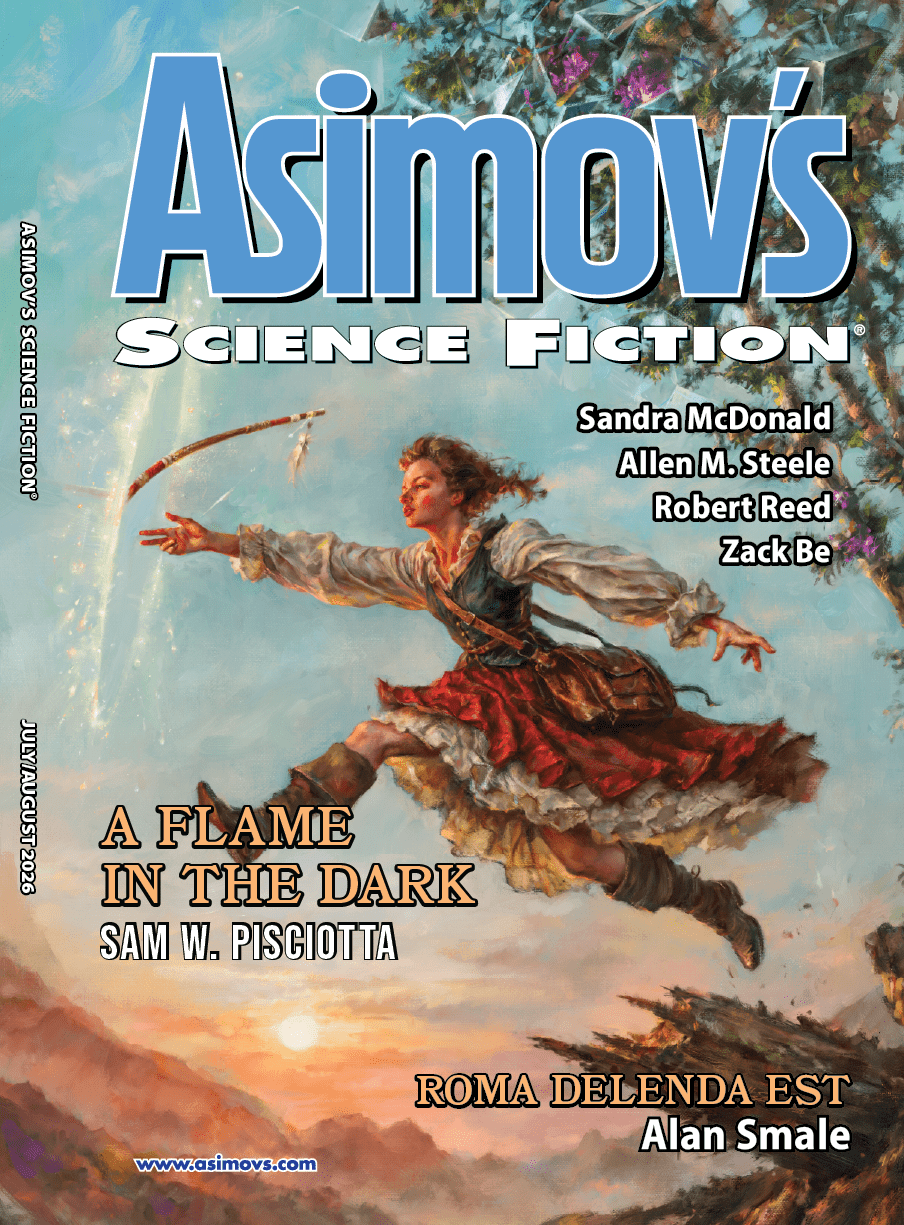
Mineas Bad grows up a gifted athlete in the City of Saints, a mortal metropolis on the shore of the Sea of Giants inside the Great Ship, where immortal humans and aliens occupy the far side beyond the Infinite Wall. As a teenager he watches, unmoved, as a bullied boy falls to his death during a cruel prank; a year later, as a nineteen-year-old star athlete, he throws himself in front of a cable car to save a different falling child, losing his career, his leg, and much of his body in the process. Landie Sweet, the girl who orchestrated the first boy’s death and escaped punishment through her mother’s influence as a bishop, visits Mineas in the hospital. The two remain loose acquaintances for years, both marked by guilt they never fully name.
Mineas becomes a tour guide for wealthy immortal tourists and eventually a finder of missing people. Landie, restless within her mortal faith, secretly plans an escape: she robs her mother’s church of billions in platinum, using stolen passwords and a five-dimensional key, and swims across the Sea to acquire an immortal, cyborg body through an illegal alien clinic. Her disappearance triggers a citywide panic and a brief, humiliating jail stint for Mineas, who is questioned as a suspect. Unknown to the authorities, a renegade Ship captain named Pamir, hiding under the guise of an elderly, unremarkable man called Mr. Evert, quietly intervenes to clear Mineas’s name and to track the family that helped Landie vanish.
Landie eventually returns to the City in her new immortal body, reconciles awkwardly with her furious mother, and gives back a quarter of the stolen wealth in exchange for immunity. She reveals to Mineas her plan to found a colony of converts on a remote, sunless moon, having realized during her escape swim that the City of Saints — not any promised afterlife — is the true paradise humanity has built. Before leaving him for good, she offers Mineas a vial of longevity nanotechnology harvested from her own body, enough to heal or extend the lives of hundreds of hospital patients. He refuses to keep it for himself and instead throws it back to her, letting her carry it to the hospital and disperse it before diving into the Sea for good.
Years later, Mr. Evert reappears as a nameless immortal companion, quietly funding Mineas’s search-and-rescue work with a valid-wisp before vanishing from the City forever. In the story’s final scene, an elderly immortal woman — implied to be Landie herself, transformed and ancient with experience — takes a young tour guide to see the preserved skull of Oliana, the church’s founding saint, and casually reveals long-buried secrets: that the captain who saved Oliana centuries earlier was Pamir, and that he once whispered to the dying girl an idea that could quietly reshape the boundary between mortal faith and immortal life. She boards a ferry newly named for Mineas Bad and disappears back into the vastness of the Great Ship.

Robert Reed is the author of nearly three hundred published stories, plus more than a dozen novels. He is best known for his Great Ship stories, including Marrow and The Memory of Sky. And for the novella, “A Billion Eves,” which won the Hugo Award in 2007. He lives in Lincoln, Nebraska with his wife and daughter.
The author tells us, “Most of my recent work is focused on my dear old friend, the Great Ship. Some GS stories appear in established magazines. Asimov’s, for example. Others get sent straight up to Kindle. A story called ‘The Neighbor’ was one of those self-published efforts. My favorite chapter takes my protagonist to a habitat where mortal humans live on one side of a deep, narrow sea, while the other shoreline is jammed with immortals from a multitude of species. An intriguing setting, and later, wanting to learn more about the realm, I decided to write a second novelette. ‘Oliana’s Skull’ was always set on the mortal shoreline. At the beginning, I was convinced that the second city and those giant aquatic aliens would be allowed their own chapters. But alas, there wasn’t room. Millions of watery brains and tens of thousands of years of history . . . that’s more than enough terrain as it is. ”