
Uncanny, May/June 2026
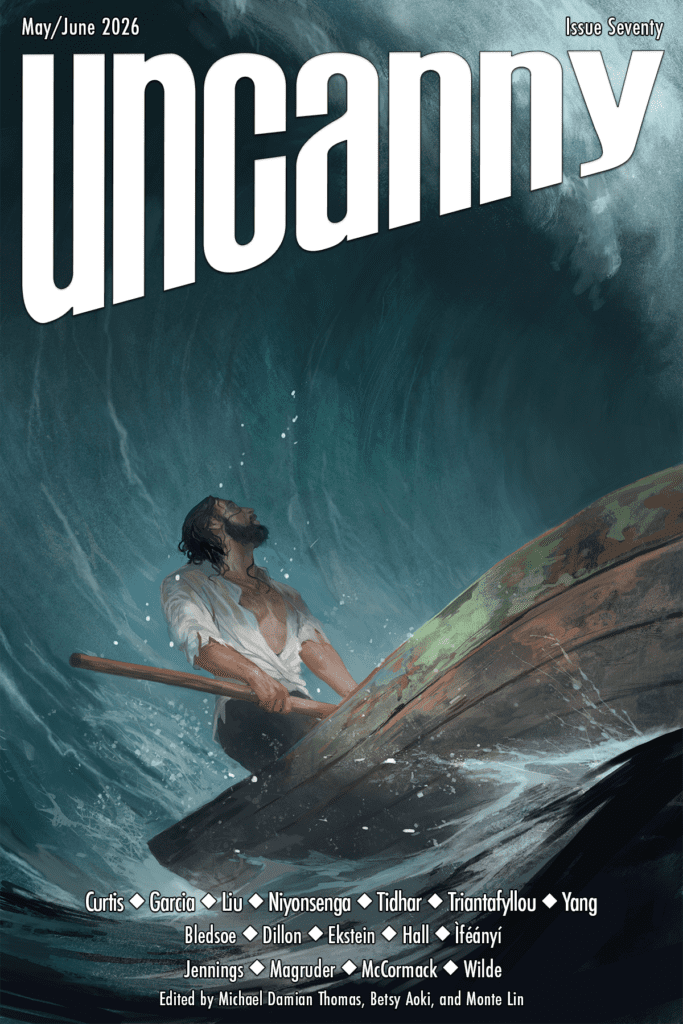
An elderly woman on Mars sits with her family’s photographs and narrates them, numbered one through twenty, to her daughter Helena, who has left the solar system aboard an Exodus ship. The first few images are described impersonally, as if from an archive: a night photograph of the crash-landed jalopies that formed the settlement called Terminal, a humanoid robot glancing back at the camera; a drone shot of the later, domed city of Tong Yun; a polaroid of a young woman floating in zero gravity on the way to Mars, who is not believed to have survived the landing. Then the voice turns personal. She shows Helena her great-great-grandfather Joaquín, tattooed and alone on a bench in an Outback dome as a train passes without stopping, his wife Olha absent from the frame.
The narrator recalls the day she posed with Helena’s father at Tong Yun’s Multifaith Bazaar, pregnant and exhausted while he fruitlessly hunted for an Alice rose from Venus to give his orchid-growing father. She describes her mother, Bella Chen, an ethnographer who collected stories across the Outback, and the tabby cat Bela named in her honor. Bella used to sing her a lullaby about the Others, the digital intelligences of the Conversation. Another set of photos belongs to her grandfather Anton, an unverifiable storyteller who lived among gramophone records and argued with his toaster. One of his pictures, taken at the south pole, shows mercenaries of Clan Ayodhya installing the Cores of the Others beneath the ice, while a strange object dangling from a crane seems to shift whenever she stares at it. She admits she never believed the wild rumors about the pole.
Fond memories follow: a publicity still from her beloved soap opera “Chains of Assembly,” which she once watched with Bella and now watches alone; a blurry snapshot of five-year-old Helena and her cousin Niamh at the Port Jessup spaceport, where a stern station master kept a gold watch; ice cream at the Ayinde Oasis while Helena’s father vanished into the greenery in search of new flowers. Looking at the spaceport, she reflects that she never wanted to leave Mars, and that her family is a line of restless people who left one home to build another. Someone, she decides, has to stay and remember for the rest.
Her tone darkens as the album does. A lone robotnik walking the tracks prompts her to ask Helena if she feels the same solitude beyond the Oort, and to admit that she misses her. She describes the day Anton died, when a ghost collector extracted his memories and her mother declined to have them decanted into a robot, choosing the Public Heavens instead. She tells of a drone photograph of a vast tangle of railway tracks where every kind of Martian train gathers for the legendary Convocation of the Trains, a story she insists is only that. Of a photograph taken at Helena’s father’s funeral, she says only that she does not want to talk about it.
The most painful image is Helena on her last day on Mars, framed on the narrator’s shelf, radiant and nervous. She wonders whether Helena’s happiness was at going or at leaving, pictures her daughter asleep in cryogenic suspension, and knows she will be only a blurry photograph by the time Helena wakes. Comparing humans to ants who must always spread outward, she asks whether Helena will remember her and the love she carries. The final photograph is of empty black space somewhere in the Oort, where Mars and Earth can no longer be seen.

Lavie Tidhar’s work encompasses literary fiction (Maror, Adama, Golgotha, and Six Lives), cross-genre classics such as Jerwood Prize winner A Man Lies Dreaming and World Fantasy Award winner Osama, and genre works like the Campbell and Neukom winner Central Station. His latest books are The Three Coffin Problem and Guns and Sorcery, both 2026.