
khōréō, March 2026
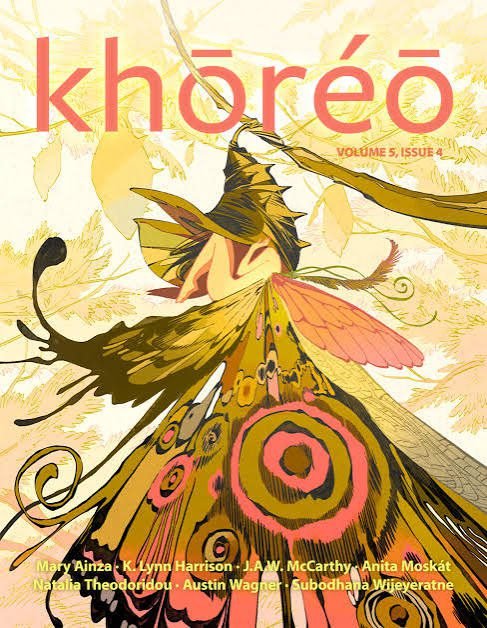
A man travels by ship toward a new country, having no place in the world he can call home. On his narrow red bed lies the right arm of his fiancée, Marianne, which she gave him before his departure, her other hand gripping a bloodied hatchet and her face streaked with tears. The arm is warm and curls against him like a cat, and he talks to it, confessing what he never told Marianne: the voyage was not compulsory, his employer’s lodgings and salary could have accommodated her, and he never truly loved her. He hopes to find someone new and forget his old life entirely.
On deck, he notices a young man in a green velvet vest, and an unexpected longing stirs in him. The young man, Victor, soon joins him for breakfast and reveals himself to be a charming philanderer, always accompanied by a different beautiful young woman. When pressed on whether he travels alone, the man admits that his fiancée’s arm is with him in his cabin. Victor offers pity, which the man decides is almost as good as admiration, and asks to meet the arm. Later, he examines it with an odd, unreadable expression and asks whether the man is ever afraid of it, wondering what it does while he sleeps and what it thinks of him.
The question festers. The next morning, as the man reaches for a glass of water, the arm seems to grab his shirt, and he falls and knocks his head against the sink. Doubts overwhelm him: Marianne’s tears on the day of her sacrifice may have been resentment rather than love, and perhaps he pressured her into giving the arm. When the ship docks, he locks the arm in a drawer and follows Victor to a brothel, where, to his own surprise, he asks for both a man and a woman. Returning that night, he feels a chill in the cabin and finds the arm limp and seemingly lifeless. Guilt-stricken, he apologizes, kisses its hand, pricks it with a sewing needle to no effect, and sleeps beside it until morning.
After they reach their destination, the man grows tender with the arm, though he privately blames Victor for the rift. In his new house, the arm revives, and the two sit together like an old married couple. He calls his mother but never thinks to call Marianne, who has become nothing more than her arm in his mind. He gives it its own room and listens at night as it bumps blindly against the wall. Over the following month he builds a life of business and evening walks, leaving the arm locked in a drawer, and renews his friendship with Victor, who says he should let the arm go.
That night, a recurring nightmare begins in which the arm chases him across an empty white room and strangles him. Each time he wakes in a sweat and finds the arm lying innocently on its bed. When he tells Victor, his friend warns that this will not end well. After one more dream, the man finds the arm next to him in bed, slaps it away, and carries it downstairs, where he throws it into the burning woodstove.
The next day he takes the day off and strolls with Victor, feeling light and calm. At lunch, Victor introduces his new fiancée and her delightful friend. The man notices the friend’s soft waves of hair and bare shoulders, and reaches across the marble table to touch her hand. She smiles and returns the gesture. He envisions their entire future together, from courtship to a house and perhaps a voyage. As they part that evening and embrace, he tells her she has lovely arms, the greatest compliment he can think of.

Natalia Theodoridou is a transmasculine writer whose stories have appeared in publications such as Kenyon Review, Uncanny Magazine, Lightspeed, and Strange Horizons, and have been translated into Italian, French, Greek, Estonian, Spanish, Chinese, and Arabic. Natalia won the 2018 World Fantasy Award for Short Fiction and the Nebula Award in 2025. He holds a PhD in media and cultural studies from SOAS, University of London, and is a Clarion West graduate. His debut novel, Sour Cherry, a queer Bluebeard retelling about toxic masculinity and cycles of abuse, came out in April 2025 (Tin House & Wildfire). Website: www.natalia-theodoridou.com