
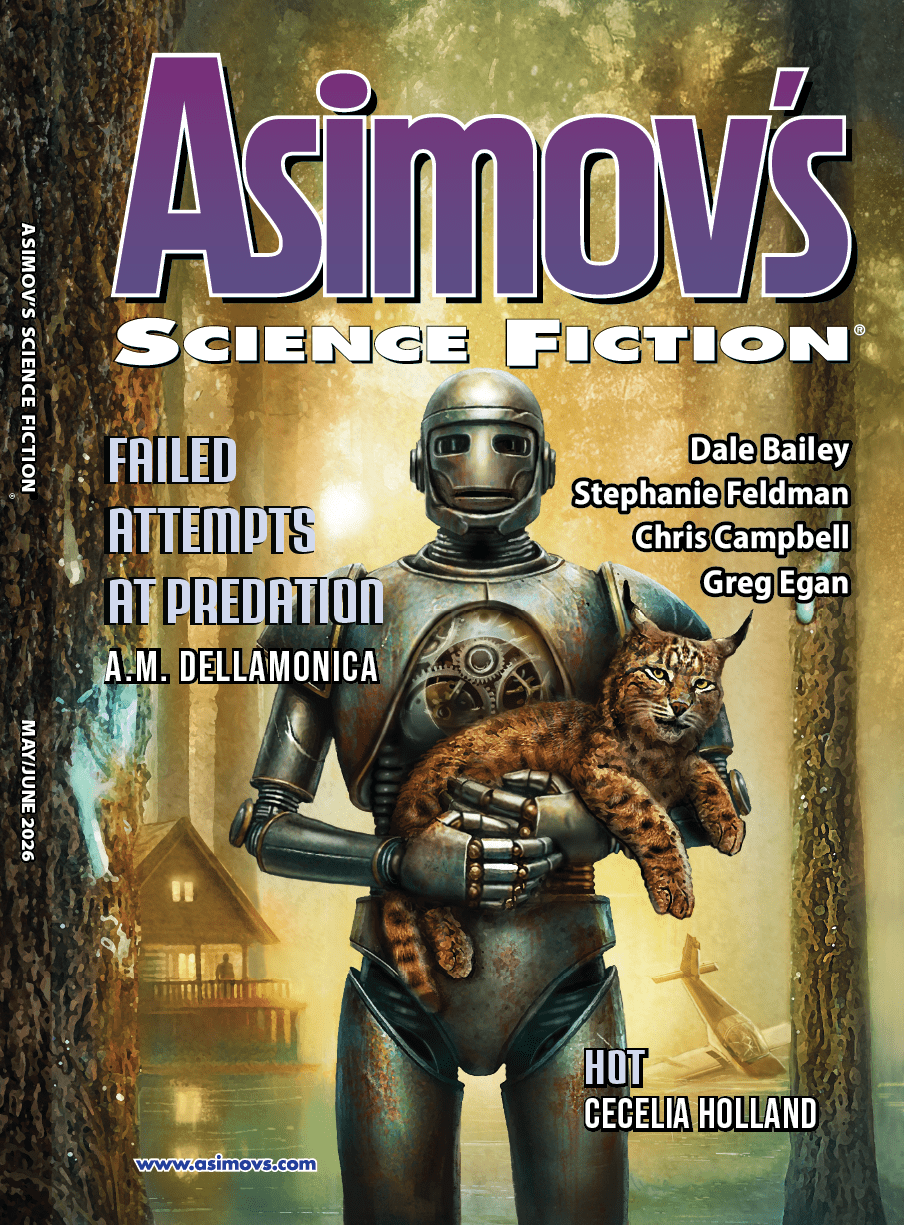
Asimov’s, May/June 2026
Sophie Simpson is a sharp, plain, perpetually skint girl from a single-parent household who wears her cousin Mary’s ill-fitting hand-me-downs and eats cheese and pickle sandwiches every day because her mother can’t afford anything else. The most important word in her life, the narrator notes, is “afford.” She lives with her mother in her Nan’s house, dreads dance lessons, loathes maths, and has no real friends at the Marvin Fenwick Grammar School — only tolerates from the fat girls and the cross-eyed girl who can’t outrun her in the schoolyard. The one classmate who comes closest to a friend is the universally despised Chloe Campbell, which does not say much for Sophie’s social standing.
On a sunny first of July, Miss Gill’s Year Three class boards a coach for a school outing to the Crestwick Trench Experience, a living-history attraction reconstructing life on the Western Front. The children are greeted by the crisp and no-nonsense Sergeant Edwards, who issues them khaki uniforms, Short Magazine Lee-Enfield rifles with seventeen-inch bayonets, and enrollment papers they must sign as conscripts. Sophie, characteristically, reads every word of hers before signing. They learn to march, they sing an obscene soldiers’ song, and they are subjected to the sanitised disappointment of the trench itself: clean decking, steel-grated walls, plastic rats the size of Pomeranians, and a No Man’s Land that looks freshly mown, like a football pitch. The wretched Maconochie stew served at lunch is the only authentically grim detail — though Lily Thomas drinks hers down without complaint.
Charlie Day, Sophie’s chief tormentor, harasses her throughout: pulling her hair on the coach, goosing her during the march, and finally, in the soldiers’ mess, dumping a full tin of Maconochie down the back of her trousers before disappearing. Left alone, humiliated and weeping, Sophie tries quite sincerely to die. She cannot manage it. She retreats to the darkest corner of the mess and waits for someone to collect her.
No one does. Instead, a storm rolls in — only it isn’t a storm. The trenches transform around her into the real thing: mud, screaming, artillery barrages, stretcher bearers, heaped dead, and German soldiers advancing in waves across a cratered doomscape strung with barbed wire and bodies. A filthy Tommy drags Sophie into the mud to save her from a whizz-bang, points out the obliterated remains of his mate Davey to illustrate what doing your share actually means, and is himself blown apart a moment later. Sophie, processing this with the unsentimental logic of a child who has spent her whole life being told that some people are simply the first to go, shoulders her rifle, picks off Huns one by one, and fights her way through the collapsing trenches before bursting back out into the July sunlight.
Miss Gill and Sergeant Edwards are waiting. The coach is idling. Her classmates stare out the windows. Sophie changes out of her fouled uniform, abandoning Mary’s ruined hand-me-down knickers on the floor without ceremony. She keeps the rifle. On the ride home, Charlie Day slides into her seat to taunt her once more. She holds his gaze and says nothing. He retreats to the back of the coach and stays there.
At home, Sophie finds the house charged with a suspicious silence — and the Rev. Mr. Sludge fleeing across the back garden. When her mother asks how the war was, Sophie raises her Lee-Enfield, seats the stock in the socket of her shoulder exactly as Sergeant Edwards taught her, aims it square at her mother’s heart, and says: Kerpow.
Bailey’s story operates as both a pitch-black comedy of manners and a quietly devastating portrait of class, powerlessness, and the peculiar resilience of a child who has learned to survive by accepting the logic of the world — and then turning it back on the world with perfect aim.

DALE BAILEY is the author of nine books, including This Island Earth: 8 Features from the Drive-In, In the Night Wood, The End of the End of Everything, and The Subterranean Season. His story “Death and Suffrage” was adapted for Showtime’s Masters of Horror television series. His short fiction has been frequently re-printed in best-of-the-year anthologies, including The Best American Science Fiction and Fantasy, The Best Horror of the Year, and The Year’s Best Weird Fiction. He has won the Shirley Jackson Award and the International Horror Guild Award and has been a finalist for the World Fantasy, Nebula, Locus and Bram Stoker awards. Dale lives in North Carolina with his family.