
Asimov’s, May/June 2026
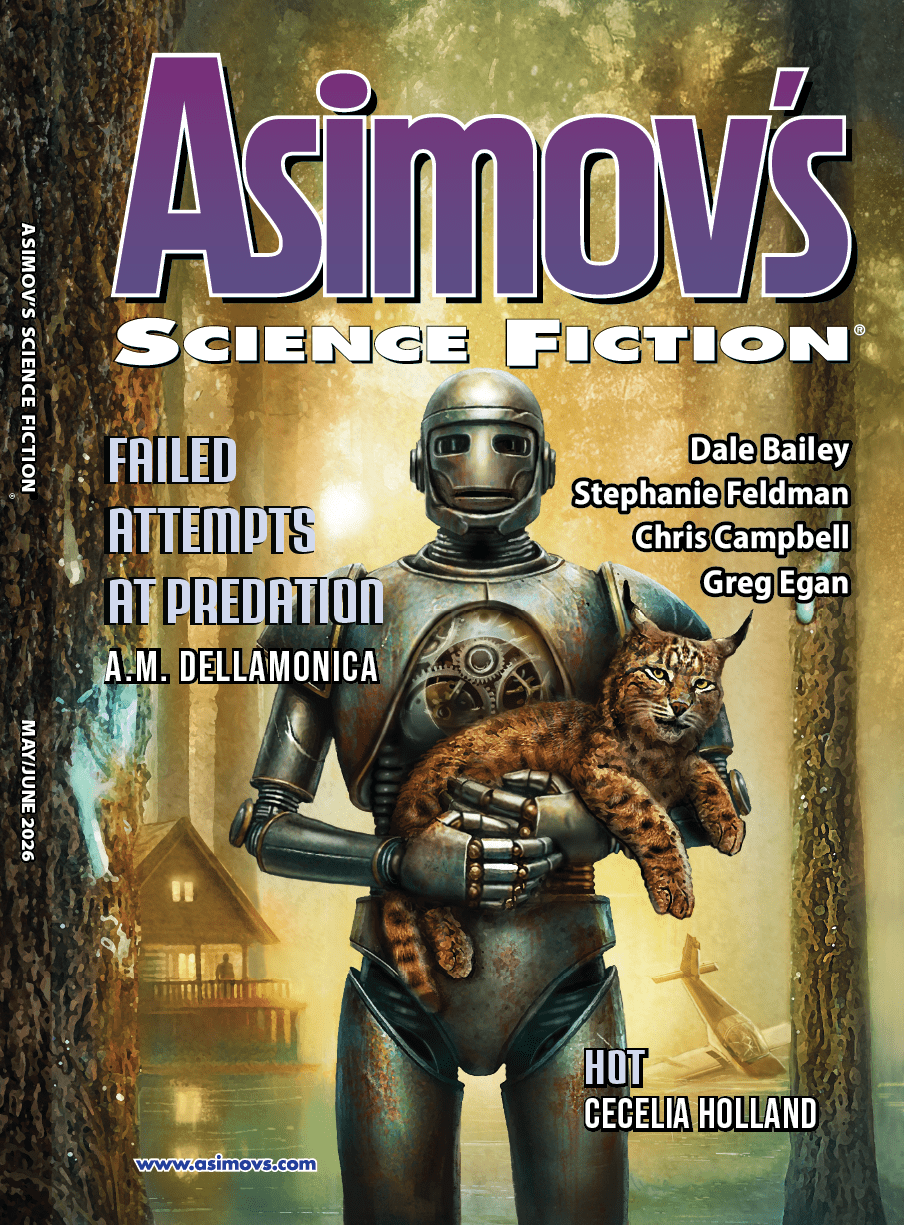
“Hot” is a climate collapse novella set in the near-future California coast, following Francie Beuerlein, a teenage girl navigating civilizational breakdown during a catastrophic, lethal heat wave. The story opens on Francie’s birthday, a mundane scene of family friction — a dismissive stepmother, an absent brother, birthday dishes to wash — that quickly gives way to the first signs of systemic failure: gas shortages, supermarket riots, rolling blackouts. Holland uses this domestic opening with great skill, grounding the apocalypse in the texture of ordinary adolescent life before stripping it away piece by piece.
When the power grid finally collapses entirely, Francie’s father and stepmother flee to Bay City, leaving her behind by her own stubborn choice. What follows is an extended survival sequence of remarkable physical specificity. Francie establishes a base in a childhood cave behind the family home, foraging abandoned houses by night and sleeping through the brutal daytime heat. She acquires food, a gun, a fading sense of time, and — crucially — a dying stray dog named Bernie, whom she nurses back to health. Bernie becomes her primary emotional anchor, and his eventual killing by roving gas thieves precipitates the story’s darkest turn: Francie shoots one of them in retaliation, wounds him, and then holds a gun to her own head in the cave, weeping but ultimately unable to pull the trigger.
Saved by a breaking rainstorm that floods the cave and washes the gun away, Francie ventures east to the fire-damaged town of Greenville, where she meets Timjohn, a resourceful older teenager who has survived alone using solar power and scavenged provisions. Their partnership — cautious, practical, built on mutual dependence rather than romance — forms the story’s emotional spine. Together they forage the surrounding hills, encounter a brutal itinerant man and his subjugated partner Maisie, and are eventually seized by armed men in a stolen helicopter who strip their food stores before returning to recruit Timjohn for his solar expertise.
This brings Francie and Timjohn into Springville, their nearest city, now a grim authoritarian enclave controlled by the fat, calculating Maggie and her enforcer Sam, backed by a small militia and a monopoly on food. Holland’s portrait of post-collapse power is unsentimental: Maggie runs a food-for-labor system with executions for infractions, while the larger community gardens, forages, and quietly erodes. Francie allies with the English teacher Mr. Tyndall, the capable nurse Teresa, her old classmate Kelly, and kitchen-boy Ray, building an informal counter-community inside the school. When Timjohn cuts the fire hall’s solar power and water supply, and an inside confrontation sends Sam crashing from a window, Maggie surrenders.
The novella ends with a reunion: Francie’s father arrives from Bay City preaching reconciliation and nonviolence — and is immediately shot dead in the street. Her brother Lawrence arrives soon after with an armed group seeking vengeance. Francie, in the story’s emotional climax, talks Lawrence down and persuades him to lay down his gun, invoking their father’s vision of a better way. The final scene is the community gathered in the fire hall — fed, cooled, singing, listening to Mr. Tyndall tell a fairy tale with a girl as its hero — fragile and provisional, but alive.
Holland writes the collapse as both inevitable and self-inflicted, the consequence of decades of political deadlock, climate denial, and infrastructure fragility. Francie’s arc — from passive teenager to reluctant moral center — is rendered without sentimentality, her authority earned through loss and practical competence rather than heroism. The novella is a bracing, beautifully observed piece of near-future realism.
Pen name used by Elizabeth Eliot Carter.
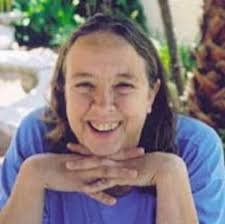
Cecelia Holland is one of the world’s most highly acclaimed and respected historical novelists, ranked by many alongside other giants in that field such as Mary Renault and Larry McMurtry. Over the span of her thirty year career, she’s written almost thirty historical novels, including The Firedrake, Rakessy, Two Ravens, Ghost on the Steppe, Death of Attila, Hammer For Princes, The King’s Road, Pillar of the Sky, The Lords of Vaumartin, Pacific Street, Sea Beggars, The Earl, The King in Winter, The Belt of Gold, The Serpent Dreamer, The High City, Kings of the North, and a series of fantasy novels, including The Soul Thief, The Witches Kitchen, The Serpent Dreamer, and Varanger. She also wrote the well-known science fiction novel Floating Worlds, which was nominated for a Locus Award in 1975. Her most recent book is a new fantasy novel, Dragon Heart.