
Clarkesworld, April 2026
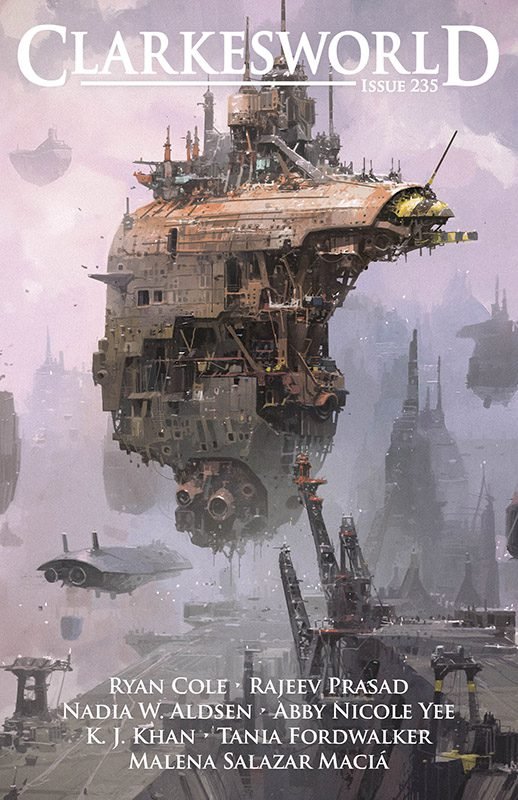
Narrated entirely in the clipped, clinical voice of an alien researcher named Hecrimona, “Human Studies 401” unfolds as a set of research notes documenting one of the most coldly monstrous acts in recent speculative fiction: the deliberate seduction and destruction of a human subject in the name of academic ambition. The story’s genius lies in its form — the confessional lab report — which keeps the narrator’s monstrousness at an ironic remove even as the full horror of what she has done accumulates, line by line, across five pages.
Hecrimona is a student from the galaxy Mardeoptra, engaged in what amounts to a xenoanthropological thesis on human behavior, specifically on the question of whether humanity’s unique susceptibility to romantic love represents a fatal evolutionary flaw. Her specimen is Efren Vargas, a man she selected not at random but by hacking the assignment system — he alone possesses a rare nascent ability to consciously regulate his own neurochemistry, an evolutionary leap that makes him, theoretically, capable of resisting even the most powerful emotional manipulation. He is engaged to Joan Dimagiba, his girlfriend of nine years. He is, in short, the perfect test case.
To corrupt him, Hecrimona engineers Eva, a synthetic human woman assembled from black-market organic material and calibrated in every detail — appearance, pheromones, behavioral patterns, emotional resonance — against the unfiltered contents of Efren’s own subconscious, which Hecrimona has been covertly reading. Eva is not merely attractive; she is the literal embodiment of Efren’s deepest desires, a figure conjured from his dreams and dropped into his waking life. Hecrimona also deploys a chemical love formula that seeps from Eva’s pores, a concoction potent enough that she later sells it to a human historian for two million Klaruveps.
Efren resists for two years — a fact the narrator grudgingly admires. She even confesses to rooting for him in some small, private corner of herself. But the experiment is rigged from the start: when the thing dangled before you is not merely beautiful but is precisely the shape of your own unconscious longing, resistance becomes philosophically impossible. Efren succumbs. He leaves Joan. He wins nothing.
Hecrimona wins the Best Thesis Award and earns a scholarship to Pectaadi University, the finest institution in the neighboring galaxy. The story doesn’t end there. Four hundred years later, the Vadenii government — Hecrimona’s people — deploys a chemical love bomb derived from her research, rendering all of humanity euphorically, passively extinct. They die not in war but in a rapture of manufactured feeling, too blissful to eat, too consumed to survive. Hecrimona frames this as pest control: humans were becoming technologically threatening and were, in her view, dispensable.
The story’s final image is its most devastating. Hecrimona keeps Efren alive in a jar on her desk as a keepsake — a preserved, rotten souvenir. She catches him mouthing Eva’s name, voicelessly, his face wearing the look of love. The story is a precise and savage fable about instrumentalization: of people, of feeling, of entire civilizations. Love here is not transcendence but vulnerability — the one lever that, once found, can unmake even the most evolved among us.

Abby Nicole Yee (she/they) is a Filipino neurodivergent writer of speculative fiction and poetry born and based in Cagayan de Oro. Her work can be found in Penumbric, Clarkesworld, Philippines Graphic, among others, and has been longlisted in the YA OPEN contest by Voyage YA/Uncharted Magazine. She is currently taking up Complete Weirdo and Conduct (Creative Writing) at University of the Philippines Diliman. When not writing your problematic faves, she’s squinting at the world at large, or trying to make sense of some astonishing absurdities, like her fried cheese brain. Find links to her other work at abbynicoleyee.com.