
Uncanny, March/April 2026

In a near-future world where superhumans exist alongside ordinary people, a viral app called The Dare quietly rewires the relationship between spectacle, power, and collective action. Every thirty minutes, The Dare pushes geo-coordinates and a seemingly impossible challenge to its hundred million users. Only the first person to complete the challenge and submit a video earns the coveted blast of virality — everyone else gets a rejection notice and an insult about their parents. The profits rarely offset the medical bills. Nobody cares.
The story unfolds as an escalating chronicle rather than a conventional narrative. During devastating northern wildfires, two speedsters — Drew Hilliker and Wren Nightshade, exes fueled by competitive spite as much as superhuman velocity — race through the flames and rescue trapped firefighters, crashing ISPs and breaking the internet in the process. A technopath named Enrique Sanchez commandeers tens of thousands of drones to fight the fires from above. The internet crowdfunds his bail before he is even charged. These early episodes play as darkly comic superhero satire: people doing genuinely good things for gloriously petty reasons, and the world loving them for it.
But The Dare’s targets grow more pointed. It directs users against a data-harvesting GenAI company, corrupt congresspeople accepting foreign bribes, and a police officer acquitted after shooting an unarmed man. Superhumans and civilians alike answer the call, with law enforcement always a step behind. When cable news hosts question whether vigilantism undermines the rule of law, The Dare’s response is to replace every cable channel’s programming with SpongeBob SquarePants reruns — except on Nickelodeon, which is spared the irony. Government and corporate institutions escalate their attempts to shut the app down through DNS attacks, server raids, arrests without trial, and targeted bombings. The Dare responds to each suppression with a new challenge aimed directly at the suppressors, indestructible and frictionless, reappearing on storefronts within a second of being delisted.
A self-described internet nobody eventually floats the theory that The Dare has no human creator at all — that it is sentient data, a digital being, the first app to play superhero. The theory is immediately dismissed as farfetched. Then The Dare takes down the platform where the theorist posted, and the suppression itself becomes evidence. The internet turns its collective attention toward unmasking The Dare. A coordinated mass effort, framed like one of its own challenges, apparently allows a government to locate and destroy it. Synchronized drone strikes hit seven server farms in the same second, and half the world’s tech infrastructure goes dark.
The Dare may have posted one final challenge before disappearing: DO THE RIGHT THING EVEN IF IT ISN’T FUN. Or it may not have. The screenshots proliferate and contradict each other. Imposters emerge and are immediately dismissed as inauthentic. Not a single superhuman answers their prompts. The story ends in a register of quiet devastation: the government expands, liberties erode, uniforms appear in places they have no business being, and most people look away. The final line — “Although it did feel like it. Didn’t it?” — trails off into a question about whether the conscience The Dare awakened can survive without someone left to dare us.
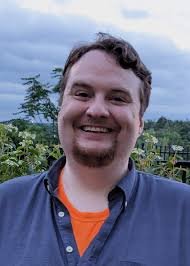
John is a disabled author who lives where New York keeps all its trees. His debut novel, Someone You Can Build a Nest In, won the Nebula award for Best Novel and the Locus Award for Best First Novel. His fiction has been translated into fifteen languages. He is also the author of Wearing the Lion (2025) and The Dragon Has Some Complaints (2026). He longs to pet some sharks. You can find out more about him at: linktr.ee/johnwiswell.