
Uncanny, March/April 2026
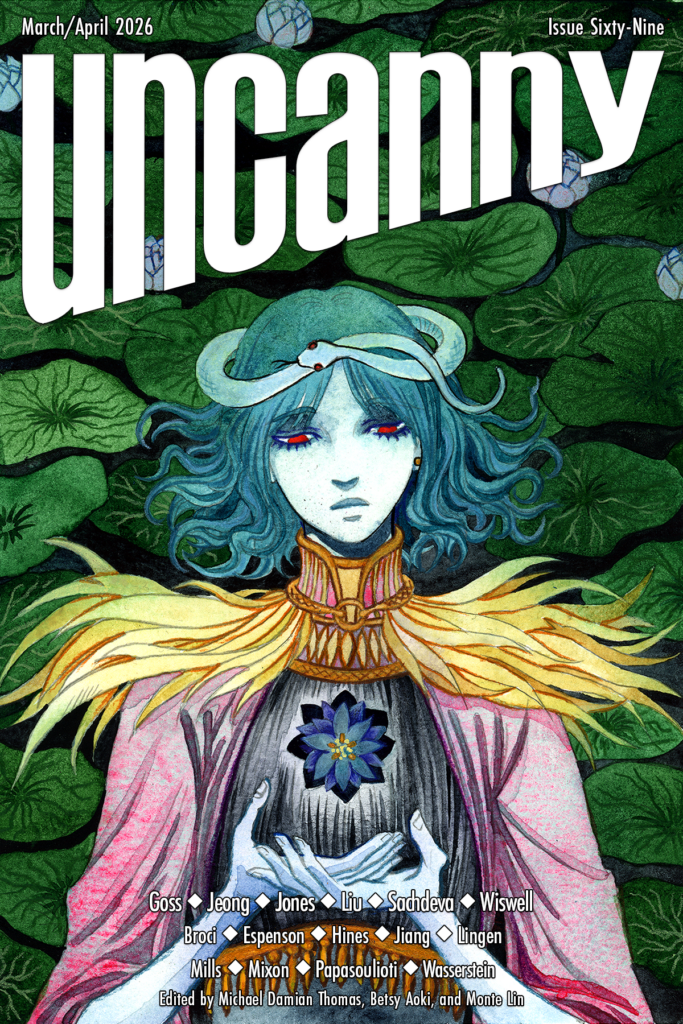
The story is narrated by an American academic on sabbatical in Budapest, researching changes in the Hungarian educational system in the post-Soviet era. One spring morning, she witnesses a tiny, eccentrically dressed elderly woman — layered in mismatched winter clothing despite the warm season, white hair hanging loose and unbrushed — calmly pull a blooming hosta out of the planter in front of her apartment building and tuck it into a plastic shopping bag. Unable to confront her in Hungarian and too startled to act, the narrator watches in disbelief as the woman toddles away.
What begins as a single odd sighting becomes an obsession. The narrator spots the old woman again and again — stealing periwinkles from the park around the National Museum, Alchemilla and violas from Károlyi Kert — until, invoking Kipling’s elephant’s child as her self-deprecating avatar, she begins deliberately trailing her quarry through the soot-covered streets of Józsefváros. The pursuit culminates in the narrator following the woman into a crumbling courtyard building, where she discovers the mystery’s solution: the entire third-floor balcony has been transformed into an impossible, riotous garden, every species in simultaneous improbable bloom, clematis vines cascading down toward the floor below.
The deeper strangeness surfaces when the narrator lingers. The woman who emerges to water the garden is dressed identically — same jeans, same white hair — yet moves with the strength and fluidity of someone decades younger, tending each plant with birdlike attentiveness. The narrator cannot reconcile what she sees: the same person, but somehow young. She files the contradiction away and, on a coffee date with her friend Dr. Szabó Magda, an archaeologist at the National Museum, recounts the whole episode — including her observation that plants flowering out of season all at once is not how gardens work.
Magda is intrigued. She leads the narrator into the museum’s restricted storage vaults, past Turkish armor and Habsburg relics, to a dusty corner of Roman Pannonian statuary, where she retrieves a small, crudely fashioned terracotta figure: a provincial rendering of Flora, goddess of flowers. The statue’s crucial feature is that it has two faces — one young, one old — back to back, unlike any other known Flora statue in the Roman world. Magda theorizes that the Romans, arriving in the Carpathian Basin, simply overlaid their goddess onto a pre-existing local deity: a seasonal garden goddess who cycled through youth and age, bloom and decay, perhaps endlessly.
The story closes with the narrator’s quiet, open-ended acceptance of ambiguity. Before leaving Budapest, she leaves a bag of purchased flowers — pansies, pinks, hyacinths — outside the woman’s balcony door as either a neighborly gift or an offering to an ancient power. Back in New Hampshire, resuming the eternal rhythms of academic life, she finds herself smiling at the memory of the woman scuttling through the city streets, eighty or perhaps eight thousand years old, still gathering flowers. The old gods, the narrator reflects, may not have entirely vanished from the earth after all.

Theodora Goss is the World Fantasy, Locus, and Mythopoeic Award-winning author of the Athena Club trilogy of novels, starting with The Strange Case of the Alchemist’s Daughter. Her other publications include several short story and poetry collections, including Snow White Learns Witchcraft, The Collected Enchantments, and Letters from an Imaginary Country. She has been a finalist for the Nebula, Crawford, and Shirley Jackson Awards, as well as on the Tiptree Award Honor List. Her work has been translated into fifteen languages. She is currently a Master Lecturer in Rhetoric at Boston University. Visit her at theodoragoss.com.