
Augur Literary Society, #8.3 November 2025
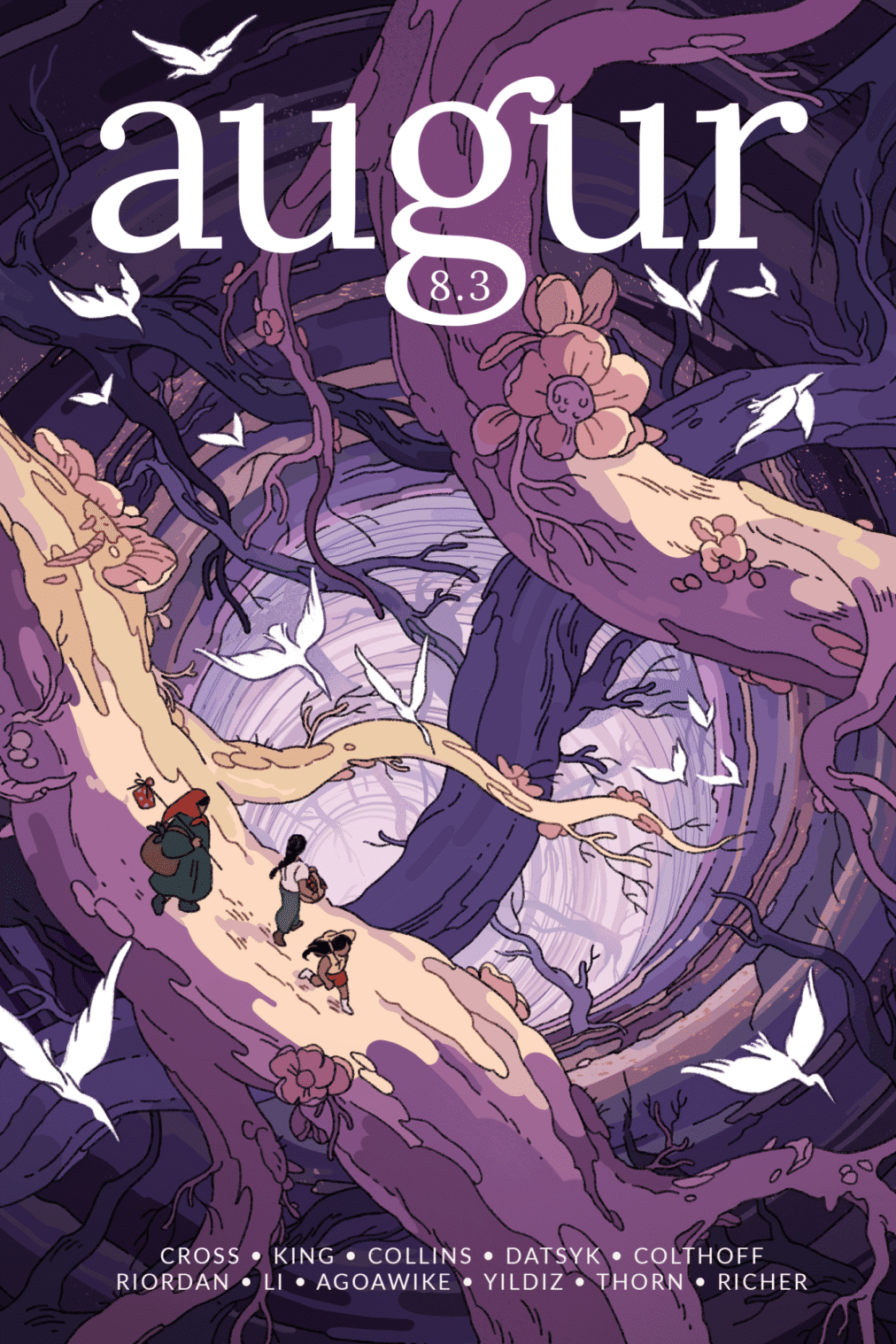
In an unnamed mountain town bordered by dense forest, a class of second graders is supernaturally summoned into the woods during recess. The forest calls to them through instinct—rustling through their bodies, whispering of fruit, quickening their pulses—until, before they can fully comprehend what is happening, they transform into animals and lose all memory of their human lives. The town is devastated. For four years, parents search obsessively, scanning the tree line with binoculars, following animal tracks, refusing to hunt or trap or fish lest they harm a child in disguise. The butcher closes. The steakhouse empties. The community splinters between those who grieve openly and those who quietly urge moving on.
Dinah is a third grader at the time of the disappearances—too old to be taken, too young to fully process the grief surrounding her. Her family stays whole, which isolates her in its own way: she watches classmates mourn while yearning to announce her own birthday. Now thirteen, she is dealing with a different kind of transformation. Born with a defective heart, she has just received a transplant—a bear heart, harvested from an animal found dead in the forest. Her parents hesitate before consenting, haunted by the same fear the town has carried for years: What if she becomes like them?
The answer, it turns out, is something. After her surgery, Dinah grows restless at dusk, craves berries and beetles, hears frequencies others can’t detect, and loses interest in the curated digital world she once found compelling. She smells emotions. When she returns to school, the classroom celebration staged for her triggers something low and primal in her throat—a sound she chokes back. She gravitates away from her old friends and toward the returned sixth graders, the children who came back from the forest four years older, feral, and forever altered. They communicate in glances and touch, nibble bark, and carry the forest’s logic in their bodies.
Among them are Lillian, who misses the pack she ran with as a pup; Charlie, who now rubs against trees to scratch his sides and fears loving his mother; and Shireen, who slept alone in thickets and ate feathers and entrails, and has outgrown daughterhood entirely. When Dinah lingers at the edges of their group, Lillian bluntly invites her in. The sixth graders are planning to return to the forest—simply by walking back in. Shireen tells Dinah with quiet certainty. That night, Dinah lies awake feeling the earth vibrate beneath her, her body thrumming with nocturnal awareness, instinctively knowing how to survive in the wild.
The story’s final scene is its most charged: Dinah watches the sixth graders circle the schoolyard perimeter in animal silence, then disappear into the trees—some dropping to all fours as they go, their faces lit with joy and relief. Without consciously deciding to, Dinah calls out “wait”—and then runs after them, away from the school bell and toward the forest, following the bear heart in her chest toward the life it already knows.

Ev Datsyk (she/her) is a cat lover and storyteller, in that order. Her work has appeared in Augur Magazine, Bloodletter Magazine, Flame Tree Publishing, and elsewhere. Her story “Limerence” was nominated for the Pushcart Prize in 2025.
As a queer, second-generation settler living on the land known today as Canada, Datsyk draws from her own experiences and perspectives to inform her work. All errors are hers, and terminology, etc. are intended with respect.