
Apex, February 2026
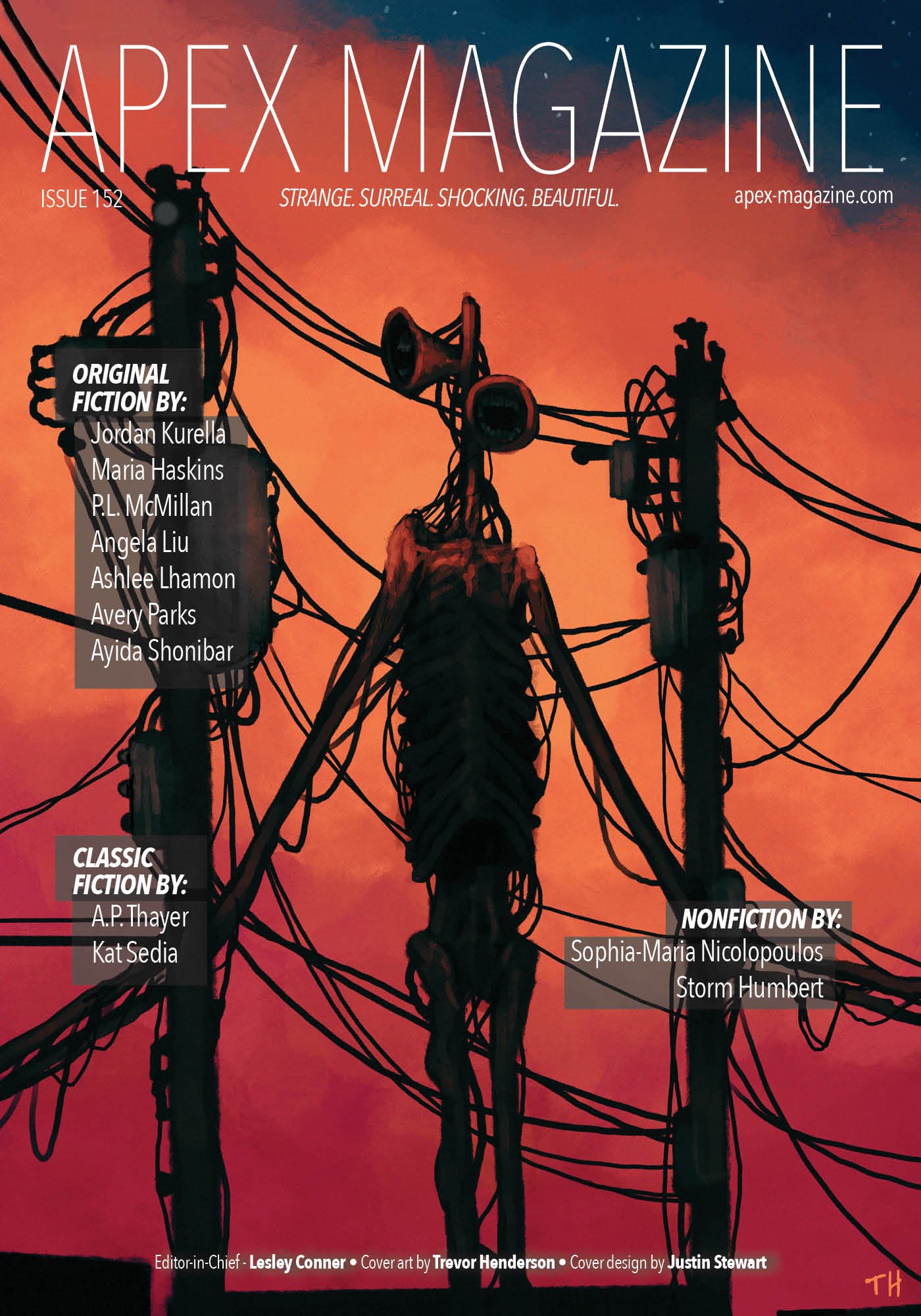
In a dystopian reimagining of the Hundred Acre Wood, Piglet is a long-haul trucker employed by Kanga Corp, the corporate empire that Kanga has built in the wake of Christopher Robin’s departure. He wakes hungover after a job with Roo, his memories chemically suppressed, and makes his way to check on Pooh — a routine he maintains out of quiet, guilty devotion. When he arrives and finds Pooh’s home in disarray — broken furniture, blood on the wall, a smashed honey pot — he knows something terrible has happened, and that Pooh did not leave of his own accord.
The story unfolds across two alternating perspectives. In interleaved scenes, Kanga presides over her compound with cold authority, wielding a cattle prod and nursing both tea and grief. She is the Wood’s de facto ruler, a figure of methodical cruelty who remembers everything — including the old prank in which Pooh, Piglet, and Rabbit kidnapped baby Roo and hid Piglet in her pouch, a grievance she has never forgiven. Her emotional life is defined by the loss of Christopher Robin, a wound that has curdled into control and violence. She has arranged what she calls a “party” for Pooh — in reality, a trap.
Piglet, panicking and still half-drunk, runs through a Wood rendered almost unrecognizable by Kanga Corp’s development projects — felled trees, leveled hills, creatures dispossessed from their homes. He ends up at The Rabbit Hole pub, where Rabbit nervously serves him pints and Owl sleeps in senile oblivion, evicted from his tree like Eeyore before him. Roo arrives, looming and menacing, and warns Piglet off the search. But as Roo leaves, the drugged amnesia lifts and Piglet remembers the job: a two-day drive to the coast to collect three heffalumps from a ship, creatures intended as Kanga’s instrument of revenge against Pooh.
Realizing what he has done — delivered Pooh into Kanga’s hands — Piglet races to the Kanga Corp compound. He finds the gate locked and falls to his knees in the rain, screaming for Christopher Robin in a moment of raw desperation before accepting that the boy is never coming back. What saves him is not rescue but resolve: the CR, his beloved truck, is still parked in the lot. He rams the gate open with it — breaking the rig he loves — and drives inside.
The heffalumps have already broken loose, and the compound is in chaos. Piglet finds Pooh battered but alive in the wreckage of Kanga’s mansion, singing softly to himself, confused about the party that never materialized. Piglet presses the small jar of clover honey into his paws. As they flee to the CR, the heffalumps stream past in pursuit of Kanga and Roo, and Piglet glimpses Eeyore — feral and laughing — trailing in their wake. In the moment one heffalump meets his eye, Piglet recognizes not a monster but a fellow prisoner finding its way free.
The story closes with Piglet driving Pooh home through a golden evening, the dented CR still rumbling steadily. When Pooh asks what’s for breakfast, Piglet laughs — not from relief alone, but from something harder won: the understanding that whatever comes next, a Wood where heffalumps roam free and old tyrannies lie in ruins, he is no longer afraid of it.

Maria Haskins is a Swedish-Canadian writer and translator. She writes speculative fiction and poetry, and currently lives just outside Vancouver with a husband, two kids, and a very large black dog.
Her work has appeared in Black Static, Beneath Ceaseless Skies, Flash Fiction Online, Shimmer, Cast of Wonders, and elsewhere. Find out more on her website, mariahaskins.com,