
Beneath Ceaseless Skies, February 2026
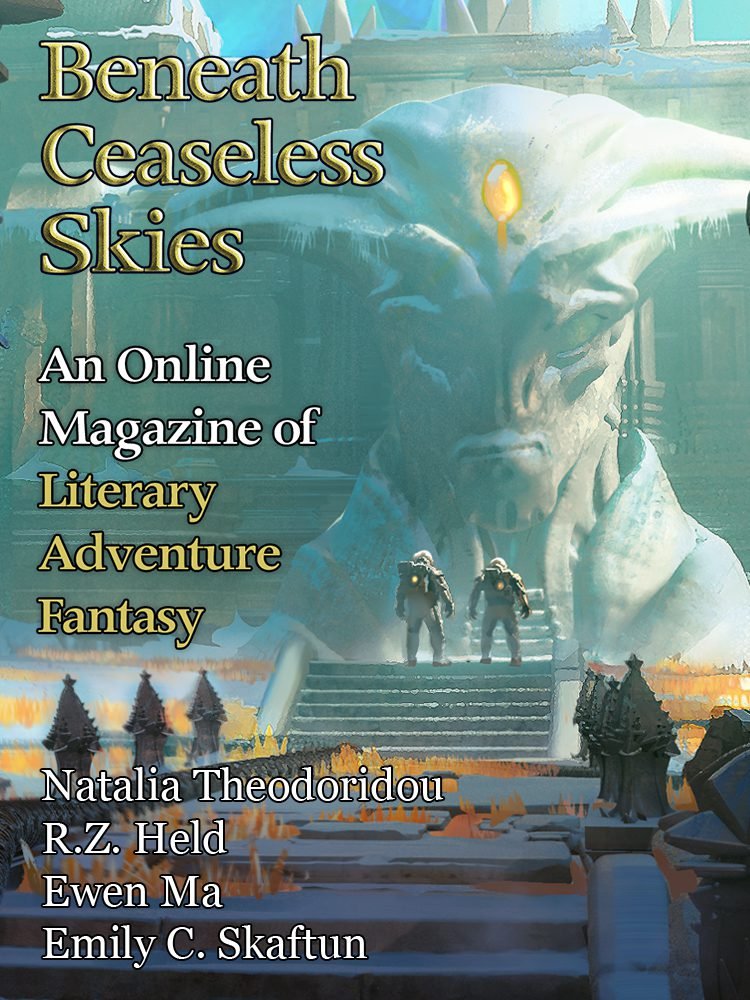
This science-fantasy novelette weaves together two parallel narratives across vastly different eras, united by a single devastating premise: parents who sacrifice their children to appease a war god’s demands.
The contemporary storyline follows Sel, a gender-nonconforming young adult living in the Cerulean Palace on the world of Galador En. Child of the powerful Mercantile-General, Sel has always been an outsider to political life — preferring the company of exotic animals in the palace menagerie to the performative rituals of diplomacy. When their father returns from successful trade negotiations with the Laqsin Confederacy, Sel happens to be the first creature to emerge through the menagerie’s accidentally open gate. Bound by a vow he made to the Jealous God — a deity who devoured his divine siblings and now demands absolute fealty — the Mercantile-General is obligated to sacrifice whatever emerged first through that gate. That creature is now his own child.
Granted thirty days of seclusion to “sanctify” themselves before the ceremony, Sel summons an AI imprint of Ifyri of Meidithuy, a historical figure from millennia past. Ifyri was a devoted cleric of Anicu, god of small rituals and careful record-keeping, renowned for her diplomatic and bureaucratic genius. Sel hopes to find comfort or guidance in this reconstructed consciousness — someone who might truly understand their situation.
The second narrative reveals why: Ifyri’s own story is hauntingly parallel. Summoned to the war-torn world of Pothe Eän under false pretenses by her parents, Ifyri discovers she has not been called to negotiate a peace treaty but to serve as a human sacrifice — offered by her father to Varche, god of war, to atone for a destroyed shrine. Locked in a prayer chamber to await her execution, Ifyri rails against her fate with ferocious, tragic dignity. Unable to escape, she uses her remaining time to write a radical philosophical manifesto in the margins of a prayer book, ultimately scratching her final words in her own blood when the ink runs dry. Her argument — that humanity existed before the gods and will outlive them, and deserves to remake itself worthy of better divinity — is found by her father, who burns it with her body, believing it destroyed forever.
Back in Sel’s timeline, facing their own imminent sacrifice, they make a similar choice. Unable to physically escape, they smuggle their own heretical writings to Tildaai, their father’s most trusted counselor and Sel’s closest ally. The writings carry the same essential idea Ifyri reached independently centuries before: that the gods are not permanent, that change is possible, that those who survive must carry the work forward. When Tildaai warns that only a god can kill a god, Sel offers their final, quietly revolutionary correction — only a god has killed a god so far.
The story is a meditation on sacrifice, legacy, and resistance, suggesting that martyrs don’t change the world directly — they change the people who outlive them.

Aimee Ogden is an American Nebula- and Eugie Foster Award-nominated speculative fiction writer living in the Netherlands. Her first two novellas, “Local Star” and Nebula Award Finalist “Sun-Daughters, Sea-Daughters” debuted in 2021, and her short fiction has appeared in publications such as Lightspeed, Clarkesworld, Analog, and Beneath Ceaseless Skies.