
Lightspeed, March 2026
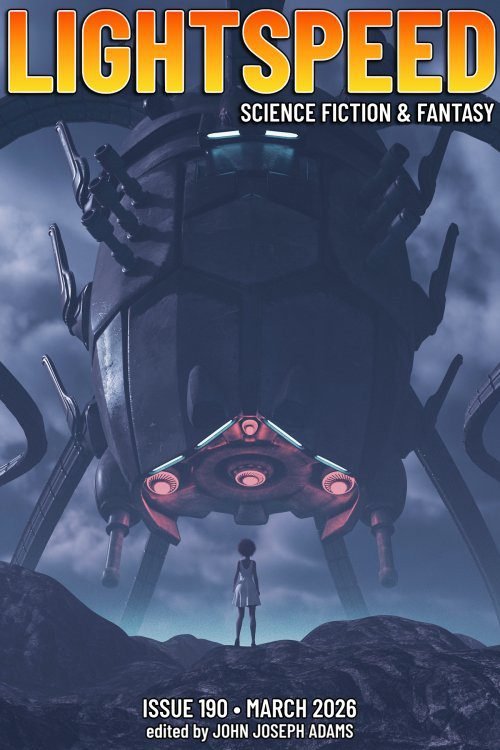
Espie Droger is a young data engineer working in a subbasement office of a government Procurement and Logistics building, surrounded by moldering cardboard boxes and lit by a single fluorescent tube. He takes quiet pride in his work — untangling vast spreadsheets and optimizing logistical systems for a government waging what he tells himself is a necessary war against enemies within. He is efficient, unsung, and largely alone, lying to colleagues about his social life while spending weekends on takeout and video games. His superiors praise him. He sleeps easy, or tries to.
But Espie keeps waking into visions of another life: an old, guilt-hollowed man on a private Maine island, where the ocean has risen and the snow never comes and the only visitor is a weekly mailboat. These intrusions feel like nightmares born of overwork, and Espie dismisses them — until the visions begin bleeding into his waking hours, and a figure from them starts appearing at the edges of his present.
That figure is Lieutenant Major Ursula Ghauri, a brown woman in a heavily decorated military uniform, who materializes at the foot of the old Espie’s bed to deliver a verdict. She represents the Temporal Council of War and the New Terran Governing Corpus, a future world government formed after a global nuclear war. She has come to execute a sentence called spotchkai — “life attenuation by gradual reality diminishment” — an asymptotic punishment in which consciousness is not extinguished but endlessly attenuated, forever reliving its crimes in diminishing loops. Espie, she informs him, has been found guilty of responsibility, direct and indirect, for more than eleven million deaths — his government’s chief data engineer, whose cost-cutting orders denied medication to prisoners, cut water filtration to internment camps, and starved inmates by rescinding food deliveries.
Ghauri’s confrontation with Espie unfolds across collapsing layers of time: beach and basement, lounge and ashen wasteland, her poisoned future world where cancer is universal and the sky glows ultraviolet. She names the dead with deliberate specificity — an oncology nurse, a fifteen-year-old girl with disabilities, her own grandparents — pressing each name against Espie’s insistence that he only moved numbers. The horror is not spectacular cruelty but bureaucratic complicity: Espie never pulled a trigger. He just signed footnotes and streamlined systems and went out for expensive Scotch on the government’s tab.
The story’s pivot comes when the younger Espie, back at his basement desk and newly broken open by all he has witnessed, grasps that the deeper war — not the government’s war but a war against the system he has built — can be fought from exactly where he sits. He has total system access. His superiors trusted him completely. In a few keystrokes he erases months of work and all its backups, collapsing the infrastructure he helped construct. Ghauri appears one last time as shadow and voice, warning him of the shame and execution that will follow — and acknowledging that her own timeline, her daughter, her entire existence, will be unmade by what they are doing together. They press Enter as one.
The story closes with Espie alone in the dark, waiting to be arrested, caught inside the same loop the opening described — still dreaming, still attuating, the lightning flash of his life neither ending nor escaping, only diminishing. Kressel builds his indictment of systemic evil with quiet, relentless precision: the real horror is not the man who dreams of war, but the man who never thought he was fighting one.

Matthew Kressel is a multiple Nebula and World Fantasy Award nominated author and coder. His many works of short fiction have appeared in Analog, Asimov’s, F&SF, Lightspeed, Clarkesworld, Reactor, Beneath Ceaseless Skies, and many other publications and anthologies, including multiple Year’s Bests. His most recent books are: The Rainseekers (Tor.com, Feb ’26), Space Trucker Jess (Fairwood Press, July ’25), and his short story collection Histories Within Us (Senses Five Press, Feb ’25). Alongside Ellen Datlow, he runs the Fantastic Fiction at KGB reading series in Manhattan. He co-hosts The Nerd Count podcast with Mercurio D. Rivera. And he is the creator of Moksha, the submissions system used by many of the largest publishers today. More at matthewkressel.net.