
Lightspeed, February 2026
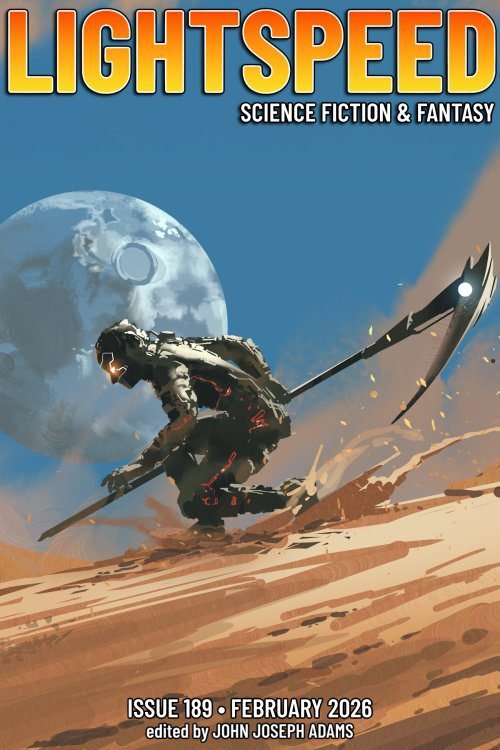
“Dream Destinations” is a work of speculative fiction framed as a travel guide to impossible, surreal locations on a mysterious eighth continent that has suddenly appeared on Earth. The narrator — written in the collective “we” voice of guidebook writers — acknowledges the absurdity and danger of their task while remaining committed to documenting these dreamlike destinations for would-be travelers. The continent itself behaves like a living creature, disappearing beneath the ocean and reappearing elsewhere, making every journey to it an act of faith.
The first destination, the Emporiums of Sonom, is an island shrouded in permanent fog where travelers drink a milky potion and enter vivid shared dreamscapes. The cost, however, is psychological: visitors return home haunted by strangers who feel like intimate acquaintances, their waking lives forever blurred with their dream lives, compelling them to return again and again to settle debts they can never quite repay.
The Hotel Androga, built in 1634 by a heartbroken prince, carries centuries of grief within its walls. Despite modern renovations and fine dining, guests find themselves overcome by a creeping melancholy — gazing at their children and already mourning their departure, unable to reach for their loved ones, leaving the hotel convinced their lives have been largely wasted.
The Mountains of Montblau offer a more transcendent, if equally melancholy, experience. Monks play enormous crystalline instruments called ooradin, breathing continuous notes that conjure entire cities into existence — full of lovers, children, candlelight, and rain. When a monk dies, his city dies with him. The piece mourns the temple’s decline as young people abandon the monastic life for modern ambitions, and the music — and the worlds it sustains — slowly falls silent.
The Artists of Snee paint on rainy days along a riverbank, their canvases depicting the futures of the very tourists watching them. Visitors see themselves in moments of joy yet to come — love, friendship, sunlit afternoons — before the artists pack up and leave, and the traveler walks away alone, returning to a life that now feels like it exists inside a painting.
The Gardens of Élani appear to be a paradise conjured overnight by a mysterious builder, but harbor a sinister trap: falling asleep in the central field transports visitors to Thlax, a dim underworld city from which no one ever escapes. The guidebook writers themselves confess to being permanently stranded there, watching the living world through a pane of fogged glass.
Finally, the Beaches of Masipora are a pure mirage — an unreachable desert illusion populated by beckoning, welcoming strangers. Despite knowing it is a trick of heat and light, the guidebook writers confess they walked toward it anyway, and some were lost. Those rescued cannot shake the feeling that another, richer world pulses just beneath the surface of ordinary life, forever calling them closer.
Taken together, the destinations form a meditation on longing, loss, and the seductive danger of places — real or imagined — that promise more than the world we already inhabit.

Alexander is the founder and Director of the Martha’s Vineyard Institute of Creative Writing and the author of the short story collections, Universal Love and Children of the New World, which was chosen as a New York Times Notable Book of the Year, and a best book of the year by NPR and Electric Literature. His fiction has appeared in Best American Science Fiction & Fantasy and Best American Experimental Writing. His short story, “Saying Goodbye to Yang,” was adapted as the film After Yang by A24 Films, and was the recipient of the Alfred P. Sloan Prize at Sundance, the Boston Society of Film Critics Award, and Barack Obama’s Best Films of 2022.