
Reactor, March 2026
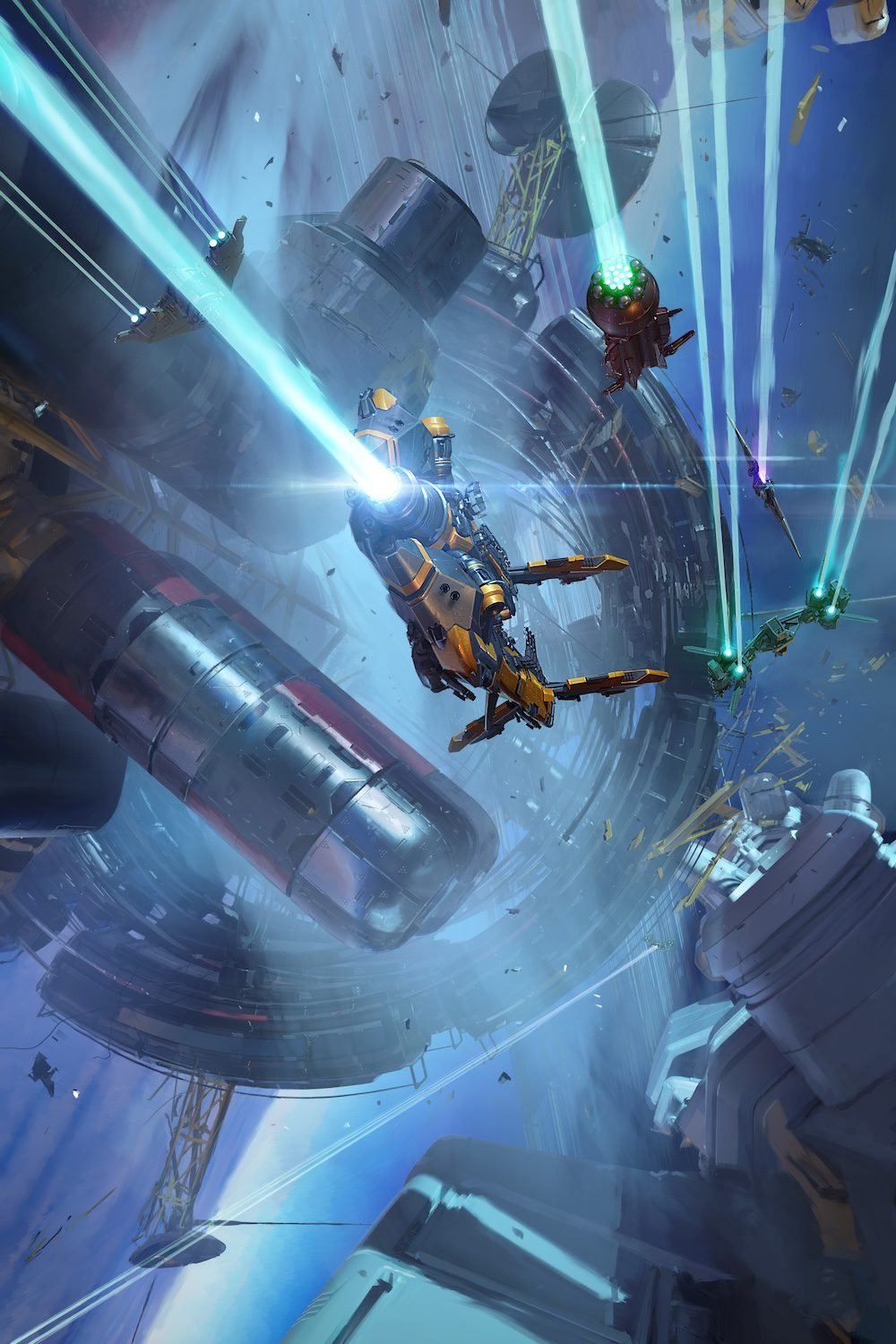
In the interstellar war between the nation-states of Hausse and Lyonesse, spacecraft have long been piloted by “deuces” — artificial intelligences so costly to develop and integrate that they are nearly as expensive as the ships themselves. When a series of ships lose their deuces in combat, Hausse military command makes a cold calculation: it is cheaper to refit the vessels for human operation than to train new AI pilots. The result is a small, mismatched squadron assembled from data analysts, historians, fashion designers, a marine, a geneticist, and others deemed expendable enough to staff this experiment. Their commanding officer is Captain Diadra, a data operations veteran who understands better than anyone that her people are an economic workaround rather than a military asset.
The story is narrated by Vaughn, one of Diadra’s pilots, and unfolds as a compressed chronicle of the squadron’s training and combat experience. Under Diadra’s exacting command at Base Flamberge, the pilots spend months in flight simulations, learning momentum, inertia, and the brutal calculus of space combat. Distinct personalities emerge and crystallize into callsigns: Harikawa becomes Esprit for his reckless brilliance; Becker becomes Lorelei for her gift at playing bait; Latkiewicz becomes Scalpel for his surgical calm; Vaughn earns the name Centurion for his knowledge of dead languages. They nickname their carrier Whiplash, after Diadra’s tongue. The training sequences are vivid with both camaraderie and dread — the pilots bet against their own survival, wake from nightmares clutching phantom control boards, and gather at viewports to stare at a nebula as though peace might be visible from the right angle.
When the squadron is pitted against actual deuces in combined exercises, they are comprehensively defeated, confronting the full gap between human reflexes and machine precision. Diadra redirects them: rather than trying to match deuces, they must exploit human unpredictability — asymmetric tactics, randomized macros, guerrilla approaches that even their AI opponents find difficult to anticipate. This reframing transforms the squadron from a liability into something genuinely strange and hard to counter.
Combat at the front is rendered in fragmentary, impressionistic strokes. Deaths accumulate: Ferrine first, then Chinua and Peter, then Candace. In the third and most brutal engagement, Diadra herself is killed executing a maneuver of extraordinary violence and precision — a last salute, a human gesture in a war that has nearly ceased to have any. The surviving pilots, stripped of their captain but left her hidden maps and contacts as a final gift, make the decision to desert, transmitting an open message to both sides inviting any who are willing — Hausse, Lyonesse, human, deuce — to leave the war behind and head for unexplored space.
The story’s quiet revelation is that Lyonesse, too, has been cutting corners — fielding human soldiers because it also cannot afford enough deuces. The war grinds on not from conviction but from institutional momentum, no one able to remember its origins. When Vaughn broadcasts his invitation, the Lyons hold their fire and let the deserters through. The Hausse deuces salute them as they go. The title works on every level: as military slang, as bureaucratic cynicism, and finally as a kind of unintended grace — a shortcut taken for the worst reasons that opens, improbably, toward something like hope.
Yoon Ha Lee is the author of Ninefox Gambit, which won the Locus Award for Best First Novel and was shortlisted for the Hugo, Nebula, and Clarke awards; its sequels, Raven Stratagem and Revenant Gun, were also Hugo finalists. His middle grade novel Dragon Pearl won the Mythopoeic Fantasy Award for Children’s Literature and was a New York Times bestseller. He lives in Louisiana with his family and a very lazy catten, and has not yet been eaten by gators.