
Kaleidotrope, April 2026
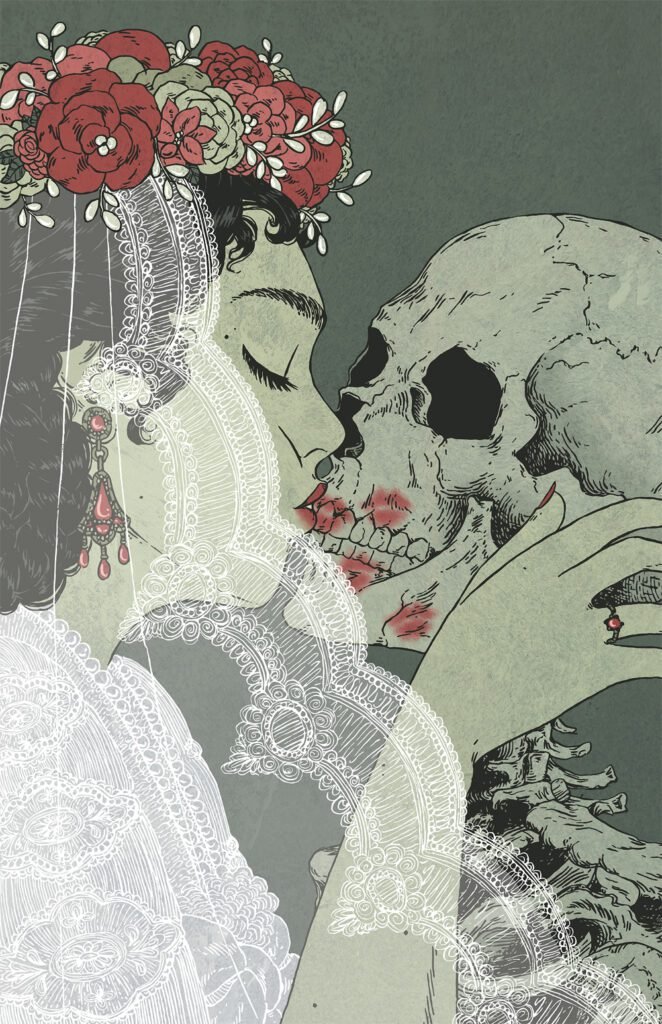
The story is structured as a pseudo-scholarly dossier, narrated by an unnamed collective of researchers — scientists or academics of some institutional authority — who are piecing together the life of a woman known as Ma’anu Wei, born Dena Mann. Their account is fragmentary by necessity: almost all documentary evidence of Dena’s life was destroyed, either by her father’s habitual erasure or by the fire that eventually killed her. What the researchers possess is her handwritten journal, discovered sewn into the lining of a smoke-damaged bedroll that survived the blaze along with her son. The story alternates between the researchers’ dry, clinical prose and italicized passages from the journal itself — lyrical, parabolic, sometimes ecstatic — creating a sustained tension between the rationalizing voice of institutional knowledge and the visionary interior life it can never quite contain.
Dena Mann was born in the same hour her mother died, and raised by her cold, pious father Rene Mann in an unnamed religious tradition of deliberate obscurity. Enrolled at fourteen in a strict religious boarding school for girls, she was a poor student but a fervent believer, repeatedly — and unsuccessfully — applying to an overseas pilgrimage program open only to honors students. In her final trimester she arranged the trip herself, without sanction. In the holy city of her faith’s forefathers, during a spring festival called an “outdooring” — a ceremonial first public appearance of newborn children — Dena wandered into forbidden proximity to the men’s celebration hall and was raped by a man she had trusted as a co-religionist. She fled in a stolen canoe, was nearly lost at sea, and washed ashore on an island whose inhabitants communicated entirely through hand gestures, without spoken language.
On the island, Dena was renamed Ma’anu Wei — a term coined to mean something like “Them,” an outsider who is neither wholly present nor absent, a joining of us and not. She spent roughly two years there, living with a young man she describes in her journal in near-mythic terms, as a creator-figure whose hands spoke the world into being. Objects on the island existed not through possession or naming but through a continuous act of gesture; nothing was owned, nothing feared as perishable. No one died. Ma’anu Wei bore a son — his paternity deliberately left ambiguous by the text — and became convinced the child was the island’s gift, immune to death. She eventually understood that her own presence was corrupting the island’s language, causing words to fall from the young man’s hands like physical things. To protect the island from the contagion of naming, she left, carrying her promise: the child would live only by hand, never by mouth.
Back at her father’s house, Ma’anu Wei communicated solely through gesture and refused all explanation. Rene Mann, violent and uncomprehending, eventually set fire to the house. Ma’anu Wei died in a locked closet, her son in her arms — but the boy survived the blaze entirely unharmed, bearing not a single burn. The researchers, who have taken custody of the child, are convinced he is evidence of something unprecedented: a hidden people, possibly immortal, certainly uncontacted, who represent a final frontier for science and perhaps a solution to the world’s scarcity and disease. Their appeal for resources and expedition rights closes the dossier.
The story’s formal brilliance lies in its ironic layering. The researchers are clearly unreliable — colonialist, reductive, condescending toward Ma’anu Wei’s “fanciful scribblings” even as they depend entirely on her testimony — while the journal passages they dismiss as delusion are the story’s most philosophically alive writing, meditating on language, creation, impermanence, and what it means to speak a world into being rather than consume it. Schaffzin’s central conceit — that naming destroys what it names, that Ma’anu Wei’s very existence as an outsider introduces mortality into a deathless world — operates simultaneously as ontological fable, colonial critique, and elegy for the unnameable.

Eliezra Schaffzin is a recipient of the Calvino Prize for fabulist fiction (judged that particular year by Brian Evenson). Her collection of very short stories, Tiny Creatures, was published by Ethel, a micro-press. One of its tiny tales, about a tardigrade, was a finalist for the SmokeLong Quarterly Award for Flash Fiction, and another, “Triptych: Little Deities,” won the Los Angeles Review Award for Flash Fiction. Sometimes her work lies awhile in a DIY literary crypt and then undergoes a rude awakening. She wrote “Ma’anu Wei: What We Know Thus Far” in 2007. Her website is eliezraschaffzin.com.