
Beneath Ceaseless Skies, April 2026
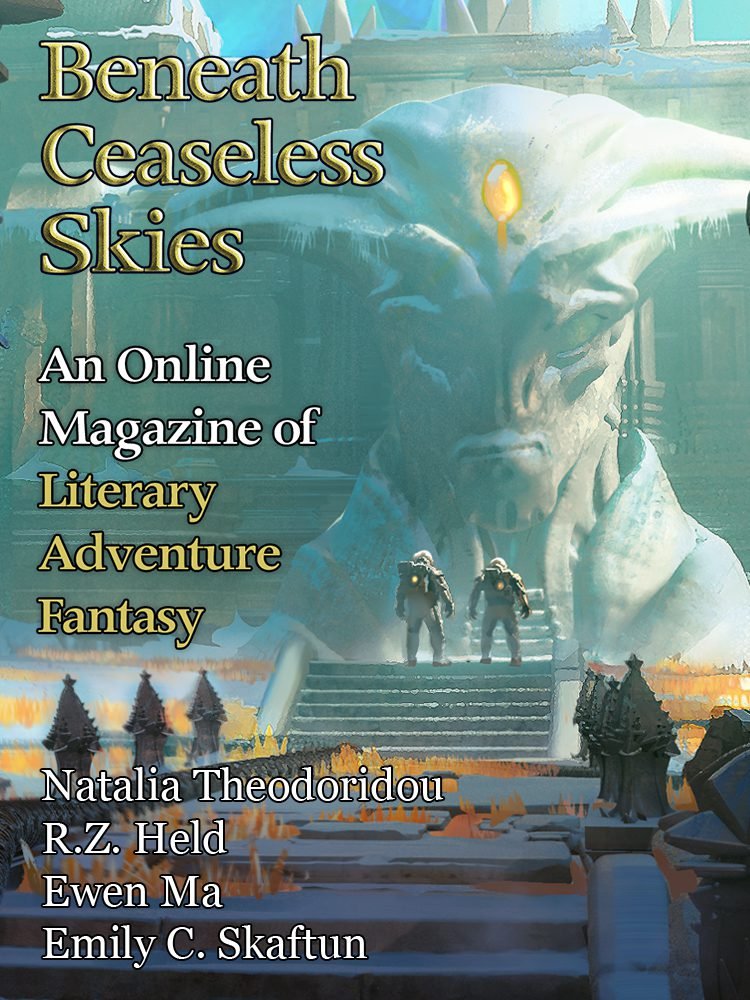
Naomi is a widow in mourning, living in the prairie village of Somerled among her husband Endride’s people. Her infant son Iovita has recently died of fever, and Endride himself was sacrificed weeks earlier — his throat cut by the chieftain, Fareld, in a ritual meant to break a devastating drought. As the story opens, Naomi sits beneath a red oak tree weaving a basket, numb with grief, while a hunting party returns led by her younger brother Isra. He has slain an extraordinary beast: a roan stag twice the size of a normal deer, with a single spiraling horn and six pale, opalescent eyes. The village erupts in celebration; the elders proclaim the gods have sent meat to sustain the people in their time of need. Naomi feels only unease. The creature matches no natural animal she knows, and old mountain legends stir uneasily in her memory.
When the day resets — inexplicably returning her to the same moment under the oak, basket reeds in her lap — Naomi realizes she alone retains the memory of what has already happened. The village, the hunters, her brother: all proceed as though the day is new. She has been caught in a time loop anchored to the stag’s death. Over the course of many iterations she tries everything she can think of to break the cycle: warning her brother, demanding the chieftain halt the feast, burning the hunting party alive in a ring of oil, shooting the stag herself, abandoning the village and walking east or west into the dark. Nothing works. Each attempt leaves a physical trace — scars, gray hair, deepening wrinkles — as Naomi ages through the endless repetitions while the village remains frozen.
The stag, she eventually discovers, is not merely an animal but a god — ancient, cyclical, one of a lineage of divine prey-beasts that has sustained countless peoples across the ages. Through visions of leopard prides and prehistoric land-ravens, she understands that the stag exists to be consumed: its willing death and the communal feasting of its flesh constitute a sacred transaction through which it is reborn, carrying the spirits of those who ate it into a vast cycle of life. The stag speaks to her plainly: all must partake for the cycle to complete and for dawn to return. Because Naomi — bound by the rules of widowhood mourning, and by her own ferocious grief and resistance — will not eat, the day cannot end.
The story’s emotional core is Naomi’s love for Endride and their son, and her terror that partaking means surrendering any hope of reunion with them. She questions the stag on what becomes of those it consumes, and it tells her that in time, the spirits shed from it are returned to the world — reborn into woods and rivers, mountains and plains. She does not know whether to believe it.
What finally moves her is not argument but exhaustion and love. In a late iteration of the day, Isra finds her by a stream and tells her something she never knew: that before Endride’s sacrifice, he had begged Fareld to take his place, to die in her husband’s stead. The revelation breaks something open in her. Old and aching across countless lost days, she allows herself to be led back to the feast. She picks up a globe of the stag’s impossible red meat, closes her eyes, and whispers to Endride to hold their son until she arrives. Then she eats, and waits.
A meditation on grief, complicity, and the terrible patience required of those who survive, “How Gods Feed” asks what it costs to remain — and what it means, finally, to let go.

Merc Fenn Wolfmoor is a queer non-binary writer from Minnesota, where they live with their two cats. Merc is the author of several short story collections and the novella, The Wolf Among the Wild Hunt. They have had short stories published in such fine venues as Lightspeed, Fireside, Nightmare, Apex, Beneath Ceaseless Skies, Escape Pod, Uncanny, and more.