
Strange Horizons, April 2026
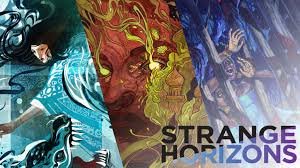
In a near-future America where Augmented Skiins™ — artificial second skins that transform one’s appearance — are as commonplace as clothing, Ogden is a young Black man defined by what he cannot have. Allergic to every aug he’s ever tried, he has spent his life watching the world glitter and shimmer around him while he remains in his plain, natural skin, deflecting the endless Question: Why are you still skiinless? His answer is always a lie. The truth is longing, deep and chronic.
Ogden channels what he cannot control — his appearance — into what he can: his body in motion. He is a virtuosic dancer, trained across styles from breaking to waacking, but the professional dance world is obsessed with the visual spectacle of augged performers, and no casting director will look twice at a skiinless dancer. He scrapes by doing motion capture for video games, his skeleton digitized and re-skinned by animators who never have to see the real him.
The story pivots around Ogden’s discovery that Laurence Laurens, a famous skiinless Black singer who has become a cultural icon of natural-skin pride, is holding a no-aug audition. For the first time, Ogden feels like the playing field is level. He dances brilliantly through multiple rounds, only to be sidelined at the final cut when the casting director begins asking about Skiin™ options for the lighting design. The job goes to a dancer with augs. The cruelty is quiet and complete.
What follows is a tender, destabilizing romance. Ogden encounters Laurence Laurens at a nightclub, where the singer intervenes when Ogden is harassed by a group of augged men. Their connection is immediate and electric. Laurens courts him with food, laughter, and an almost paternal intensity — urging Ogden to embrace the hatred directed at his skin as narrative fuel, a story to tell the world. Ogden, aching for recognition and belonging, falls hard.
The betrayal arrives in layers. First, Laurence Laurens launches a Skiin™ line of Black augmentations — the first convincing ones ever made — using Ogden’s exact complexion, his moles, his warmth, without permission. Black skin becomes fashionable overnight. Ogden suddenly finds doors opening, auditions returning calls, strangers treating him as one of their own — but only because they assume he’s wearing the new aug. The visibility is hollow. The liberation is a costume.
Then the final unraveling: “Laurence Laurens” is not a Black man at all. He is Anthony, a white man whose Black Skiin™ was itself a custom aug — an experiment gifted by his wealthy father. The persona, the philosophy, the calls to Black pride, the Georgia drawl — all of it a performance. Ogden’s skin was not honored. It was harvested.
The story ends not in resolution but in reclamation. Ogden, shattered and furious, finds his way back to a dance studio, where a group of genuinely Black dancers — skeptical, wounded by the same cultural theft — reluctantly make room for him. Moving together, sweat and sound and reflection, Ogden finally holds his own gaze in the mirror. He does not look away.
Skiinfolk is a story about the violence of having your identity commodified by someone who has the luxury of wearing it like a jacket and taking it off. McGhee uses the logic of science fiction to make visceral what is already happening: the aestheticization of Blackness divorced from the people who carry it, and the quiet, persistent work of finding yourself beautiful in a world that would rather sell your skin than see you.

Jamie McGhee explores how Blackness is constructed, deconstructed and policed around the world. Her books include You Mean It or You Don’t: James Baldwin’s Radical Challenge, and her work has been supported by Harvard University, MIT and Zurich University of the Arts. Connect with her at www.Jamie-McGhee.com.