
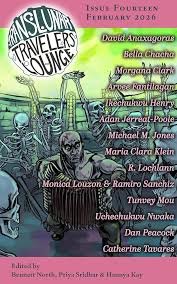
Translunar Travelers Lounge, Issue 14, February 2026
In Ikechukwu Henry’s speculative short story, a nomadic settlement lives atop a vast, living creature called the Great Wanderer — an enormous land-beast whose back serves as their world, their home, and the foundation of their entire culture. The people have built their lives around the Wanderer’s movements, guided by Pathfinders who map safe routes across its hide, and governed by rituals overseen by the authoritative High Elder Borin. Central to their tradition is a ceremony called the Blessing, in which a chosen community member is offered through a fissure in the Wanderer’s skin — a sacrifice the elders frame as an act of sacred gratitude.
The story follows Elara, a young woman with an unusual sensitivity to the Wanderer’s pulse. As the Blessing approaches, she begins hearing the creature’s voice directly — ancient, vast, and deeply angry. The Wanderer reveals that it has been deceived: rather than receiving willing, strong offerings, it has been fed the weak and dying, a hollow transaction that dishonors both parties. “Betrayal approaches,” it warns her. “The debt grows too heavy.”
When the night of the Blessing arrives, Elara watches her childhood friend Lyra — fragile, terrified, and clearly unwilling — being guided toward the glowing fissure by Pathfinders maintaining the polished pretense of sacred duty. The Wanderer’s voice intensifies in Elara’s mind, threatening to take something far greater than one girl if its hunger for truth goes unanswered. Unable to stay silent, Elara disrupts the ceremony, crying out that the Wanderer is being starved and lied to. Elder Borin attempts to silence her, calling her mad, but the Wanderer itself intervenes — cracking fissures open at Borin’s feet, shaking the ground hard enough to scatter the crowd and shatter his authority.
With Lyra freed and the villagers shaken, Elara addresses the settlement directly. She explains what the Wanderer truly demands: not the sick or the coerced, but genuine, willing belonging. Slowly, volunteers step forward — a fisherman, a rope-maker, a hunter — people who choose freely rather than being chosen by fear. Lyra, given back her agency, also steps forward on her own terms. One by one, they enter the fissure not as victims but as participants, absorbed into the Wanderer gently, without screams.
In the aftermath, the tremors ease. Borin weeps, stripped of his power and pretense. The villagers stand in stunned silence, transformed by a night that cost them dearly but could not be undone. Elara, exhausted and grief-stricken, leans on her grandmother, uncertain whether she did right. “It was truth,” her grandmother tells her. “That will have to be enough.”
The story closes on a quieter Wanderer — its rage replaced by a steady, patient rhythm — and an Elara who, for the first time, feels she truly belongs. Henry crafts a rich allegory about institutional deception, the courage required to confront inherited lies, and the difference between sacrifice imposed and sacrifice chosen.

Ikechukwu Henry is an Igbo Nigerian writer whose writings tackle the issues of environmental and climatic crises, family dynamics, queerness and speculative otherworldliness. He was fifth place in Christian Speculative Fiction Prize, shortlisted for The Oriire Folktale Prize and has stories published in, but not limited to, Brittle Paper, The Kalahari Review, Lampblack Magazine and others. When not writing, he can be found searching for the next magazine to submit to.