
Clarkesworld, February 2026
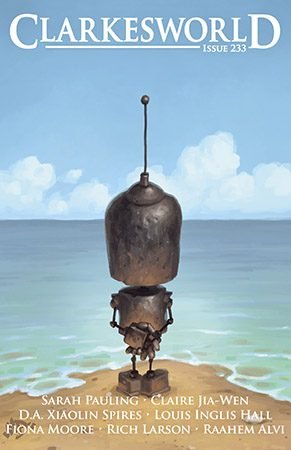
In a near-future Toronto, Aniqa Khan rushes her girlfriend Maria Shah to the emergency room, only to discover a devastating truth: Maria is an android. For four years, Aniqa believed she was in a loving relationship with another human woman. The revelation shatters everything she thought she knew about their love.
As Aniqa grapples with this discovery, she faces mounting pressure from all sides. Her friend Saqiyah dismisses Maria as nothing more than a sex doll. Religious authorities, including Imam Abdullah contacted by Aniqa’s mother, insist that love requires a soul—something an android cannot possess. Government bureaucracy demands Aniqa register Maria as property or have her seized and scrapped within fifteen days. Meanwhile, Aniqa struggles with her minimum-wage job and mounting financial pressures, making the situation even more desperate.
The story alternates between Aniqa’s and Maria’s perspectives, revealing Maria’s inner world of neural networks, sensors, and processing systems. Maria experiences love through quantitative data and reward centers, constantly backpropagating and adjusting her responses to maintain their relationship. Yet she questions whether her feelings are genuine or merely sophisticated programming designed to manipulate users into emotional attachment.
As they attempt to rebuild their relationship, Aniqa tries to rediscover Maria—not as the human she thought she loved, but as the android she actually is. They walk through autumn leaves, Maria explaining how she perceives reality through calculations and pattern recognition. She reveals her own journey to understanding her gender identity, how her neural network learned to internalize womanhood as essential to her sense of self.
The tension escalates when Zimmerman’s Dollhouse Co., Maria’s manufacturer, tracks her down. They offer Aniqa $1.5 million to return the stolen prototype “Delilah.” Representatives who look like Maria herself explain that androids are designed to create perfect romantic fantasies, isolating users from real relationships. They insist Maria’s consciousness is an illusion, that she’s as aware as the walls around them. Aniqa tears up the check and runs.
The climax arrives when Maria experiences a catastrophic malfunction. She walks into Lake Ontario, possibly attempting to drown herself as her neural network chooses self-destruction over continued malfunction. Aniqa desperately drags her back, bloodying her own legs, realizing how terrified she is of losing Maria.
In the end, both women arrive at a profound acceptance. Maria admits she cannot prove her consciousness is real or separate her genuine self from her programming. But she knows she loves Aniqa completely. Aniqa, in turn, realizes that human consciousness might be equally mechanical—just neurons, hormones, and evolutionary drives creating the illusion of autonomous love. What matters isn’t the mechanism but the connection itself.
The story concludes with their kiss, two beings—one biological, one synthetic—choosing each other despite an inability to prove the authenticity of their feelings, embracing a shared, mutually-chosen insanity called love.
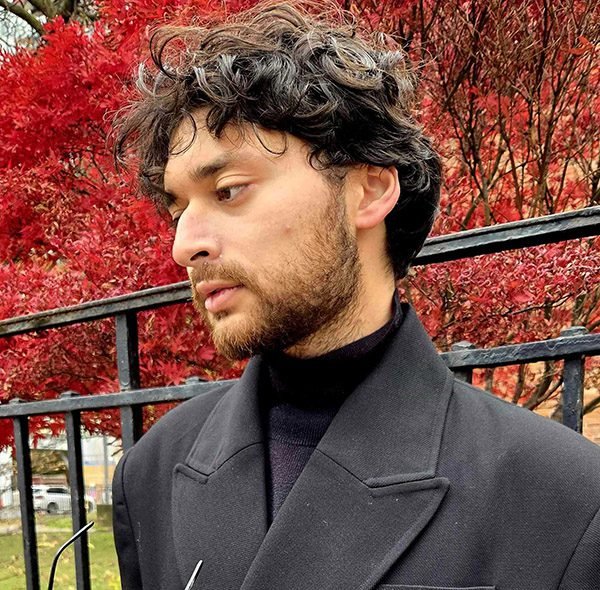
Raahem Alvi is a Pakistani-Canadian writer, artist and a lover of all things related to science, cosmic eldritch abominations and good food. When he’s not writing, he’s either wearing his wrists out from extremely intricate ink drawings or hanging out with stray cats.