
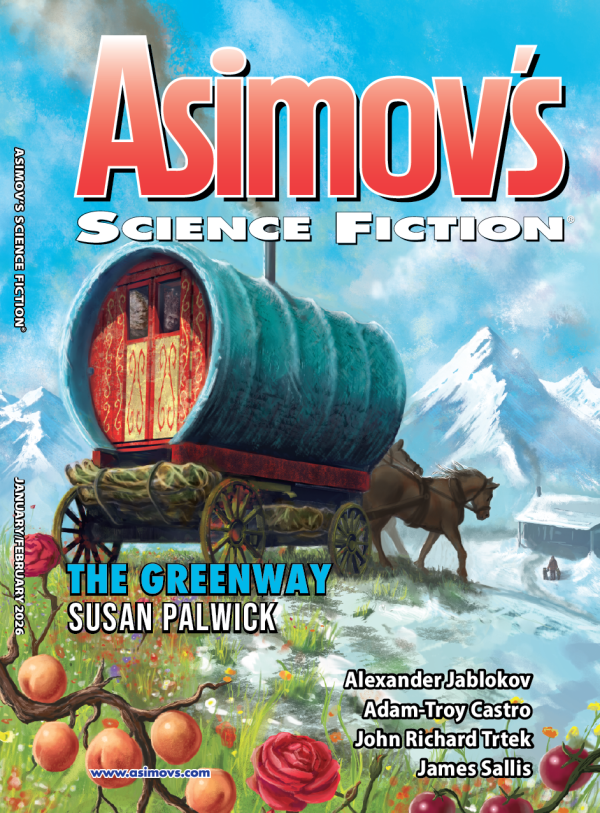
Asimov’s Science Fiction, January/February 2026
Lavie Tidhar’s “The Moribund” is a dark science fiction story set in a dystopian Australian city where people illegally experience the final moments of dying individuals through black market brain-scanning technology. The narrative weaves between three perspectives: the Client (Isabelle), the Porter (Samuil), and the Moribund himself, with interludes called “The Nexus” that frame the central scene.
The story opens in a hospital at 3 AM, where a mysterious client meets a night porter in an alleyway. She pays him in gold coins to access a dying patient. The porter leads her to a private room where a young man with a gunshot wound lies dying, guarded by two drugged bodyguards. Using illegal bioscan technology, the porter places a metal ring around the dying man’s head and gives the client a headset that will allow her to experience his death in real-time.
Through flashbacks, we learn how each character arrived at this moment. Isabelle, the client, grew up as the daughter of a ’Ndrangheta crime boss. Her fascination with death began in childhood when she killed snails and wondered what dying felt like. In university, she discovered research showing that brain activity continues for minutes after death, creating vivid final experiences. She became addicted to experiencing these death moments, first with animals, then with humans after the illegal “Moribund” trade emerged.
Samuil, the porter, was a good man destroyed by gambling addiction to poker machines. After losing his house and family, he owed money to a low-level loan shark named Jimmy Dimitriou. To work off his debt, Jimmy forced him into the Moribund business, providing the equipment and clients while Samuil identified suitable dying patients and facilitated the sessions.
The Moribund himself turns out to be Jimmy Dimitriou, the very loan shark who coerced Samuil into this dark trade. His dying memories reveal a life of violence and crime, from an abusive childhood to working as an enforcer. Ironically, he is revealed to be the same boy who tortured snails in Isabelle’s childhood, creating a circular connection between all three characters.
The story’s experimental structure includes vivid sensory descriptions presented as if creating art: “Color the sky above it black,” “Draw in some ambulances in pencil.” An interlude titled “What Rats Dream When They Die” poetically describes a rat’s final moments of consciousness.
In the climactic scene, Isabelle experiences Jimmy’s death as his heart stops and his life flashes before his eyes. When it’s over and the porter asks what dying is like, she responds cryptically that “we’ll find out in time,” suggesting mortality is the one universal human experience.
The story explores themes of mortality, addiction, exploitation, and humanity’s morbid fascination with death. Tidhar creates a noir atmosphere in a future Australian city where technological advancement enables the ultimate violation: commodifying and consuming the intimate experience of death itself. The title “The Moribund” refers both to the dying individuals and to a society in moral decay.