
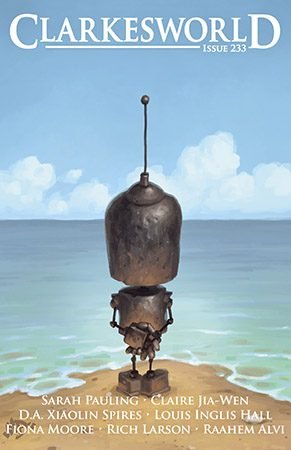
Clarkesworld, February 2026
In a near-future where the “Mindmesh” technology allows humanity to store memories in the cloud rather than biological memory (“lobemeat”), Iris recounts her mission to assassinate billionaire CEO Clara Amsel. She’s been erased from the Mesh—and thus from everyone’s memory—by a cult leader she’s addressing throughout the narrative, who remains bound and gagged as Iris forces her to remember.
Iris joined the cult under false pretenses. While the leader believed she was radicalizing Iris to kill Clara for environmental crimes (Clara’s corporation planned untested stratospheric aerosol injections), Iris actually sought out the cult because she already wanted Clara dead for deeply personal reasons. The cult’s technology—a “worm” that can erase identities from the global Mesh network—offered Iris exactly what she craved: the ability to become a ghost, forgotten by everyone.
The erasure process was ritualistic. The cult leader’s “memory-martyrs” undergo tests of endurance before being wiped from collective memory, retaining only their local cache of memories. For Iris, this meant losing some memories permanently while keeping enough to function. The cult leader gave her a neurotoxin injector as her “knife” to kill Clara.
Iris’s journey to Clara’s island estate reveals her complex psychology. She discovers an addictive joy in being forgotten—when she encounters her abusive ex-boyfriend on a ferry, his complete lack of recognition validates her feeling of being “nothing” to him. She manipulates a drunk security guard, Robbie Yu, stealing his biometrics while he disturbs her by wanting to remember her “in the meat”—using precious biological memory storage for a stranger, which she finds perverse despite having fantasized about doing the same with the cult leader.
The mission fails catastrophically when Iris reaches Clara. Despite the global memory wipe, Clara remembers her—she had stored Iris in biological memory, in “the meat.” This reveals that Iris and Clara were former lovers, and Clara had abused Iris severely. The biological memory storage feels like a violation to Iris, yet also suggests Clara may have loved her. In their confrontation, Iris kills Clara with a piece of petrified ginkgo, but finds no satisfaction or understanding.
The story concludes with Iris back at the cult’s bunker, having bound and gagged the leader. Rather than kill her mentor, Iris plans to torture her and force her to remember Iris biologically—to “remember me in the meat”—inflicting the same violation Clara committed. She recognizes the cult leader’s similar patterns of abuse and control, acknowledging she fell for the manipulation despite knowing better.
The narrative explores themes of memory, identity, abuse cycles, and bodily autonomy in a world where consciousness exists partially outside the body, questioning what makes us human when memory can be externalized, erased, and violated.

Sarah Pauling graciously shares her Seattle home with two cats and a husband. She was shortlisted for the James White Award for new writers and is a graduate of the Viable Paradise workshop. In her spare time, she wrangles the slush team for Small Wonders and reads for Diabolical Plots. Further hobbies include tabletop gaming, singing barbershop harmony, and reading comics in order to complain about them. Find her work in places like Strange Horizons, Clarkesworld, Escape Pod, and the Shirley Jackson Award-winning anthology Aseptic and Faintly Sadistic: An Anthology of Hysteria Fiction.