
Adventitious, February 2026
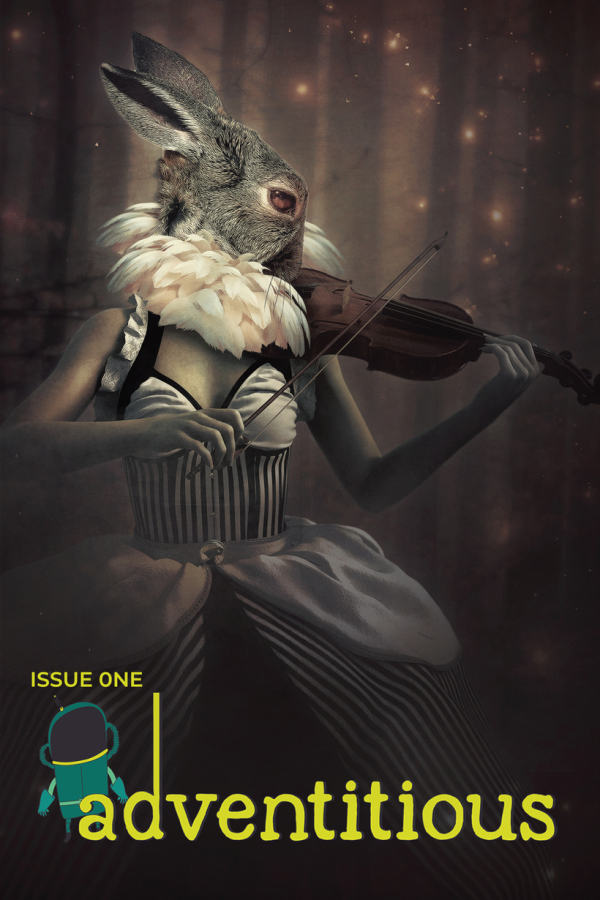
This darkly comic short story is framed as a transcript of an academic lecture set in a distant future, where Professor Elizabeth Boucher teaches a course on late twentieth and early twenty-first century western culture — treating our present era as a distant, somewhat baffling historical period.
The story unfolds through the recording of Boucher’s opening class, complete with ambient sound cues (clunking microphones, rustling students walking out) that ground it in the familiar rhythms of academia. The professor introduces three texts from what her civilization calls the “Death Ages,” a period characterized, in her telling, by primitive reproductive technology, widespread atheism, and a troubling dependence on electronic storage (which, she notes sadly, proved catastrophically unstable).
The centerpiece text under analysis is a work called Bella Swan Pegs Satan — presented entirely earnestly as a significant literary achievement worthy of archival preservation. Boucher reads passages aloud to her students: a gleefully maximalist fanfiction-style prose featuring a beautiful, kind protagonist who encounters and ultimately dominates Satan himself, rendered with dark curls, “limpid dark orbs,” and a pouty lip. The professor analyzes this work with complete scholarly seriousness, drawing connections to Greek mythology (Leda and the Swan, the ouroboros), comparing its stylistic punctuation choices to Cormac McCarthy, and arguing that the text’s assertion of Satan’s literal existence makes it a covertly brave, deeply moral, even religious work.
The joke deepens as the story reveals that the future civilization is itself a theocratic one — the professor casually references Monsignor Prentiss’s concern for her soul and Father Auerbach’s nearby office. From this vantage point, the explicit sexual content in a piece of internet fanfiction becomes evidence of spiritual courage, a hidden affirmation of God’s existence smuggled through smut.
The authorship section adds another layer of absurdist warmth. The “Bella Pegging Author” is identified only by the pseudonym orpheus_account, and her appended author’s note — a gushing, grateful message to her readers, mentioning seven years of work begun in high school and a forthcoming computer science degree — is treated as precious biographical artifact. The professor laments that the promised epilogue appears to have been lost to the “digital wars.”
The lecture ends abruptly when an alarm sounds mid-sentence, and the professor calmly directs students to grab their breathing apparatus and head to the shelter, before signing off with a teaser for next week’s text: a work known only as Cruel Prince Ass Eating 27.
The story is a love letter to internet fan culture, gently satirizing both academic pretension and the way history inevitably dignifies whatever survives it. It suggests that the chaotic, earnest creativity of online fandom communities is as worthy of preservation as any canonical literature — and that future scholars might well agree.

Stacie Turner’s short fiction has appeared online and in anthology collections. Before going all-in on writing, she worked in professional theater, exhibited her photography nationwide, taught Latin and English, had children, and spun yarn with a drop spindle. Now she lives in Connecticut.