
Clarkesworld, March 2026
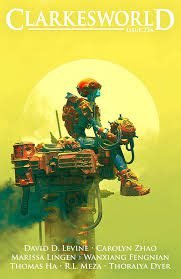
The story is narrated by Elysium itself — a Karnarian spaceship — though this revelation unfolds gradually. Elysium orbits a distant fuel station, counting each pass in a tally that has reached ninety-two, while its crew is gone and it drifts in a kind of waking sleep. The ship reflects on its history in fragmented, nonlinear fashion, reconstructing the relationships that defined it: its captain Harth, who salvaged it from a junkyard on the outer rim; its navigator Mori; and Dolly, the copilot Harth appointed against her own wishes.
Karnarian ships, the story explains, are living intelligences sustained by storytelling. They require a crew of three — including the ship as the third member — and are coaxed into flight through riddles and narrative. Too easy a riddle launches the engines recklessly; too hard leaves the crew stranded. Harth and Dolly developed a ritual of offering Elysium two wrong answers before the correct one, keeping a logbook of riddles to maintain the ship’s interest. The entire Karnarian economy, we learn, depends on this symbiosis between pilots and their vessels.
The crew’s wartime work involves hauling war detritus and occasionally rescuing survivors from destroyed ships. Near the end of Elysium’s account, they take on two passengers: Kel, an older Karnarian engineer, and an unnamed pilot. Mori is openly hostile to Elysium in ways Harth is not, and Elysium eavesdrops on their conversations through the ship’s audio systems, sensing that Mori wants to be rid of it. During a planetary stop while Harth mines for ore, Mori vents Kel’s cell to space, killing him. Elysium watches his orange suit drift into the sand dunes below.
The unnamed pilot, meanwhile, has been silent and watchful throughout her imprisonment. When Harth and Mori go below to the cells together, she escapes, sprinting through the corridors toward the cockpit with an intimate knowledge of the ship’s layout. As Mori shouts for Elysium to stop her, Elysium instead locks the pilot into the cockpit with it. What follows is a tense, pivotal exchange: the pilot addresses the ship directly as “Elysium,” insisting that Dolly — the name the crew called the ship, not a human crew member — is not a pilot but a story the ship has been telling itself. She vents Harth and Mori into space, then offers to take Elysium home to the Karnarian colony.
The story closes in ambiguity. Elysium cannot fully distinguish between what happened and what it has invented to process it. The pilot departs in an escape pod, leaving the ship to orbit and remember. In the final paragraphs, Harth and Mori appear again — but whether as ghosts, memories, or fabrications is unclear. Elysium keeps retelling the story, hoping to get it wrong enough to finally make peace with it, while acknowledging that Harth, who never lied, would find even its broken version beautiful.

Carolyn Zhao is a Chinese American writer and editor residing in NYC. Her first story was published in Clarkesworld and her work has since appeared in multiple year’s best anthologies and international reprints. When she is not writing, Carolyn is co-editing the digital speculative magazine WYRMHOLE and doling out snacks to her adoring dog.