
Baffling Magazine, Issue 5 April 2025
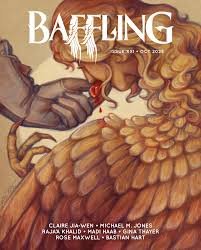
This poignant short story explores grief, memory, and the different ways people preserve connections to those they’ve lost. The narrator prepares eggplant parmesan using a cherished recipe card covered in tomato sauce stains and handwritten notes from their deceased partner. As they cook, they imagine their partner standing in their right-side blind spot, offering reminders and guidance that weren’t written down.
The story unfolds in a near-future setting where hologram technology allows people to recreate deceased loved ones from recorded conversations and uploaded memories. While the narrator cooks, their partner Noel sits at the kitchen table having an after-work chat with a hologram of Noel’s mother, who died the previous year from Alzheimer’s disease. The hologram asks about Noel’s day at the county transportation department and compliments the eggplant parmesan, just as she did when alive.
Through the cooking process, the narrator reflects on memories of their partner, who has been gone for seven years. These memories shift and sharpen unexpectedly—like the time they got stuck on a rutted country road in high school and the narrator’s partner faked an asthma attack to call for help. The recipe becomes a bridge between past and present, a tangible connection to someone who can no longer be physically present.
The narrative juxtaposes two approaches to preserving the dead: Noel’s hologram technology versus the narrator’s more organic memory-keeping through cooking and imagination. While Noel finds comfort in daily conversations with their mother’s hologram, the narrator explicitly rejects this approach. They state they would resent an algorithm calculating what their partner would say, preferring instead to maintain their own living memories, however imperfect.
The story emphasizes how the narrator’s partner inhabits the “empty space” on their right side—their blind spot—which becomes a metaphorical space for memory and presence. The recipe card, stained and marked by both partners’ cooking sessions, represents their shared history. The narrator has added their own drips to the card, transforming it from “your recipe” to “our recipe.”
Milbrodt weaves in the backstory of Noel’s mother’s Alzheimer’s progression with heartbreaking details—how she became “unstuck in time” and talked about dating someone, yet still recognized that the eggplant parmesan was excellent. This disease “takes in drips and drabs,” the narrator observes, capturing the gradual erosion of memory that makes the hologram technology both comforting and painful.
The story concludes with a small domestic moment where Noel suggests simplifying the recipe, but the narrator and their partner’s memory speak in unison, insisting the ricotta is essential. This merging of voices suggests that memory and presence aren’t binary states—the dead can remain with us in the recipes we follow, the wisdom we remember, and the choices we make that honor them.
Ultimately, “Conversations with You” asks what it means to keep someone alive after death and whether technological preservation can match the intimate, imperfect art of human remembering.

Teresa Milbrodt is the author of three short story collections: Instances of Head-Switching, Bearded Women: Stories, and Work Opportunities. She has also published a novel, The Patron Saint of Unattractive People, and a flash fiction collection, Larissa Takes Flight: Stories. She believes in coffee, long walks with her MP3 player, and writing the occasional haiku.