
Translunar Travelers Lounge, Issue 14, February 2026
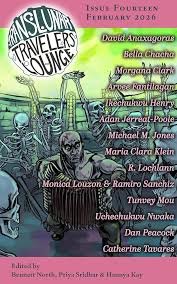
Told in second-person fragments punctuated by vivid descriptions of handcrafted masks, “Coat Check Girl” is a lyrical dark fantasy set inside a supernatural circus with three concentric rings, each more dangerous and transformative than the last. The narrator is the coat check attendant — a skeleton who takes patrons’ literal skins at the door, issuing tickets for their retrieval, working with quiet professionalism in a world of bone tents, fire breathers, and memory-devouring carousels.
The circus attracts a particular nocturnal crowd: insomniacs, goth girls, caffeine-wired grad students. Most are first-ringers — thrill-seekers who want a brush with the uncanny before retreating safely to their ordinary lives. The second ring lures obsessives and the grief-haunted, trading memories or life energy for glimpses of their past and future. The third ring is spoken of only in whispers: a place where anything lost can be found, and where few who enter ever leave unchanged.
The story’s emotional core arrives with a young woman who does something no patron ever does — she speaks to the coat check attendant as though she matters. Her boyfriend dismisses the narrator as “a robot, a gimmick,” but the woman lingers, asking genuine questions, letting the narrator sign her mask in eyeliner. She returns night after night, trying on other people’s discarded skins with irreverent delight — a weapons manufacturer’s body, a starlet’s, a forgotten politician’s — while the narrator, despite being only bone, begins to feel something uncomfortably alive stirring in her chest.
The woman brings a gift: a hand-sewn lace mask with peacock feathers, which she labels “courage.” The narrator accepts it, knowing immediately it is hers. When the woman eventually reveals she has brought her dismissive boyfriend to the circus as a deliberate sacrifice — the toll required to enter the third ring — the narrator understands what she intends to do. She wants to find something. She walks through the curtain, and the narrator, unable to speak the warning or the plea forming in her hollow chest, lets her go.
Time passes in grief. The narrator tends the woman’s stored skin carefully, keeping it free of mold and lichen, hoping.
Then the woman returns — changed, fractured at the wrist, movements erratic — carrying two skins: her own, and one she claims belongs to the narrator. What follows is revelation: the narrator was not always a skeleton. She was once a girl, one of two friends waiting in an alleyway for a punk show. She went ahead alone, surrendered herself to the carousel’s memory-draining rides, and forgot entirely who she was. The circus gave her a new identity: coat check girl. The woman had ventured into the underworld again and again to recover the narrator’s lost memories and skin.
Outside the circus threshold, the narrator’s heart begins to beat. She drinks a potion the woman provides and her memories flood back — pain, sensation, identity. The woman ties the lace courage-mask around her head and pulls her back into life with a kiss.
It is a story about the courage required to retrieve someone you love from the place they have lost themselves.

Adan Jerreat Poole is a queer author living in Kitchener, Canada. Their YA fantasy novels, The Girl of Hawthorn and Glass (2020) and The Boi of Feather and Steel (2021) were published with Dundurn Press. Their short fiction has appeared in The New Quarterly, Soliloquies, Space and Time Magazine, and NonBinary Review.