
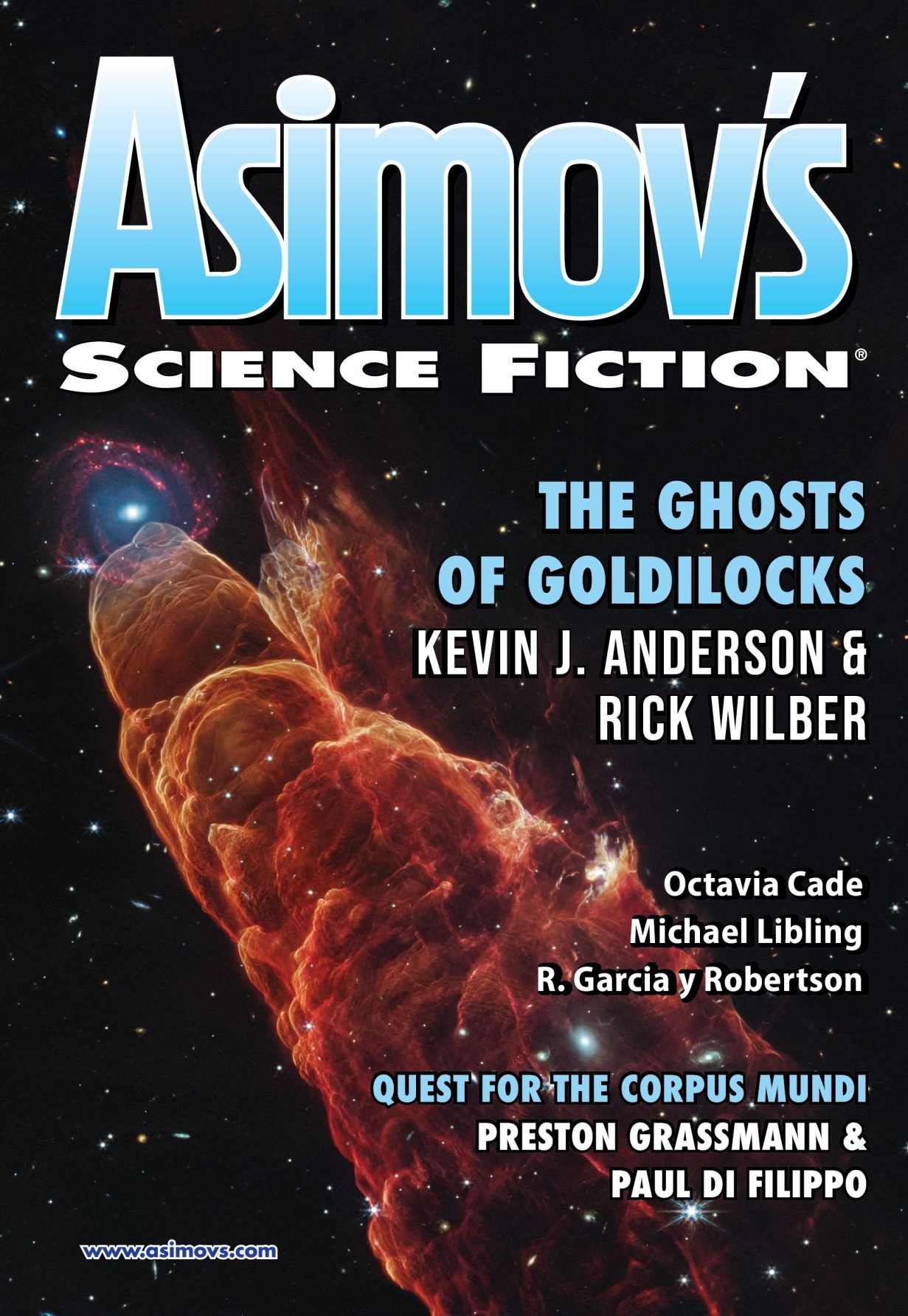
Asimov’s Science Fiction, March/April 2026
Gu Shi’s “Antarctic Radio” presents a haunting vision of climate catastrophe through the format of a radio broadcast interwoven with a family’s desperate journey at sea. The story alternates between two narratives: a cheerful radio show hosted by Little Ice and Big Mountain broadcasting from Antarctica, and fragments of dialogue from a small family vessel battling dangerous waters.
The radio hosts discuss a world transformed by climate disaster. References to 2026’s cascading catastrophes—Australian wildfires, pandemics, hurricanes, floods, and global conflagration—set the stage for a future where sea levels have risen dramatically. Beijing Bay now exists where the Chinese capital once stood, with tropical fish swimming through the flooded Forbidden City. London’s Soho district lies underwater, and major cities worldwide have been submerged or abandoned. Temperatures regularly exceed 50°C (120°F), and massive vessels like the Chang’an—carrying over three million people—serve as floating cities for climate refugees.
Little Ice reveals she came to Antarctica aboard the Chang’an, a ship so large it contained airports, rice paddies, and pastures. Her family could only afford one ticket, so she traveled alone, smuggling her cat aboard. She took the job at Antarctic Radio partly hoping her parents might hear her voice and find hope that she’s alive. Big Mountain shares his own refugee story: stranded on the Diamond Princess during a 2020 pandemic outbreak, he eventually made his way to Antarctica when the ice sheets melted, creating a habitable oasis in what had been the frozen continent.
Parallel to the broadcast, a family of three struggles aboard a small fishing vessel. Pop, Ma, and their child battle an approaching wave while Ma suffers from heatstroke. They’ve been listening to Antarctic Radio, and in her delirium, Ma believes she hears her daughter Little Ice on the broadcast. Her family dismisses this as heat-induced confusion, reminding her they put Little Ice aboard the Chang’an years ago.
The story’s power lies in this devastating dramatic irony. As Little Ice tells Big Mountain that her parents grew up in a fishing village and she knows they’re still alive somewhere at sea, the reader realizes the family on the boat is her family. When Ma insists she hears her daughter’s voice, she’s right—but her family, focused on survival, turns off the radio to concentrate on navigating the crisis.
The final moments show the family spotting Antarctica on the horizon, having miraculously survived. Ma, still believing she heard Little Ice, insists her daughter is in Antarctica, urging her family to listen. The story ends with this bittersweet near-miss: a reunion tantalizingly close yet unachieved.
Gu Shi crafts a story about hope persisting against overwhelming odds, about families separated by circumstances beyond their control, and about the human cost of environmental collapse. The radio format creates an intimate connection between scattered survivors while highlighting their isolation. Little Ice’s message—“There’s always hope, listeners. If you’ve lost family, keep searching, and don’t stop believing!”—resonates with profound irony as her own family unknowingly approaches the shore where she broadcasts, believing her delirious rather than prophetic.

Gu Shi is a Chinese speculative fiction writer and a senior urban planner. She is the author of two short story collections, Möbius Continuum and 2181 Overture. Her fiction has won major awards in China, and she was a Hugo Award finalist for best novelette in 2024. The author’s stories have appeared in English translation in the collections Sinophagia (2024), The Climate Action Almanac (2024), Book of Beijing (2023), Sinopticon (2021), The Way Spring Arrives (2021), Broken Stars (2019), and Current Futures (2019) as well as Clarkesworld magazine. Her stories have also been translated into German, Italian, Japanese, Romanian, and other languages.