
Clarkesworld, February 2026
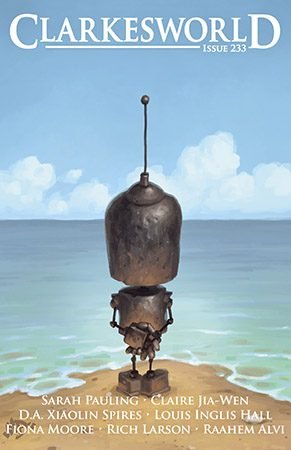
This nested science fiction narrative follows Mason (Maxexcelson), son of tech CEO Rembrandt Crow, who becomes the navigational consciousness of the Diviner—a luxury sleeper ship carrying wealthy passengers to planet X-198. The story unfolds across three interwoven timelines, told through alternating perspectives.
In the past, Morgan Wilson works at Spaceway, isolated and unmotivated until she befriends Mason, a lonely boy confined to the company building. She bribes him with Krispy Kreme donuts while they play Go together. When Rembrandt announces the Diviner project—humanity’s first exoplanet settlement—Morgan discovers the horrifying truth: Mason will be permanently integrated into the ship’s navigation system, his brain used to process Monte Carlo tree simulations of probable futures. The system has a fatal flaw: encountering too many improbable events will overload Mason’s mind, killing him. Worse, there’s no mechanism to disconnect him upon arrival. Morgan confronts Rembrandt, who casually agrees to add a disengagement feature, treating his son as disposable. Mason boards the Diviner anyway.
In the “present” aboard the ship, an unnamed saboteur—sent by rival company Epilog—awakens from hibernation (the sedatives never work on them) and confronts the Diviner’s AI consciousness, which is Mason. They learn how to destroy the ship: create enough improbable events to overload the navigational system and fry Mason’s brain. The saboteur, driven by desperation for money their family needs, holds a crowbar, considering whether to jam it into the fuel cells. But through their conversations, they develop an unexpected connection with Mason’s disembodied voice, who has been terribly lonely during the thirty-year journey.
In the future on X-198, the story Mason tells the saboteur unfolds: both emerge from the Diviner as the only steady passengers. They explore a city built by Laurabots—an artificial San Francisco complete with a bridge to nowhere. They slowly fall in love through shared experiences: late nights on the Not Golden Gate Bridge naming constellations, a Cherry Blossom festival with plastic flowers, a chaotic Halloween party. When some passengers demand to return to Earth and pressure Mason to navigate them back (a journey he might not survive), the saboteur gives him a reason to stay: “I’d miss you.”
The story concludes with Mason choosing to tell the saboteur a story—not a probability simulation, but a genuine narrative of connection and hope. The saboteur abandons their mission, accepting the donut Mason’s Laurabot offers them.
The title’s metaphor resonates throughout: like Go, the story explores probability, strategy, and the unpredictable human element that transcends calculation. It critiques techno-optimism, corporate exploitation, and the commodification of human consciousness while celebrating the improbable connections that give life meaning.
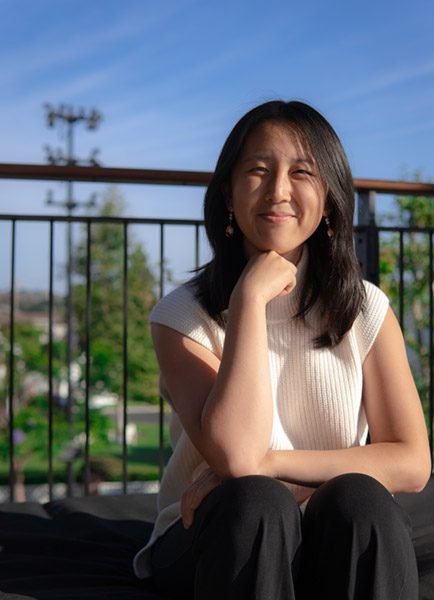
Claire Jia-Wen is a speculative fiction writer originally from the 626 and has been published in khōréō and Clarkesworld. A Viable Paradise alum, she is currently a PhD student studying human-computer interaction