
Will This Be A Problem, Issue 2
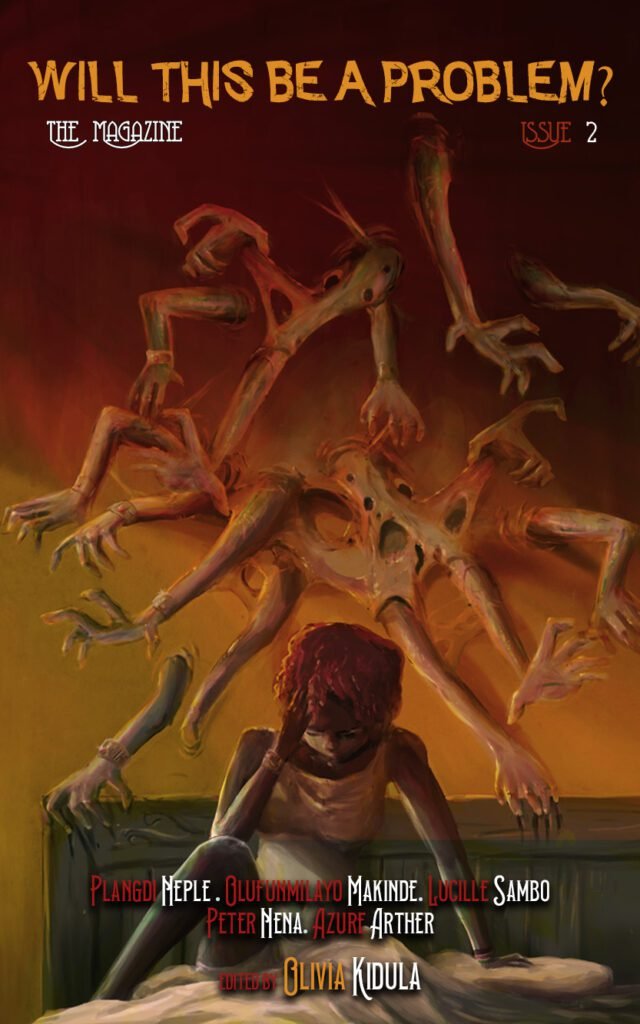
In a dystopian future society called Jupiter, Acacia Sidai falls mysteriously ill with severe vomiting and fatigue. Medical androids, equipped with advanced bio-imaging technology, can find no pathogens. Her case triggers alarm throughout the medical system, leading to quarantines and isolation protocols. The android doctor, Dr. Botein, discovers abnormally high levels of reproductive hormones—estrogen, progesterone, and hCG—in Acacia’s bloodstream, a finding so unprecedented that the results are immediately deleted and all who saw them are marked for memory wipes.
Acacia is transported to Ganymede, the capital city, and brought before the Council—twelve eternally youthful leaders who govern alongside the Great Mother, an artificial intelligence that rebuilt civilization after a catastrophic war. Through their interrogation, Acacia learns shocking truths about human history. She discovers that humans once reproduced naturally through sexual intercourse with “Gurgs” (men), but this practice was abolished centuries ago. The Great Mother created the NeuroBloc chip, implanted in all humans’ brains, to suppress sexual desire and reproductive function. Babies now grow in ectogenesis laboratories using harvested sperm from captive Gurgs.
The Council reveals that Acacia is pregnant with twins—her NeuroBloc chip malfunctioned during her work in a radiology department. They recount the brutal history of the Gurgs, portraying them as violent oppressors who enslaved women and destroyed the planet. After the war, surviving Gurgs were imprisoned underground, kept alive only to harvest their sperm before being starved to death or converted into fertilizer in Bio-Conversion Laboratories.
Through flashbacks, Acacia recalls her internship at Amalthea Laboratory, where she witnessed the horrifying Bio-Conversion process. Working in the Embryo-Genesis Department, she encountered Gurg G.089, a particularly well-built specimen created from refined genes. Despite her complete lack of understanding about sexuality or reproduction, her malfunctioning NeuroBloc chip allowed her to experience sexual desire for the first time in five centuries of Jupiterian history.
Acacia began visiting the Gurg’s pod daily, eventually engaging in sexual activities with him. She named him Jomy and developed genuine feelings for him, caring for him with extra food and affection. Their encounters culminated in sexual intercourse, resulting in her pregnancy—an act so unthinkable in this society that even the surveillance androids didn’t recognize or report it.
The Council condemns Acacia, particularly horrified that she claims to love a Gurg. Her android guardian, Bunda (B), will be decommissioned for failing to detect the chip malfunction. The Great Mother—revealed to be an AI with a child’s voice—pronounces Acacia’s sentence: death in the Bio-Conversion Laboratory, where she will be dissolved and converted into fertilizer, the same fate as the Gurgs.
The story ends with Acacia wailing in terror as she’s dragged away, desperately protesting her innocence while the Council watches with pitiless indifference. This dark tale explores themes of reproductive control, dehumanization, gender dynamics, and the dangers of totalitarian technological control over human nature.
Peter Nena is a Kenyan writer and award-longlisted author known for his work in African horror and speculative fiction, frequently featuring complex, central child characters. His notable work includes the 2026 BSFA Awards longlisted story “Babies Don’t Grow in People,” “The Soulless,” and “Why Donkeys Have 44 Teeth”.