
Grist, January 2026
Six-year-old Rami Saleh’s precious multicolored porcelain bird shatters in the school playground, triggering a crisis that mobilizes his entire elementary school. The bird, a cherished gift from his mother, represents one of the few belongings Rami brought with him after his family was displaced by bushfires. His mother, recovering from severe burns in the hospital, had given him the bird to comfort him during her long absence.
Rami is part of a “re-homing program” at a conservation school designed to help environmentally displaced children. He’s known among his peers as sensitive and prone to tears, but the children respond to his distress with remarkable empathy. They establish the “Federal Magician’s Court” to deliver justice for Rami and attempt various solutions: gluing the shattered pieces together, creating origami birds, making pom-pom and balloon versions—all rejected by the inconsolable child.
Meanwhile, Principal Marconi pressures Anje, Rami’s climate grief-trained counselor, to remove him from the program. He argues that Rami’s constant crying disrupts other students and that the school has reached capacity for program children, who are essentially subsidized by paying families. Anje advocates for patience, insisting that Rami needs stability and time to adjust, not another displacement.
The children’s court hatches a bold plan to capture a live bird from the principal’s sanctuary—a Christmas Island White-eye, one of many threatened species housed at the conservation school. Their amateur heist goes awry when the captured bird panics, escapes, and scratches the principal’s face with its talons. The incident intensifies Marconi’s conviction that Rami needs therapy, not school, prompting Anje to confront him about his lack of patience and understanding.
Anje approaches the children’s barricaded court with respect for their mission. She introduces Rami to the White-eye, explaining that like him, the bird has been displaced from its home on Christmas Island, which is no longer safe. When Rami confesses he “just wanted to go back home,” Anje helps him understand that the bird shares his grief and displacement.
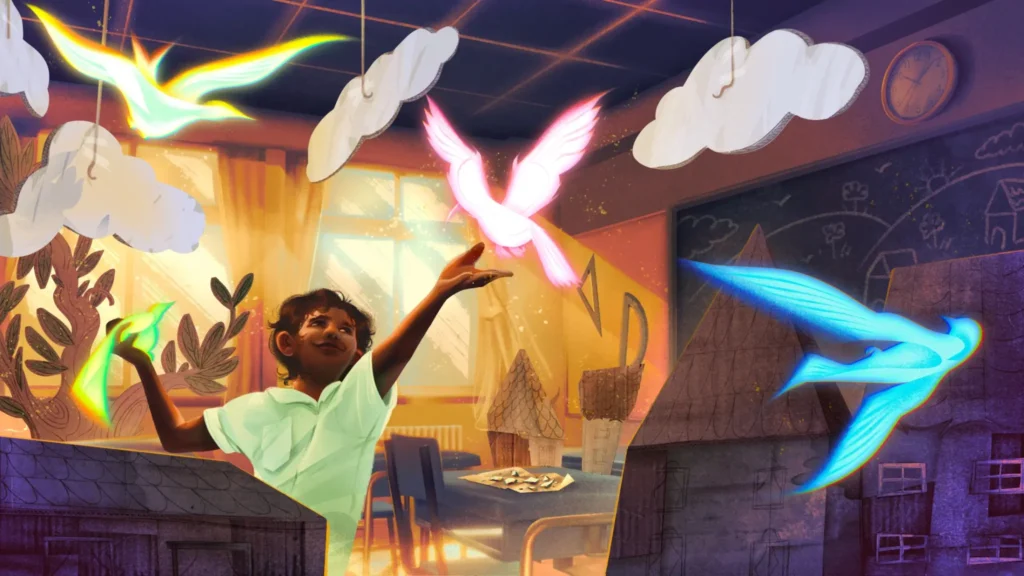
Through gentle conversation, Anje guides Rami to describe and sketch his lost porcelain bird, which triggers memories of his mother and their home. He recalls sitting on the veranda with her, watching rainbow lorikeets visit at dusk. Inspired, Anje orchestrates the entire Federal Magician’s Court to reconstruct Rami’s memory of home as a miniature theatrical set, complete with gumleaves, painted walls, and Rami’s imaginative embellishments.
The project transforms Rami. While the recreation may not be accurate, it helps him feel at home again. He and his peers care for the conservation birds together, and Rami’s tears gradually diminish. His mother’s healing is aided by witnessing her son’s growing resilience. The story suggests that belonging and recovery come not from recreating the past, but from building new connections and finding purpose in caring for others who share our grief.

Marlene Jo Baquiran is a writer and publisher at Encour Press. She resides on Darug land in Sydney, Australia. Her work has appeared in Meanjin, The Ethics Centre, Island, and On This Ground: Best Nature Writing. She has worked in climate tech on the development of environmentally-friendly cultured meat, and has won the Edna Ryan Award and a feature in the Australian Museum for her leadership in community activism.