
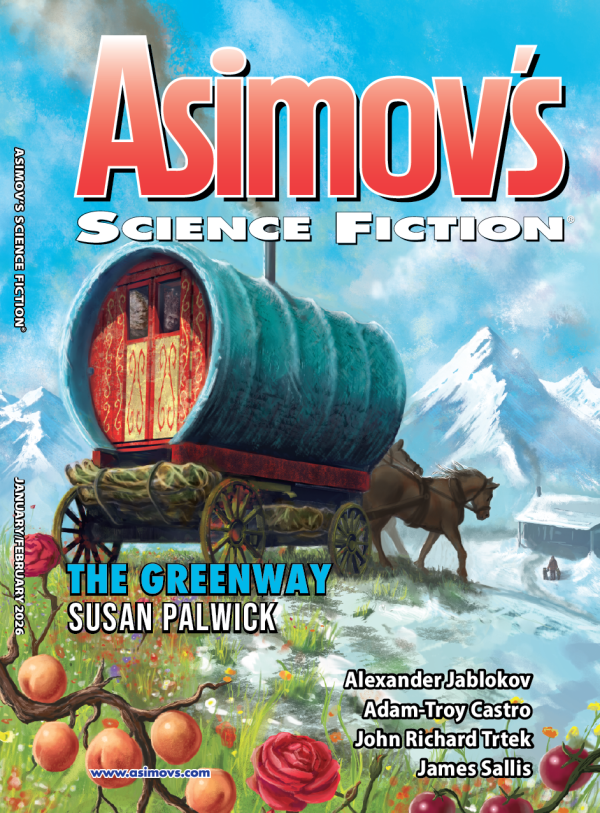
Asimov’s Science Fiction, January/February 2026
Will Ludwigsen’s story presents itself as a nonfiction guide for children interested in UFO phenomena, but gradually reveals itself to be something far more poignant and unsettling. Written in the style of educational books from the late 1970s or early 1980s, complete with references to Dewey Decimal classifications and period details like Skylab debris and plastic soda bottles, the handbook initially offers practical advice about UFO spotting.
The narrative begins conventionally enough, encouraging young readers to trust their observations of unexplained lights in the sky despite adult dismissals. It provides historical context for UFO sightings dating back centuries and explains how children, with their open minds and sense of wonder, make better observers than skeptical adults. The guide offers detailed instructions for documenting encounters, including what equipment to bring and what information to record on encounter forms.
However, darker undertones emerge as the story progresses. The narrator makes repeated, specific references to troubled home lives: a mother’s boyfriend who might hit the child, adults who rage at each other while the child hides under the bathroom sink, and references to being “physically damaged.” The guide advises young readers not to tell certain adults about their experiences and acknowledges that these children may act out at school due to problems at home.
The emotional core deepens when the handbook addresses children who are “imaginative but sad, curious but reluctant,” describing them as having injuries that make them “natural reconcilers of hope and reality.” The guide increasingly frames UFO watching as an escape mechanism, encouraging children to “keep your eyes to the sky and off the horrible things happening to you on the Earth.”
In a stunning final revelation, the narrator drops the pretense entirely and addresses a specific child directly. The book itself, we learn, isn’t a mass-produced guide at all but exists specifically for this one young reader who has been watched their entire life. The aliens have been preparing this particular child for first contact and eventual evacuation from Earth.
The story transforms from whimsical UFO guide to a meditation on childhood trauma and the coping mechanisms children develop to survive difficult circumstances. The UFOs become a metaphor for escape, hope, and the imaginative life children construct to endure suffering. The aliens represent rescue and validation, offering to take away a child who has been hurt by the “infectious” pain that damaged adults pass down to children.
Ludwigsen masterfully maintains the instructional tone throughout while building layers of emotional complexity. What begins as nostalgic pastiche evolves into a heartbreaking portrait of a child in crisis, using the language of 1970s paranormal literature to explore themes of abuse, resilience, and the power of imagination as both shield and lifeline. The story asks whether the UFOs are real or simply a necessary fantasy, ultimately leaving ambiguous whether the promised rescue represents actual alien contact or a child’s desperate hope for salvation from an unbearable situation.