
Asimov’s Science Fiction, January/February 2026
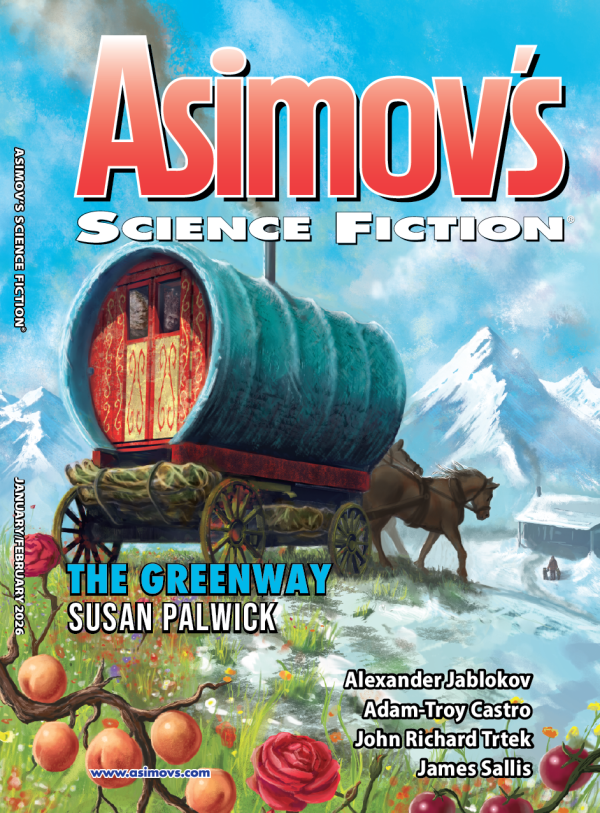
In a post-apocalyptic world, Devona lives in what remains of Streamside settlement with her two young children, Lim (age 5) and baby Mira. A mysterious plague has transformed humanity: green plants sprout from dying people’s bodies, killing them but providing crops that feed the survivors. Devona’s father became peppers and peaches; her recently deceased mother waits frozen in the shed, wrapped in plastic to preserve the purple-flowered vines growing from her body.
When Devona spots a caravan approaching across the winter plains, she knows what it means. These wagons travel the world collecting the dead, planting them along their route to create “the greenway”—a trail of warmth and abundant growth even in winter. The heat generated by clustered bodies in the wagon’s seedbed thaws the frozen ground and causes immediate spring blooms. Devona has a duty to give her mother to the caravan so she can travel and nourish people in distant places, though the thought of letting her go is agonizing.
Twin siblings Ruha and Tyron arrive with their wagon, which carries three living travelers slowly “turning” (sprouting growths) and many wrapped bodies underneath. They’re kind and patient, immediately winning over Lim, who has never seen strangers, and helping care for Mira. Though Devona appreciates the help, she’s wary of their presence and how easily her children warm to them.
The morning after their arrival, Ruha and Tyron wake the children early and take them outside without waking Devona. When she discovers this, she’s furious—until they gently explain why. While she slept, they saw her knee uncovered and noticed tiny ferns growing through the bandage. Devona has been turning for two months, since shortly after her mother’s death, though she’d convinced herself the itching and pain were just arthritis.
Ruha and Tyron insist that Devona and her children must join the caravan. Without them, the children would die alone when Devona inevitably succumbs. They promise to find good foster parents for Lim and Mira at their destination—kind people who have successfully raised other children orphaned by the plague. Devona will travel with them for as long as she can walk, then ride in the wagon when necessary, staying with her children until she must join the seedbed.
Devastated but recognizing she has no choice, Devona agrees. She tells the children they’re taking a trip with Grandma to find new people to live with, hiding her illness for now. The caravan’s warmth has awakened Streamside’s orchard overnight, creating a riot of spring growth—all the dead neighbors transformed into tomatoes, corn, daisies, roses, peaches, and cherries.
Before departing, Devona asks Ruha to promise that when she’s planted, they’ll wait until she fruits or flowers, then give something of her harvest to her children as a remembrance. She also asks to be planted with her mother. As the family prepares to leave, they stand together among the brilliant greenway, the bright plants waving goodbye—all the people of Streamside blooming one last time.