
Introduction
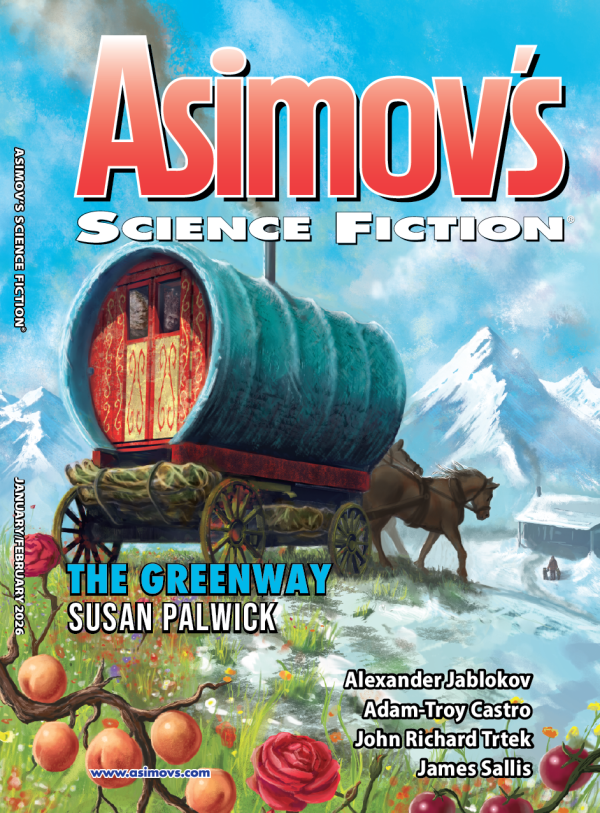
William Preston’s “Stay,” published in the January/February 2026 issue of Asimov’s Science Fiction, represents a significant contribution to contemporary science fiction’s ongoing exploration of mortality, companionship, and the ethical boundaries of artificial intelligence. Preston, whose work has appeared in Asimov’s, Zoetrope: All-Story, and other literary venues, brings his characteristic slow-burn narrative style to bear on questions of grief, substitution, and the unbridgeable gap between human intention and animal consciousness. This novelette demonstrates Preston’s mature command of emotional restraint and his ability to interrogate the limits of technological solutions to fundamentally existential problems. The work’s central thesis—that love cannot be programmed, and that technological intervention in natural processes of grief may constitute a profound category error—emerges through careful accumulation of detail rather than didactic pronouncement, making “Stay” a noteworthy example of contemporary literary science fiction’s capacity for philosophical inquiry.
Plot Summary and Context
The narrative follows Larry, a terminally ill businessman who commissions a robotic double to replace him as companion to his tri-color hound, Charlie, after his death. Larry’s plan involves extensive preparation: cameras throughout his house capture his interactions with Charlie to train the substitute’s neural network, chemical samples replicate his scent, and sculptors craft a convincing physical likeness. After Larry’s death, the substitute assumes his role, but Charlie responds with confusion and distress rather than acceptance. Larry’s estranged sister Mya becomes increasingly involved, initially resistant but gradually assuming responsibility for both Charlie and the failing technological experiment. The story culminates with the substitute’s apparent self-termination and Mya’s acceptance of her role as Charlie’s new human companion.
Preston structures the narrative across multiple temporal phases and perspectives, moving between Larry’s preparations, the substitute’s operational period, and Mya’s evolving relationship with both the technology and the dog. The suburban setting—Larry’s converted city lots, the sterile corporate offices of Subspace and Technically—provides a recognizable contemporary landscape against which the story’s speculative elements achieve particular resonance.
Critical Analysis
Thematic Concerns: Grief, Substitution, and the Limits of Technology
“Stay” operates primarily as a meditation on the incompatibility between technological solutions and emotional needs. Preston carefully establishes Larry’s motivation—“I can’t leave him bereft”—as arising from genuine love, yet the narrative systematically demonstrates how this love manifests as a failure to accept the natural order of loss and mourning. The story engages with what might be termed the “engineering fallacy”: the assumption that emotional and relational problems can be solved through sufficient technical sophistication.
The text’s treatment of grief resonates with contemporary theoretical work on mourning, particularly Judith Butler’s observation that grief exposes our fundamental vulnerability and interconnectedness. Larry’s project attempts to circumvent this vulnerability, to engineer a solution that prevents Charlie from experiencing loss. Yet the narrative demonstrates that such prevention constitutes its own form of cruelty. Charlie’s distress—his whining through the night, his half-eaten meals, his eventual escape—suggests that the substitute creates a more profound confusion than simple absence would have produced.
Preston’s exploration of the substitute’s limitations proves particularly sophisticated. The double possesses Larry’s memories and can recount events from his life, yet it cannot replicate the continuous chemical changes of a dying body. As Mya realizes in the story’s penultimate section, Charlie would have detected the cancer’s progression through scent: “As the cancer progressed, system after system and organ after organ yielding to the unstoppable advance, the chemistry of Larry’s body was altered hour by hour.” The substitute, created from samples taken at a single moment, remains static. This insight crystallizes the story’s central argument: life is characterized by continuous change, including deterioration, and any static representation—however technically sophisticated—will necessarily fail to replicate it.
Form and Narrative Structure
Preston employs a carefully controlled third-person limited narration that shifts primary focalization among Larry, Mya, Charlie, and occasionally the substitute itself. This technique serves multiple functions. First, it prevents any single perspective from dominating the narrative, creating a genuinely polyphonic text in which human, canine, and artificial intelligences each receive sympathetic treatment. Second, it allows Preston to explore the phenomenological experience of each consciousness type without privileging human understanding.
The sections focalized through Charlie deserve particular attention for their literary achievement. Preston avoids the trap of anthropomorphizing while nevertheless rendering the hound’s consciousness convincingly:
“Charlie dreamed of a shoe moving up and down, close to his head. It was all he could see. Then he saw that it was just a shoe, empty of leg.”
This passage demonstrates Preston’s ability to represent animal consciousness through sensory fragmentation and literal perception. Charlie experiences the world through smell, movement, and immediate sensation rather than abstract reasoning. Preston’s prose style shifts to accommodate these different modes of consciousness—becoming more fragmented and sensory-focused in Charlie’s sections, more analytical in Mya’s, more affectively distant in the substitute’s.
The narrative’s temporal structure also warrants examination. Preston employs prolepsis sparingly but effectively, as in the opening sentence: “Each day was different. He inhaled the difference before waking—the knowledge that something had retreated while something else advanced.” This technique establishes a contemplative, elegiac tone while also suggesting the inevitability of change that Larry’s project seeks to forestall.
Characterization and Relationships
The story’s characterization operates on multiple registers. Larry emerges as a complex figure—successful, methodical, genuinely loving, yet ultimately unable to distinguish between solving problems and addressing existential realities. His interactions with Charlie reveal authentic affection, as when he teaches the dog hand signals or reflects on Ileana’s departure: “Over weeks, his amusement changed to an awareness of how much a dog, this dog, could miss someone.” Yet this awareness does not translate into acceptance that Charlie might need to miss Larry himself.
Mya’s character arc provides the narrative’s emotional and ethical center. Initially distant and resentful of her brother’s presumption in repeatedly contacting her through the substitute, she gradually recognizes her own capacity for connection with Charlie. Her transformation occurs not through technological intervention but through embodied, sensory experience—the walk in the park where she tells Charlie the truth about Larry’s death, and especially the closing scene where she allows Charlie to thoroughly smell her, accepting the vulnerability of being known by another consciousness.
The substitute itself represents Preston’s most intriguing characterization challenge. He carefully avoids granting it either full consciousness or mere mechanical operation, instead creating an ambiguous middle ground. Its statement to Mya—“Not every plan goes the way I expected. But it works out… It works out in my favor… It’s something I say to conceal how inconsistent my results have been”—suggests either emerging self-awareness or sophisticated mimicry of Larry’s own self-deception. Preston wisely leaves this ambiguity unresolved, allowing readers to project their own theories of machine consciousness onto the text.
Charlie himself, though lacking dialogue, emerges as the story’s most fully realized character through Preston’s careful attention to behavioral detail. His mourning for Ileana, his initial confusion about the substitute, his attempt to escape over the fence—all demonstrate a rich interior life that the story respects without attempting to translate into human terms.
Symbolism and Imagery
Preston employs a restrained symbolic register that enhances rather than overwhelms the narrative’s realism. The single tree in Larry’s converted backyard recurs throughout the story as a marker of natural persistence within human-engineered space. Charlie’s gravitation toward this tree during moments of stress suggests an instinctive recognition of organic life amid the artificial.
The rawhide stick that appears in multiple scenes functions as a complex symbol. Larry recalls teaching Charlie with it; Charlie chews it in moments of stress; and in the final scene, Charlie holds it between his paws while Mya lies beside him. The rawhide represents continuity, comfort, and—significantly—a natural object (processed animal hide) that bridges the gap between nature and human manufacture. Unlike the substitute, the rawhide makes no claims to be what it is not; it is transparently a processed, manufactured thing that nevertheless serves Charlie’s needs.
The story’s olfactory imagery deserves particular attention. Preston consistently emphasizes scent as the primary mode through which Charlie experiences and understands the world. The substitute’s odor, chemically engineered to match Larry’s at a single moment, becomes a kind of olfactory uncanny valley—close enough to recognition to create confusion, but insufficiently dynamic to sustain the illusion. This sensory emphasis grounds the narrative’s speculative elements in embodied experience.
Point of View and Narrative Distance
Preston’s handling of narrative distance proves particularly sophisticated in scenes involving the substitute. Consider this passage describing the substitute’s search for Charlie:
“‘Charlie!’ The voice emerged louder than usual, though without urgency. The last vowel did not extend, as a human voice might have done when calling for someone suddenly gone.”
The narrator here occupies a position external to the substitute, observing and interpreting its behavior from outside. This contrasts sharply with sections focalized through Larry, Mya, or Charlie, where the narration enters into their consciousness. The substitute remains observable but not fully accessible, a narrative choice that reinforces its status as something neither fully autonomous nor entirely mechanical.
Historical and Cultural Context
“Stay” participates in several ongoing conversations within contemporary science fiction and broader culture. First, it engages with the “robot companion” narrative tradition extending from Isaac Asimov’s positronic robot stories through more recent works like Kazuo Ishiguro’s Klara and the Sun (2021). However, where Ishiguro explores the robot’s perspective, Preston more pointedly interrogates the human impulse to create such companions and the ethical implications of doing so.
Second, the story responds to contemporary developments in AI and robotics, particularly the increasing sophistication of “companion robots” designed for elderly care and the social isolation epidemic exacerbated by the COVID-19 pandemic (referenced obliquely in the narrative when Larry shifts to full-time remote work during “a pandemic wave”). Preston’s acknowledgment that his story concerns “an exchange of goodbyes” situates it within a broader cultural reckoning with mortality and isolation during and after the pandemic.
Third, “Stay” contributes to science fiction’s ongoing examination of human-animal relationships. Recent works in this vein, such as Becky Chambers’s A Psalm for the Wild-Built (2021) and Sue Burke’s Semiosis (2018), explore interspecies communication and consciousness. Preston’s focus on the unbridgeable gap between human and canine understanding—despite genuine affection on both sides—offers a more skeptical perspective on such communication while nevertheless affirming its value.
The story also engages implicitly with philosophical debates about personal identity and consciousness. The substitute raises questions explored in Derek Parfit’s work on personal identity and continuity: Is the substitute Larry in any meaningful sense? The narrative’s answer appears to be no, not because it lacks his memories or appearance, but because it cannot participate in the continuous change that characterizes living beings.
Evaluation
“Stay” succeeds on multiple levels. As a work of craft, it demonstrates Preston’s mastery of controlled prose, multiperspectival narration, and the accumulation of telling detail. The story’s restraint—its refusal to over-explain or moralize—allows its themes to emerge organically from character and situation. Preston trusts his readers to recognize the ethical implications of Larry’s project without requiring explicit condemnation.
The story’s emotional register proves equally sophisticated. Preston evokes genuine sympathy for Larry’s predicament while simultaneously critiquing his solution. The reader understands why Larry cannot bear to leave Charlie bereft, even as the narrative demonstrates the fundamental category error in his approach. This double consciousness—understanding and critique operating simultaneously—represents literary fiction at its best.
However, the story is not without limitations. The characterization of Mya, while ultimately successful, develops somewhat schematically in the early sections. Her initial resistance and gradual acceptance follow a predictable trajectory that occasionally feels mechanical compared to the more nuanced rendering of Larry’s declining consciousness. Additionally, some readers may find the substitute’s apparent self-termination—symbolized by the “DO NOT RESUSCITATE” note Mya earlier wrote as a joke—too convenient a resolution, a deus ex machina that resolves the ethical dilemma without requiring human intervention.
The story’s treatment of corporate and legal frameworks around substitutes remains somewhat underdeveloped. While this minimalism serves Preston’s focus on personal and ethical dimensions, readers interested in the broader societal implications of such technology may find the world-building insufficient. How common are substitutes? What regulations govern their creation and use? These questions hover at the narrative’s margins without resolution.
Nevertheless, these limitations do not significantly diminish the work’s achievement. “Stay” stands as a thoughtful, emotionally resonant exploration of grief, technology, and the limits of human control. Its central insight—that love cannot be engineered, and that attempts to circumvent natural processes of loss may constitute their own form of harm—emerges with particular force in an era increasingly characterized by technological solutions to human problems.
Theoretical Approaches
The story invites multiple critical approaches. From a posthumanist perspective, “Stay” can be read as exploring the boundaries between human, animal, and machine consciousness while ultimately reaffirming the significance of embodied, mortal existence. The substitute’s failure suggests that consciousness cannot be separated from the continuous chemical and physical changes of living bodies—a challenge to purely computational theories of mind.
A psychoanalytic reading might focus on Larry’s substitute as a literalization of Freudian denial, an attempt to refuse acknowledgment of death’s reality. The substitute becomes a kind of technological fetish object, simultaneously acknowledging and disavowing Larry’s mortality. Charlie’s distress might then be understood as the return of the repressed—the reality of death and loss that Larry’s engineering cannot successfully contain.
From an ecocritical perspective, the story can be read as an exploration of human alienation from natural processes, including death. Larry’s project represents the ultimate expression of technological hubris: the belief that human engineering can and should override natural cycles of life, death, and grief. The single tree in his backyard, carefully preserved amid otherwise total domestication of the space, becomes a symbol of the natural order that persists despite human attempts at control.
Conclusion
William Preston’s “Stay” represents a significant achievement in contemporary literary science fiction. Through its careful exploration of grief, technological substitution, and the unbridgeable gaps between different forms of consciousness, the story offers a nuanced critique of technological solutionism while nevertheless maintaining sympathy for the human desire to protect those we love from suffering. The work’s formal sophistication—its multiperspectival narration, restrained symbolic register, and carefully controlled emotional tone—places it among the more accomplished recent works in the genre.
The story’s enduring relevance seems assured as society continues to grapple with questions of AI consciousness, companion robots, and the appropriate boundaries of technological intervention in emotional and existential domains. As artificial intelligence systems grow increasingly sophisticated, the ethical questions Preston raises will only become more pressing. Can machines meaningfully replace human (or human-animal) relationships? What do we lose when we attempt to engineer solutions to fundamentally existential problems? How do we honor our connections with others while also accepting the inevitability of loss?
Future scholarly work on “Stay” might productively explore its treatment of animal consciousness in relation to contemporary animal studies and cognitive ethology. Additionally, comparative analysis with other recent works exploring human-AI relationships could illuminate Preston’s particular contribution to these ongoing conversations. The story’s subtle engagement with questions of class and access to technology—Larry’s wealth enables his expensive experiment—also invites further examination.
Ultimately, “Stay” succeeds because it recognizes that the most profound questions admit no simple answers. The story does not conclude with Mya and Charlie living happily ever after, but rather with a moment of mutual recognition and acceptance—Mya allowing Charlie to truly know her through scent, both beings acknowledging their vulnerability and mortality. This quiet ending, eschewing both technological triumph and sentimental resolution, demonstrates Preston’s mature understanding that in literature, as in life, some goodbyes cannot and should not be circumvented. They can only be lived through, one breath at a time.