
Asimov’s Science Fiction, January/February 2026
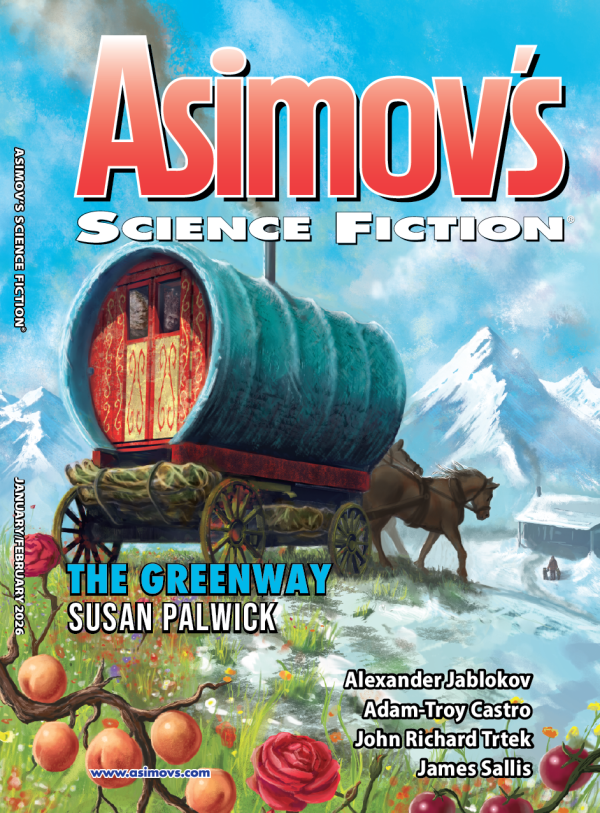
Tyler Dawson wakes up one morning to discover that his girlfriend Emma has transformed into a monster. Not just Emma—everywhere he looks, he sees grotesque alien faces with bulging eyes, translucent skin, and circulating fluids visible beneath the surface. Only his own face and hands appear normal.
Terrified and confused, Tyler struggles to maintain his relationship with Emma while dealing with his horrifying new perception. Emma, hurt by his inability to look at her, pressures him to see a doctor. Tyler visits a neurologist who initially suspects prosopagnosia (face blindness) but warns that a brain tumor can’t be ruled out. An MRI reveals no tumor but does show an anomaly in Tyler’s visual cortex—a structural difference that only manifested when his brain finished developing around age twenty-five.
The neurologist has no cure or treatment to offer. Tyler is left to cope with a permanent condition that makes everyone appear monstrous. He takes refuge in driving for Lyft at night, when darkness obscures the passengers’ faces. His relationship with Emma deteriorates as he avoids looking at her and spends more time away from home. Emma fears he’s gaslighting her or being unfaithful, comparing the situation to a previous boyfriend who had deceived her.
Tyler begins developing a paranoid “replacement theory”—the idea that aliens have replaced all of humanity except him, and that Emma might not really be Emma anymore. He questions whether she’s part of a conspiracy to silence him now that he can see the truth.
At Discovery Park, Tyler encounters Danny, another young man with a normal human face. Danny believes they’re the last real humans in an alien invasion and takes Tyler to his house. Once inside, Danny tasers Tyler to “test” if he’s truly human or a disguised alien. Danny reveals his basement torture chamber, complete with restraining straps and a noose, where he plans to interrogate the “freaks” and fight back against the replacement invasion. Danny admits he nearly hanged himself but kept the noose as a reminder not to give up.
When Danny turns his back, Tyler escapes, locking Danny in the basement. He takes Danny’s car keys and taser and drives back to retrieve his own vehicle. Eventually, Tyler returns to his apartment where Emma finds him sitting in his car, freezing. She brings him inside and makes him tea.
In their conversation, Tyler finally looks into Emma’s eyes—not just at them—and sees her, really sees her. He realizes she’s still Emma, that the “monster” interpretation is something his brain is adding, not objective reality. The difference is real, but the meaning he’s assigned to it is his own creation.
That night they reconnect intimately. Afterward, Tyler tells Emma about Danny and initially lies about remembering the location. But then, in a crucial moment of choice, he wakes Emma and tells her the truth: he does remember where Danny lives.
The story explores themes of perception versus reality, isolation, paranoia, and the human need for connection. It questions whether our interpretations of difference make us see monsters where none exist, and whether choosing trust over fear is what ultimately defines our humanity.
