
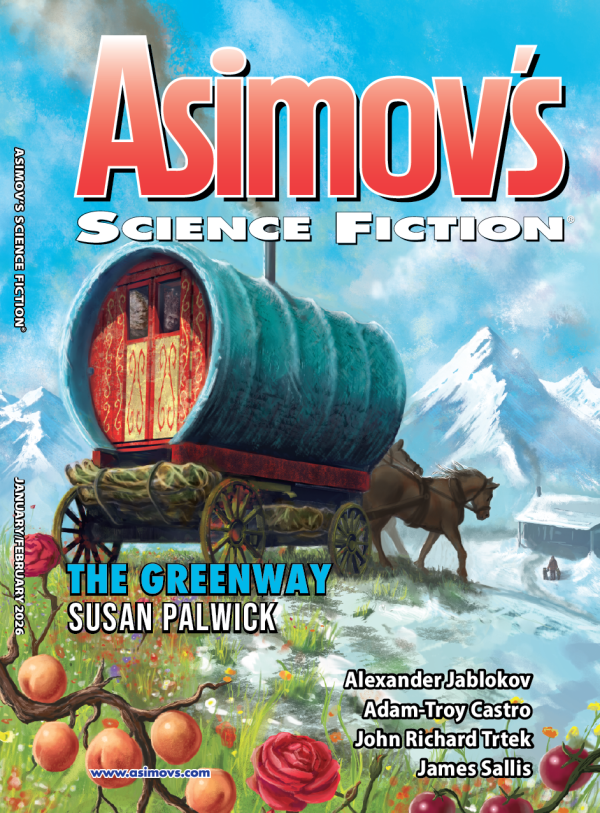
Asimov’s Science Fiction, January/February 2026
This science fiction story chronicles the final day of Parkaja, a magnificent human city about to be conquered by the Nihilators—an alien race that “repurposes” everything they claim, transforming buildings, landscapes, and even living beings into incomprehensible new forms while leaving their victims conscious to experience the horror.
The story follows two unnamed lovers (calling themselves Maia and the narrator) who are among the last inhabitants of Parkaja. Nine hundred days earlier, the Nihilators gave warning they would claim the planet, allowing time for evacuation. Millions fled on arks, but 212 people chose to stay for various reasons—some philosophical, some defiant, some simply perverse. Over those 900 days, most eventually committed suicide rather than face repurposing. By the story’s opening, only seven people remain. After two friends leap from a tower, the count drops to five, then to just the two protagonists as the other three recluses die throughout the day.
The couple spends their final day indulging in the city’s still-functioning pleasures: exotic foods, body modifications, sexual experiences in chambers that transform their physical forms, and museums. The narrator has transformed himself into a demonic figure and downloaded memories of atrocities to build emotional armor, while Maia has extensively modified her appearance with multiple breasts, extra eyes, and decorative features. Both are preparing psychologically for death while unable to commit to the act.
A crucial subplot involves the narrator’s promise to a zookeeper to euthanize all the animals before the Nihilators arrive. He finally fulfills this obligation, destroying thousands of alien creatures in an instant—an act of mercy that leaves him devastated. Maia must also visit virtual recreations of her abusive parents one final time for closure.
As evening approaches and green lights in the sky herald the Nihilators’ arrival, they climb to the tower where their friends died the previous night. They plan to jump, but hesitate, paralyzed by fear and an inability to let go of existence. They watch as the Nihilators begin systematically repurposing the city, transforming buildings into grotesque new forms. One transformation creates statues of the two lovers, wrapped in chains and merged in eternal suffering—a preview of their likely fate.
In the story’s climax, the narrator finally jumps, trying to smash himself against a gargoyle to ensure death. But the Nihilators catch him mid-fall and return him to the rooftop with Maia. They are now trapped, surrounded by bean-shaped machines bristling with blade-like appendages, moments away from being repurposed into living components of whatever the Nihilators design.
The story ends with a final act of human defiance. Maia raises her middle finger at the machines and curses them, while the narrator joins her gesture. It’s a futile but meaningful rebellion—the last expression of their humanity before transformation. The story explores themes of mortality, the difficulty of choosing death over unknown suffering, procrastination in the face of doom, and the human need for dignity and defiance even when facing inevitable and incomprehensible horror.