
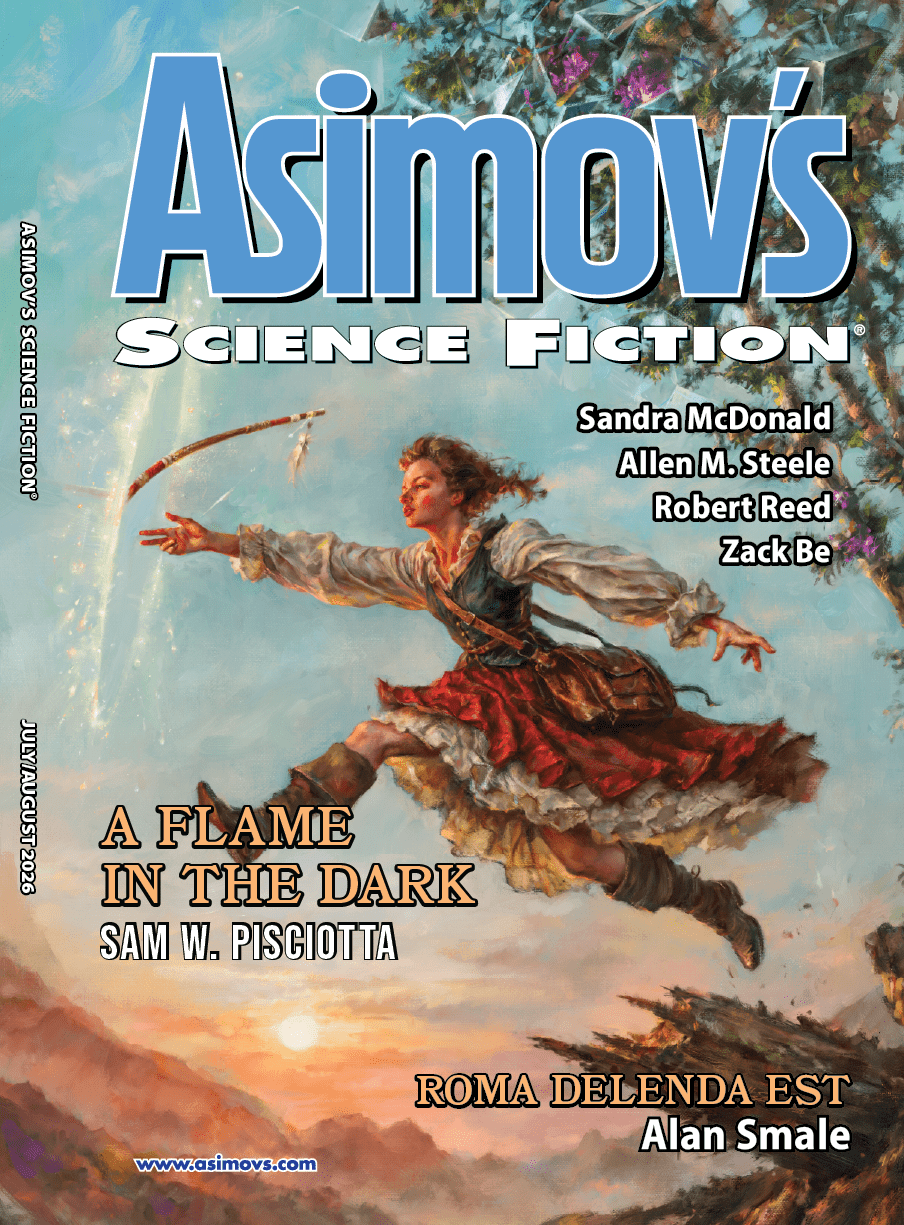
Set in 1775 in the American wilderness, A Flame in the Dark is told through the journal entries and letters of Annette Lacroix, a French naturalist living on the frontier with her scientist husband Gabriel and their taciturn German assistant Schäfer.
Gabriel has constructed a “dissonance device” — an elaborate assembly of tuning forks, violin strings, and funnels designed to isolate and expose the hidden chaos he believes underlies the Universe’s harmony. When the trio activates a new configuration of the device, they succeed beyond expectation: a poplar leaf rots in seconds, and a cornflower mutates and screams. A two-headed bumblebee crawls from the decaying bloom before Schäfer crushes it in revulsion.
Annette, a careful observer trained in Enlightenment empiricism, begins noticing further aberrations in the surrounding forest — a suicidal bull elk that leads her into the wilderness and leaps from a cliff, a fox with an extra limb circling compulsively, and fields of sunflowers that writhe and shriek at one another. She suspects a link to the experiments and names the corrupted area the “dissonance zone.” She also discovers strange artifacts in the woods: a wire sheathed in red flexible material, a thin circuit board, a metallic sphere — objects that do not belong to her century.
When Gabriel ventures to the cliff ridge to investigate, he vanishes. Schäfer is subsequently killed by a monstrous creature — enormous, half-decayed, bearing antlers, with weapons and armor shifting beneath its rotting flesh — something neither man nor bear, neither living nor dead.
Annette finds unlikely allies: Omashkooz, an Ojibwe man tracking the same beast, and Jacob, a young man who steps out of thin air at the cliff’s edge. Jacob reveals he is an artificial being — a sophisticated tool built by humans in the 23rd century — who followed temporal artifacts through a dimensional portal accidentally opened by Gabriel’s device. The strange objects Annette found are his era’s debris, scattered across time.
The cliff’s edge, Annette theorises, is a doorway where the chaotic dimension bleeds into her world. The aberrant wildlife, the beast, and Gabriel’s disappearance are all spillage from this parallel realm. Annette uses Jacob’s nanobots — passed into her bloodstream when he healed a wound — to later resurrect Gabriel after the beast nearly kills him in the other dimension.
With Jacob’s knowledge of Gabriel’s sonic calculus, the portal is eventually closed using a reversed harmonic progression on the dissonance device. Jacob departs toward his own era. Omashkooz, who waited faithfully at the ridge, pulls Gabriel and Annette back through with a bow extended across the threshold.
Themes
- Enlightenment vs. chaos — Annette’s lifelong faith in reason is tested and ultimately tempered rather than destroyed.
- The cost of progress — the beast itself is a symbol of colonial violence, industrialisation, and unchecked expansion.
- Ways of knowing — Omashkooz challenges Annette’s assumption that Western empiricism holds a monopoly on truth.
- Order and chaos as coexistent — the story ends not with chaos defeated, but with Annette accepting it as an inseparable companion to harmony.
“Chaos will never be stripped from the world; it walks at our left, with harmony on our right.”
— Annette Lacroix

Sam W. Pisciotta is an intrepid storyteller hurtling through spacetime on the power of morning coffee and late-night tea. He writes stories for people who want to visit other planets, learn magic from birds, or camp in haunted forests. His M.A. in Literary Studies from the University of Colorado trained him to deconstruct a variety of texts; living life taught him how to put them back together. Sam is a graduate of the Odyssey writing program. He loves holidays and birthdays, pints at the bar, and falling down the research rabbit hole. He would never choose the blue pill. Connect with him at www.silo34.com