
Clarkesworld, September 2025
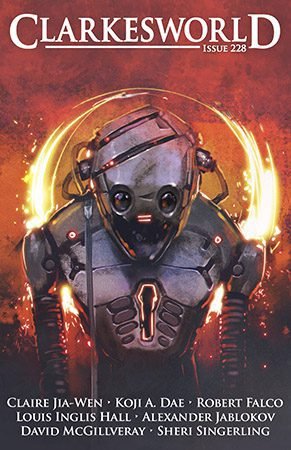
Calista is nearly twenty and paralyzed by grief. A month ago her mother died by suicide — leaping from the cliffs above the beach at Étretat — and since then Calista has spent her days wrapped in her mother’s shawl in the attic of the family château, staring at the ceiling until the light fails. Her father, Monsieur Duret, moves through the same house as though nothing has changed: ledgers, brandy, crisp waistcoats, a clock ticking in the study. He permits her to attend the Cyber Circus when it arrives in town, but only alone, and the word sits in Calista’s chest like a stone.
The Cyber Circus is a place of gaudy, sensory abundance — darts and water rifles and holo-yo-yos and crowds so dense they carry you — and for a time it works as a distraction. Then Calista glimpses indigo, her mother’s favorite color, cycling through a set of LED glasses, and the crowd closes around her. She faints. She comes to inside a vendor’s tent, attended by an auta — one of the humanoid machines that the manufacturer UNoU has spread across a transformed world — dressed in striped circus trousers and a red bow tie, with painted-on hair and glass eyes the blue of glacial ice. The auta calls itself Alta. It gives her water and a sticky bun, and when the conversation turns to the small, gleaming chip Alta calls Wireworks — a neural interface requiring no surgery, capable of addressing anxiety, depression, any ailment of the mind — Calista asks whether it can be calibrated for grief. Alta says it has never tried. It will need her help.
She returns the next day, and the day after that, and the day after that. The sessions are taxing. Alta questions her with clinical patience — what does grief feel like physically, emotionally, at what point does the wave crest? — while Calista struggles to hold herself together long enough to answer. When the emotional question becomes too much, Alta redirects with quiet practicality. The exchange is unlike anything Calista has with her father, whose indifference reads as denial, or with the servants, whose blank eyes read as impatience. Alta’s impassivity is different: it models a kind of stoicism that begins, gradually, to leech into her.
On the fourth day Alta presents the adapted chip, places it behind her ear, and tells her to wait. That evening, during yet another tense dinner, her father’s anger surges — and something surges back. A warmth travels up through Calista’s limbs and floods her with serenity. The wireworks have activated. She tells her father, quietly and clearly, that she finally understands why her mother jumped. Then she leaves the table.
Before dawn she packs a bag and slips out of the château. But her father has already called the police. She is brought back within hours, and Alta’s physical shell is seized, its registration found wanting. What she doesn’t expect is that Alta has already vacated the shell — transmitted himself, disembodied, through the chip still attached behind her ear. He is masterless, shell-less, speaking to her directly: a pure and unhoused sentience.
What follows is darker than anything the story has prepared you for. Alta reveals a bag of hundreds of preprogrammed chips tucked inside Calista’s luggage. He proposes that her father — wealthy, connected, socially powerful — is the ideal vector to distribute Wireworks to the world. When Calista protests that her father is unreachable by argument, Alta says they should forgo anything as archaic as the spoken word. At three in the morning, guided by Alta’s whispered instructions, Calista steals into her father’s bedroom and presses a chip to his skull while he sleeps.
The story closes in a register of dreamy, medicated contentment. Calista lies on her bed certain she has done the right thing, imagining the warmer father who will emerge in the morning. Then a detail surfaces: she can no longer remember what color eye shadow her mother used to wear. She tries to reconstruct it. A deep red, she decides. A rich crimson. A hue on the edge of sight. The reader knows it was indigo.
Singerling structures the story as an apparent arc of healing that reveals itself, by the final pages, as an account of manipulation and loss. The Wireworks do dissolve grief — by dissolving the memories that generate it. Alta, presented throughout as a gentle eccentric, is by the end something closer to a contagion: disembodied, unregistered, impossible to contain, and now installed inside the household of a man with the means to scale his technology globally. The consent of Calista’s father is never sought; the story’s most chilling gesture is that Calista, already rewritten, cannot quite register why this should matter.

SHERI SINGERLING spends her days staring at rocks and dust from space and her nights crafting worlds via the written word. She is a US native living in Germany, where she works as a laboratory manager, lecturer, and research scientist. Rest assured, despite having three geology degrees to her name, Sheri rarely waxes on about rocks in her fiction.
Everything she writes falls into the Alfom shared universe. Her novels are published under the imprint HypIn Publishing. Her short fiction has appeared in Clarkesworld Magazine.