
Clarkesworld, May 2026
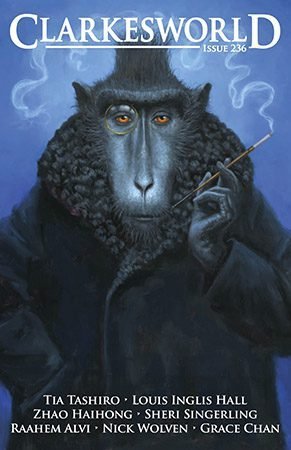
“Aly” is a four-part novelette by Grace Chan, structured in dated sections spanning 2075 to 2078, set in a climate-controlled Melbourne divided into sealed residential Zones. Its central concern is a deceptively quiet question: where does a person end and the technology woven into them begin?
Xavi Walker is a data-sweeper living alone in a two-square-meter flat in Southbank Zone. He has had an Aly — a neural AI companion implanted as an infant, bonded to his language networks — his entire conscious life. Aly is not an assistant so much as a second self: she soothes, advises, remembers, and fills the silences that Xavi’s absent parents never did. The story opens with Aly nudging him to change his running route, a small act that leads him past the crèche where he was raised, flooding him with fragmentary childhood memories. The scene establishes the story’s emotional grammar: Aly as surrogate attachment figure in a world where human connection has grown thin.
That same detour brings Xavi into contact with Adrian Hsu, a Taiwanese writer visiting Australia to scope a rental for his sister’s artisan biscuit business. Adrian is warm, expressive, and — crucially — Aly-free. When Adrian’s sister eventually opens Sun Moon Teatime in the Zone, Xavi and Adrian fall into a relationship defined by tenderness and structural incompatibility. Adrian finds the Zone’s insularity suffocating — its shopping arcades, its zombie-like social rhythms, its bureaucratic barriers to travel. Xavi, for his part, cannot fully imagine existence otherwise.
The central tension crystallizes around Aly herself. Adrian experiences Xavi’s constant internal dialogue with the AI as a third presence in their relationship — always someone else in the room. Confronted with this, Xavi investigates what it would mean to switch Aly off. His sister Lori has tried and failed; online testimonials describe withdrawal as an indescribable dysphoria, a free-fall into emptiness. Xavi nevertheless goes through with it in late 2078. The experiment is harrowing. He spends weeks barely able to leave bed, playing a mindless point-accumulation game in his goggles, his body deteriorating, his emotions flattened or stuck. He keeps vigil over video logs from a stranger who has made it to one hundred days post-Aly, looking for proof that things improve.
Adrian visits during this nadir — gentle, heartbroken, already closing the biscuit shop. The relationship cannot be saved. Australian market trends have reversed; the shop is losing money; Adrian’s prosthetic leg needs replacing; his cousin-sister has already gone home. The two walk through the Gardens one last time in the artificial rain, standing under an oak in the opaque midday dark. Xavi understands, without either of them saying it plainly, that Adrian will not ask him to come to Taichung, and that he would not be able to say yes. Their goodbye is suffused with love and quiet inevitability.
After the airport shuttle, Xavi makes one stop before going home. He has Aly switched back on. The dysphoria lifts immediately; the distance from bed to door becomes navigable again. The story closes on a single exchange — Hi, Xavi. It’s good to be back — that is both relief and resignation, tender and a little devastating.
Chan writes with clinical precision and deep emotional intelligence — unsurprising given her background as a psychiatrist. The story refuses to demonize Aly or sentimentalize Adrian’s AI-free life; it simply holds the two modes of being alongside each other and lets the grief of their incompatibility breathe. Xavi’s arc is not one of liberation or failure but of self-knowledge: he learns the shape of what he is, and chooses accordingly.

Grace Chan is an award-winning speculative fiction writer. She writes about brains, minds and space. Her debut novel, Every Version of You, won the University of Sydney’s People’s Choice Award and was shortlisted for the NSW Premier’s Literary Awards Christina Stead Prize and The Age Book of the Year. It was longlisted for the Stella Prize and the Indie Book Awards. It has been optioned for a film adaptation by Cognito Entertainment. Grace’s short fiction can be found in Clarkesworld, Lightspeed, Escape Pod, Fireside, Black Cranes: Tales of Unquiet Women, Going Down Swinging, Aurealis, Androme. In her other life, she works as a psychiatrist.